

Its Nothing To Sneeze At
Its Nothing To Sneeze At za pomocą Gil Elvgren (1914 – 1980), one of the most celebrated American illustrators of the 20th century. This piece exemplifies the vibrant and engaging style that made Elvgren famous, combining humor, zmysłowość, and a touch of glamour.
Urodzony w 1914, Elvgren’s career spanned much of the 20th century, and he is best known for his pin-up art, a genre that defined much of mid-century American illustration. Jego użycie koloru, światło, and playful narratives in his work set a hallmark for advertisements, czasopisma, and calendars throughout the era.
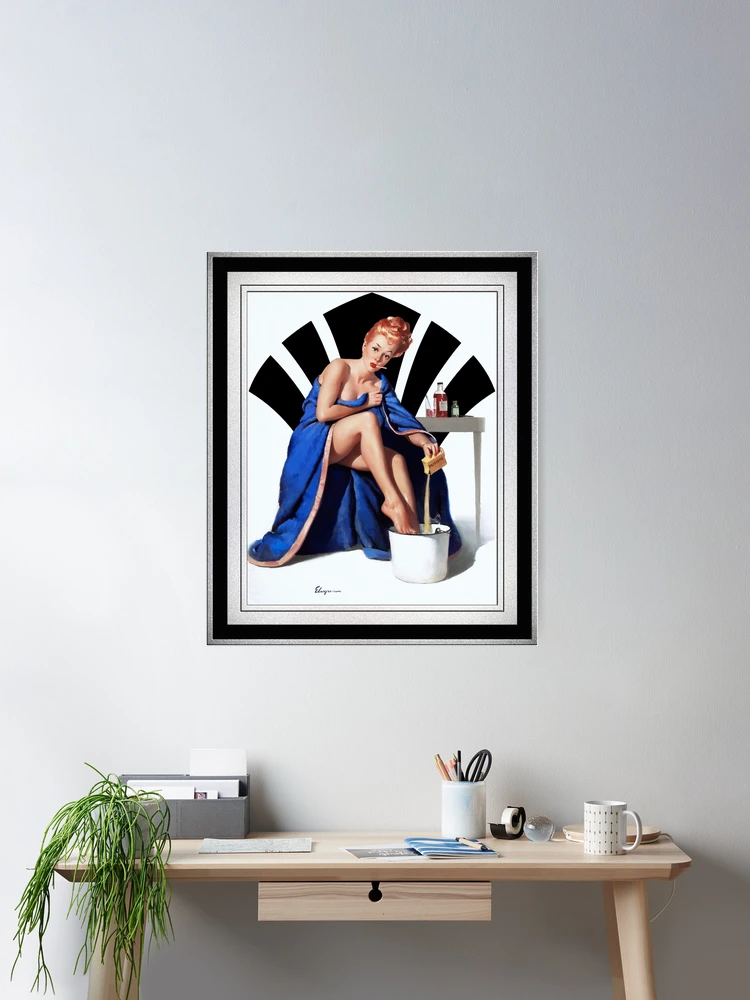
The painting portrays a young woman seated with her feet in a basin of mustard, a remedy that would have been familiar to many of Elvgren’s audience as a common cure for ailments such as colds or aches. jednak, this domestic scene is not without a touch of humor and playful irony.
The woman’s facial expression suggests both frustration and curiosity about the situation, amplifying the lighthearted tone of the artwork. Jej poza, with one knee raised and the other foot submerged in the mustard bath, directs the viewer’s attention to the woman’s figure in an elegant yet comical way.
Spis treści
Główny temat
The central figure in Nie ma na co kichać is a young woman dressed in a vibrant blue robe. The robe, adorned with a delicate pink trim, is loosely draped over her form, adding an element of seductiveness without being overtly revealing. Her strawberry blonde hair is styled in a vintage updo, giving her an air of classic 1950s beauty, further emphasizing her timeless femininity.
Her posture is slightly awkward, adding to the narrative of the scene: she is trying to find relief from an ailment, and her uncertain expression, combined with the mundane but uncomfortable treatment, invites both empathy and humor from the viewer. The angle at which she sits, with her legs crossed and one foot submerged, creates an intimate yet comical moment in a domestic setting.
Otoczenie i obiekty
Behind the figure, a table is placed, atop which rests a small collection of items: a bottle of whiskey, a glass, and what seems to be a medicinal bottle, perhaps a cure or tonic to accompany her treatment.
These objects reinforce the domestic, private nature of the scene, but they also point to the time period’s typical imagery, where relaxation and health remedies were often portrayed as part of a woman’s role in maintaining a household. The bottle of whiskey also suggests the idea of indulgence or comfort, playing into the classic visual codes of 1950s Americana.
The most significant object, jednak, is the mustard box in the woman’s hand. She is in the process of pouring mustard into the basin of water, an action that is at once comical and relatable. Mustard baths were considered an old-fashioned remedy, but its inclusion here is both playful and nostalgic, reinforcing the humorous undertones of the painting. The mustard itself is represented in rich, bold yellow, providing a striking contrast to the otherwise soft color palette of the scene.
The backdrop of the painting features an abstract fan-like design, reminiscent of a 1950s Art Deco influence. This geometric pattern not only frames the figure but also adds a sense of dynamism to the otherwise calm scene. The fan-like design could be interpreted as a subtle nod to the popular aesthetic of the mid-20th century, reinforcing the painting’s roots in its time period.
Nastrój i motyw
Nie ma na co kichać is a study in juxtaposition. On the surface, it portrays a typical domestic scene: a woman at home, relaxing, and attending to her health. jednak, Elvgren infuses the painting with humor and lightheartedness, turning an ordinary moment into something more playful and inviting. The title itself suggests a double entendre, “sneeze” evoking the common cold or sickness, but also potentially pointing to the comical situation the woman finds herself in.
The mood is decidedly light and fun. The woman’s facial expression, a mix of slight bemusement and embarrassment, encourages the viewer to smile in sympathy, as if sharing in her mild misfortune. The use of bright colors, such as the woman’s blue robe and the yellow mustard, creates a lively contrast that enhances the playful nature of the scene. There is a sense of immediacy in the moment, as if the viewer has just walked into this woman’s world and is witnessing a brief, humorous episode in her daily life.
Style and Materials
In terms of artistic style, Elvgren’s brushwork is smooth and refined, with a clear focus on realism. The rendering of the woman’s skin, włosy, and robe is done with great attention to detail, creating a lifelike quality that makes the scene all the more relatable. His use of lighting is strategic, highlighting the woman’s figure and bringing out the warmth in her skin tone.
Shadows are carefully placed to suggest volume and depth, adding to the overall realism of the piece. Tło, by contrast, is more simplified and abstract, allowing the figure to stand out as the primary focal point.
The materials used in the painting are typical of Elvgren’s oeuvre: oil paints, applied in layers to build texture and richness. The medium’s fluidity allows for a smooth, polished finish that enhances the glamour of the subject while allowing for subtle details like the gloss of the mustard and the reflective surfaces of the bottles on the table.
It's Nothing To Sneeze At to zremasterowana reprodukcja obrazu należącego do domeny publicznej autorstwa starych mistrzów sztuki cyfrowej, która jest dostępna jako druk na płótnie online.
Bio artysty pochodzące z Wikipedia.org
Gillette A. Elvgren urodził się w St. Paweł, Minnesota, i uczęszczał do liceum uniwersyteckiego. Po ukończeniu studiów, rozpoczął studia artystyczne w Minneapolis Institute of Arts.
Później przeniósł się do Chicago, aby studiować w American Academy of Art, i ukończył Akademię w okresie wielkiej depresji, w wieku dwudziestu dwóch lat.
Po ukończeniu studiów Elvgren dołączył do stajni artystów w Stevens i Gross, Najbardziej prestiżowa agencja reklamowa w Chicago, i został protegowanym artysty Haddona Sundbloma.
W 1937, Gil zaczął malować pin-upy z kalendarzem dla Louisa F. Dow, jedna z wiodących amerykańskich firm wydawniczych, w tym czasie stworzył około 60 pin-up girl pracuje na płótnie 22″ × 28″ i wyróżnia je nadrukowanym podpisem.
Wiele z jego pin-upów zostało odtworzonych jako rysunki nosa na samolotach wojskowych podczas II wojny światowej; i to było mniej więcej w tym czasie w 1944, że do Elvgrena zwróciła się firma Brown and Bigelow Publishing Company; firma, która nadal dominuje w branży produkcji kalendarzy, specjalności reklamowe i artykuły promocyjne.
W następnym roku od 1945 dopóki 1972, Elvgren był związany z Brown & Wydawnictwo Bigelow, i rozpoczął współpracę z 24 cal o 30 calowe płótna, format, którego użyje w następnym 30 lat, i podpisał swoją pracę kursywą.
Elvgren odniósł komercyjny sukces. Mieszkał w różnych lokalizacjach, i działał od lat 30. do 70. XX wieku. W 1951 zaczął malować w pracowni w swoim domu, potem w Winnetce, Illinois, korzystanie z asystenta do ustawiania oświetlenia, buduj rekwizyty i sceny, zestawy fotograficzne, i przygotuj swoje farby.
Jego klientami były znane firmy, takie jak Brown i Bigelow, Koks, General Electric i firma Sealy Mattress, aby wymienić tylko kilka. Ponadto, w latach 40. i 50. ilustrował historie dla wielu czasopism, takich jak The Saturday Evening Post i Good Housekeeping.
Wśród modelek i hollywoodzkich legend, które Elvgren malował podczas swojej kariery, była Myrna Hansen, Donna Reed, Barbara Hale, Arlene Dahl, Lola Albright i Kim Novak.