

Joan of Arc in Battle c1843
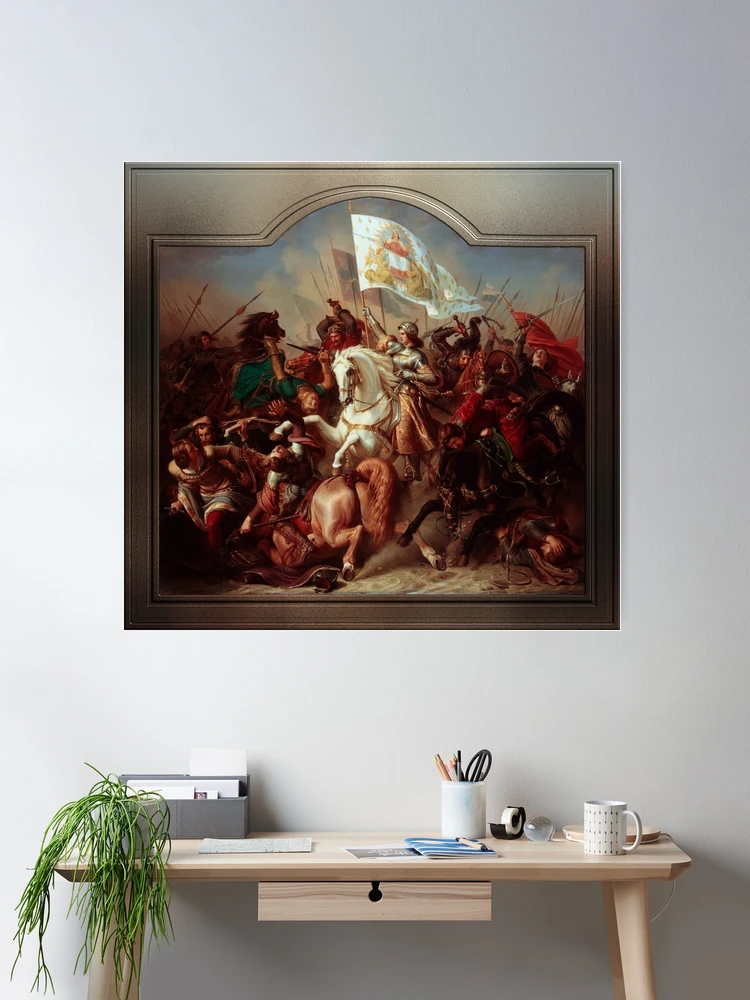
הציור ז'אן ד'ארק בקרב, נוצר ב 1843 by the German artist הרמן סטילקה (1803 – 1860), is a masterful portrayal of one of the most iconic and heroic moments in French history. Positioned as the central part of the larger triptych titled The Life of Joan of Arc, this work embodies the intense valor and fervor that defined the legendary figure of Joan of Arc during her military campaign.
The painting captures the moment when Joan, mounted on a white steed, is seen brandishing a flag in the heat of battle, a symbol of divine leadership and unwavering courage. Stilke’s composition brilliantly encapsulates both the chaos of war and the steadfast resolve of Joan, emphasizing the contrast between her spiritual mission and the brutal nature of medieval warfare.
תוכן העניינים
Composition and Key Figures
הדמות המרכזית של הציור היא ז'אן ד'ארק עצמה, dressed in shining armor, her face resolute and her posture commanding as she holds the banner high. The image of Joan on horseback, positioned against a tumultuous battlefield, speaks to both her physical and symbolic roles in the conflict.
Her white steed, which stands as a beacon of purity amidst the chaos, contrasts with the dark and grim atmosphere of the battle around her. The flag she holds is decorated with imagery that signifies her divine mandate, reinforcing the central theme of divine providence and heroism.
Surrounding Joan are various soldiers, both on horseback and on foot, engaged in the frantic combat of medieval warfare. Their faces display expressions of exertion, פַּחַד, and aggression as they clash in the background, with swords raised and shields protecting them. The chaos of battle is vividly depicted through the tangled mass of bodies, סוסים, and weaponry, which together convey the brutality and confusion that marked these historical engagements.
שטח ותפאורה
The battlefield is depicted as a vast and open expanse, with soldiers dispersed across the scene. The ground is littered with fallen combatants, while others are locked in brutal hand-to-hand combat. The landscape itself is somewhat blurred, emphasizing the immediacy of the action rather than offering a detailed view of the surroundings.
This technique allows the viewer to focus entirely on the chaotic energy of the battle, which serves as a backdrop to Joan’s divine mission. The sky above, tinged with dark clouds, suggests the oppressive and violent nature of the conflict, but it also serves as a visual metaphor for the uncertain and tumultuous times that Joan faced.
Mood and Symbolism
מצב הרוח של ז'אן ד'ארק בקרב is one of intense drama, underscored by the tumultuous environment and the focused figure of Joan herself. Stilke’s rendering of the battle scene is dynamic, filled with movement and urgency, yet Joan remains a steady and unyielding presence at the center. The contrast between Joan’s serenity and the chaos surrounding her is striking.
Her expression is one of quiet determination, almost as though she is untouched by the horrors of battle around her. This highlights her role as a spiritual and military leader who is steadfast in her belief and mission.
The flag she holds is a central symbol in the work, representing not just the military cause but also divine favor. The flag’s intricate design, with its celestial motifs, reinforces the notion that Joan’s mission was ordained by a higher power. The clash between the natural brutality of war and the supernatural power that Joan represents is a key theme in the painting, symbolizing the tension between earthly struggles and divine guidance.
סגנון וטכניקה אומנותית
Hermann Stilke’s style in this painting reflects the academic approach to historical painting that was prevalent in the 19th century. The use of classical techniques, such as chiaroscuro (הניגוד בין אור לחושך), detailed anatomical studies, and precise rendering of textures, brings a sense of realism to the scene.
הדמויות, particularly Joan, מוצגים עם תשומת לב רבה לפרטים, showcasing Stilke’s skill in capturing human expression and movement. The armor worn by Joan and the soldiers is meticulously depicted, with the reflective surfaces of metal and the folds of fabric rendered in exquisite detail.
Stilke’s use of light and shadow is particularly effective in guiding the viewer’s eye. Joan, illuminated by a soft light, stands out against the darker, more turbulent background. This creates a halo-like effect around her, symbolizing her divine role in the events depicted. The darker tones in the background serve to emphasize the violent and chaotic nature of the battle, while the lighter tones around Joan convey a sense of hope and spiritual clarity.

מַסְקָנָה
ז'אן ד'ארק בקרב is a remarkable example of historical painting that not only captures the dramatic essence of a pivotal moment in history but also imbues it with deep symbolism and emotional resonance.
Through his precise and detailed technique, Stilke brings to life the complex character of Joan of Arc, portraying her not only as a courageous warrior but also as a figure of divine strength and conviction. The juxtaposition of the violent, chaotic battle with the serene determination of Joan highlights the central conflict of her life and mission, making this artwork a powerful representation of her legacy.
זהו רפרודוקציה של אמנות דיגיטלית משופרת ותיקים של תמונה של נחלת הכלל, וכמו בכל יצירות האמנות שניתן למצוא באתר Xzendor7 זמינות לרכישה אונליין במגוון פורמטים חומריים כולל הדפסי קנבס, הדפסי אקריליק, הדפסי מתכת, הדפסי עץ, הדפסים ממוסגרים, עמוד הבית של Xzendor7, וכמו הדפסי קנבס מגולגלים במגוון גדלים מ 12 אינצ'ים ל 72 אינצ'ים בהתאם לגודל הגרפיקה בפועל ולחנות ההדפסה לפי דרישה ממנה תבחר לקנות את האמנות.
אמן ביו שמקורו Wikipedia.org
אנטון הרמן סטילקה נולד בברלין ממלכת פרוסיה בינואר 29, 1803 הוא היה צייר גרמני שלמד באקדמיה לאמנויות יפות בברלין ולאחר מכן 1821 לומד באקדמיה לאמנויות מינכן אצל פרופסור המאסטר הגרמני פיטר פון קורנליוס (1783 – 1867).
משם הלך ללמוד באקדמיה לאמנויות יפות בדיסלדורף; שם צייר יחד עם הצייר הגרמני קארל שטורמר (1803 – 1881) הפרסקו הבלתי גמור The Last Judge in the Assisensaal in Koblenz.
ב 1827 אנטון נסע בצפון איטליה בטיול לימודים, מגיעים לרומא ב 1828. ואז פנימה 1833 הוא חזר לאקדמיה של דיסלדורף, מאיפה הוא לימד 1839 – 1843.
מ 1842 – 1846 אנטון עבד באולם האבירים בטירת סטולצנפלס ליד קובלנסה על גדות נהר הריין; ובתוך 1850 הוא התיישב בברלין שם נפטר בגיל 57 בספטמבר 22, 1860.