

Juno Asking Aeolus To Release The Winds
Juno Asking Aeolus To Release The Winds c1769 by French Painter Francois Boucher (1703 – 1770), chì era ancu un disegnatore è incisore. Hà travagliatu in u stile rococò è hè cunnisciutu per i so temi classici idilliachi, scene pastorali e allegorie decorative.
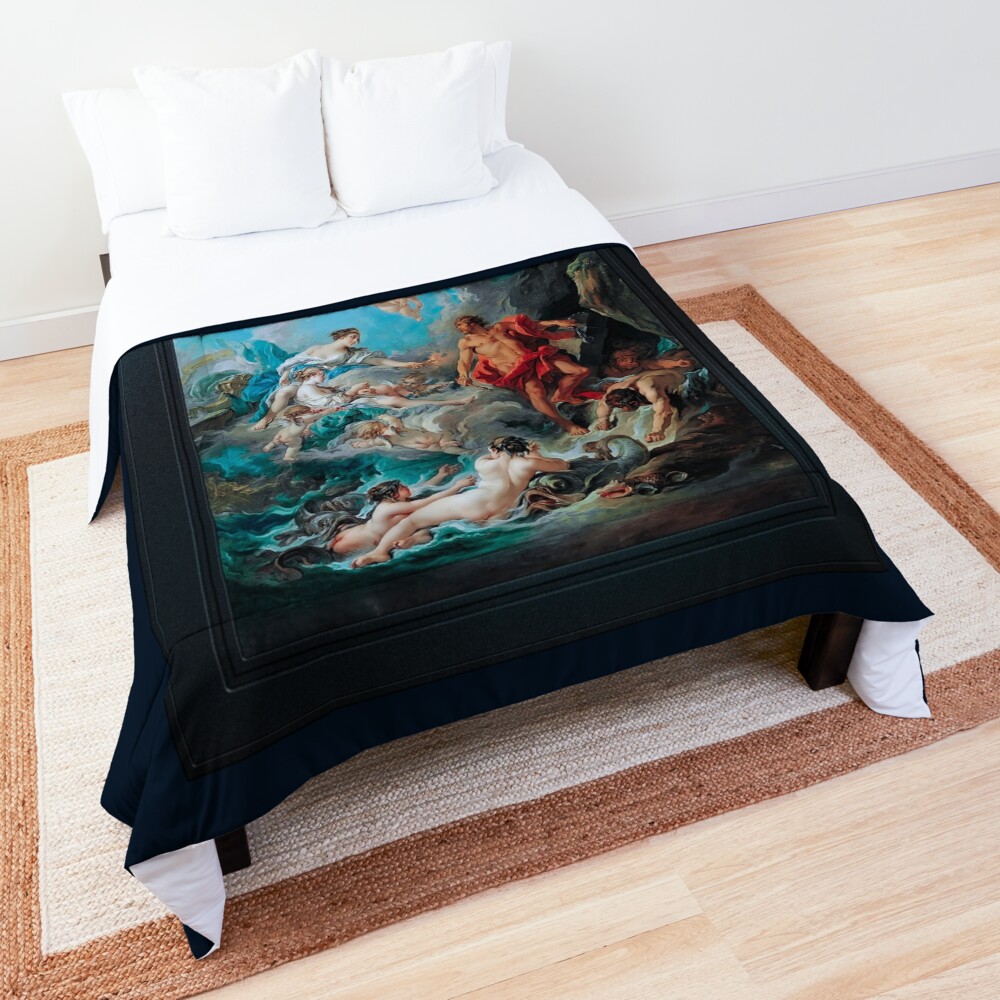
This is a depiction of the Greek-Roman Mythological tale of Juno (Chief Goddess akin to the Greek Hera) visiting Aeolus (King of the mythical, floating island of Aiolia or Aeolia), who is the keeper of the winds and urging him to release these mythological creatures so that their fury and might, may provoke a violent storm at sea, which would result in the destruction of the Aeneas’s Fleet.
Things don’t turn out as Juno expects, even though she has offered Aeolus her most beautiful nymph Deiopea in marriage; and aiming her torch strait at his heart, the love struck Aeolus does as she ask.
Then Cupid unsheathes an arrow to target the compliant nymph Deiopea, that has her wrist bound with pearls; but the power God of the Sea Neptune interferes and prevails over the winds that were released from the cavernous island interior, by rendering the waters of the sea into a calm state.
To complete the scene we find cherubs flying in the air and some floating on a cloud above the water and two other sea nymphs in the water surround by very large gulping fish.
Juno Asking Aeolus To Release The Winds is a remastered digital art old masters reproduction of a public domain image that is available as a stampa su tela in linea.
Info sottu Derivatu da Wikipedia.org
Nativu di Parigi, Francois Boucher was the son of a lesser known painter Nicolas Boucher, chì li dete a so prima furmazione artistica. À l'età di diciassette anni, un dipintu di Boucher era ammiratu da u pittore François Lemoyne. Lemoyne dopu hà numinatu Boucher cum'è u so apprendista, ma dopu solu trè mesi, andò à travaglià pè l'incisore Jean-François Cars.

In 1720, vincìu l'élite Grand Prix de Rome per a pittura, ma ùn hà pigliatu l'oppurtunità di studià in Italia finu à cinque anni dopu, per via di prublemi finanziarii à l'Accademia Reale di Pittura è Scultura.[1] Al suo ritorno dai suoi studi in Italia fu ammesso alla rifondata Académie de peinture et de sculpture on 24 Nuvembre 1731. U so pezzu di ricezione (pezza di ricezione) era u so Rinaldu è Armida di 1734.
Boucher sposò Marie-Jeanne Buzeau in 1733. A coppia avia trè figlioli inseme. Boucher hè diventatu un membru di a facultà in 1734 è a so carriera s'accelerà da questu puntu chì hè statu prumuvutu Prufessore dopu Rettore di l'Accademia, diventendu ispettore à a Royal Gobelins Manufactory è infine Premier Peintre du Roi (Primu Pittore di u Re) in 1765. Ritrattu di Marie-Louise O'Murphy c. 1752
Boucher hè mortu 30 Maghju 1770 in a so Parigi natale. U so nome, cù quellu di a so patrona Madame de Pompadour, era diventatu sinonimu di u stilu rococò francese, guidà i fratelli Goncourt à scrive: “Boucher hè unu di quelli omi chì rapprisentanu u gustu di un seculu, qui s'expriment, personificà è incarna.”
Boucher hè famosu per dì chì a natura hè “troppu verde è pocu illuminatu” (troppu verde è mal illuminatu).
Boucher era assuciatu cù l'incisore di pietre preziose Jacques Guay, à qui il a enseigné à dessiner. Il a également encadré le peintre moravo-austriaque Martin Ferdinand Quadal ainsi que le peintre néoclassique Jacques-Louis David en 1767.[4] Più tardi, Boucher hà fattu una serie di disegni di l'opere di Guay chì Madame de Pompadour hà poi incisu è distribuitu cum'è un voluminu bellu rilegatu à i cortigiani favuriti.