

La infanta Lluïsa Fernanda de Borbó, Duquesa de Montpensier
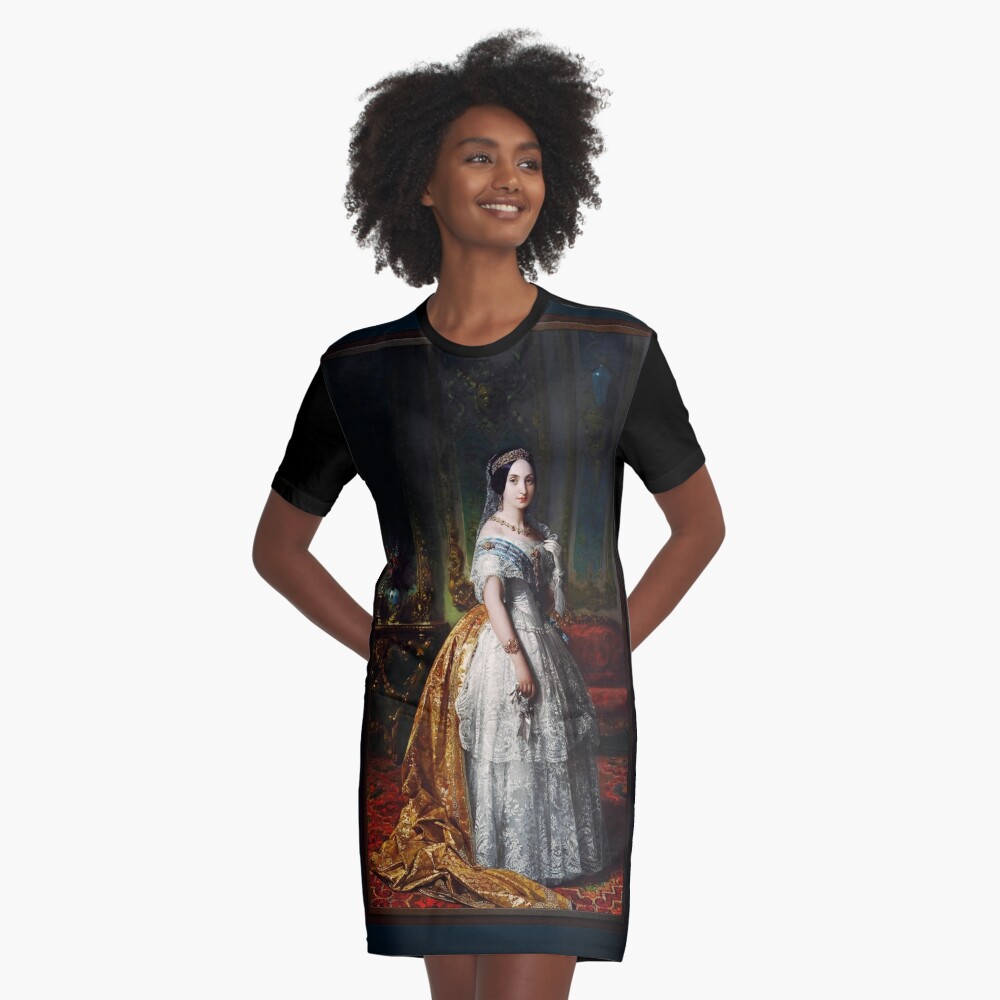
La infanta Lluïsa Fernanda de Borbó, Duquesa de Montpensier c1851 by Spanish Painter Federico de Madrazo y Kuntz (1815 – 1894); also a lithographer, writer and politician.
This is an elegant portrait of Luisa Fernanda de Borbón (1832 – 1897) the youngest daughter of King Ferdinand VII (1784 – 1833) of Spain and is fourth wife Maria Christina (1806 – 1878) of the Two Sicilies, the queen-regent, who also happened to be his niece.
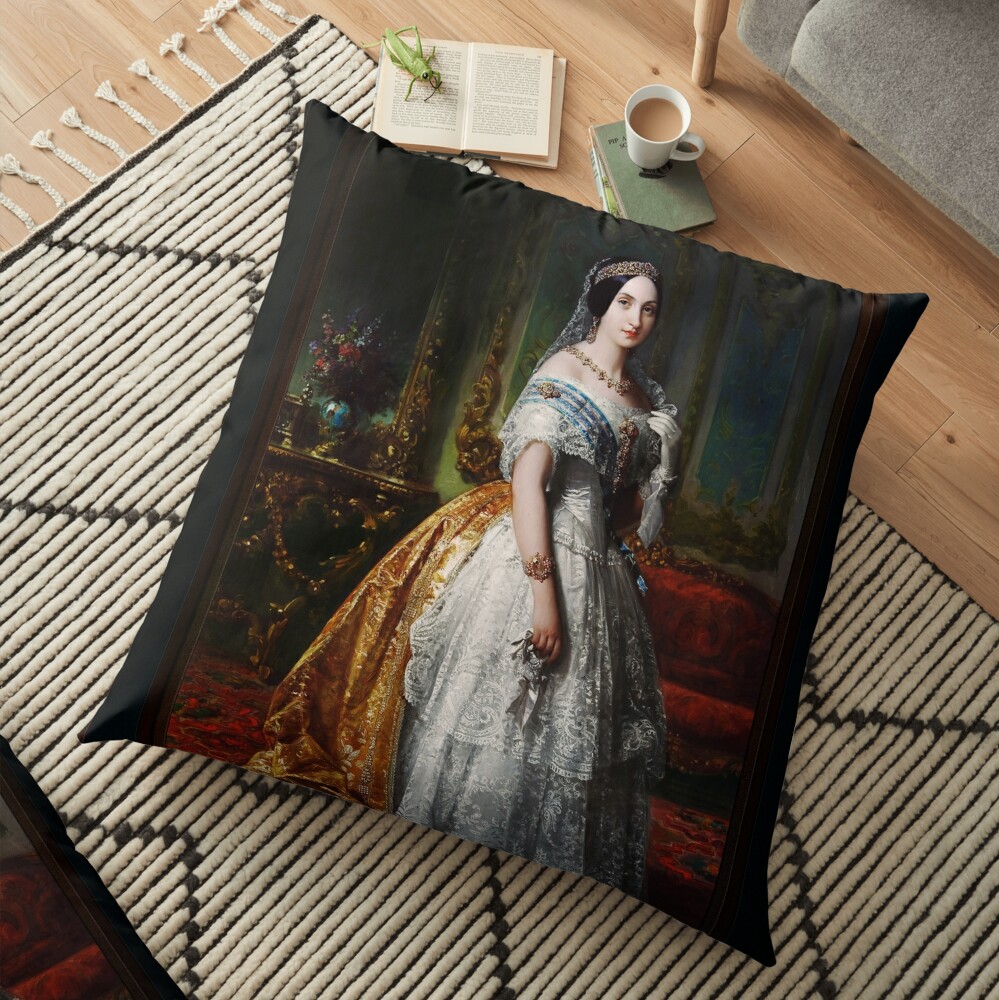
She is posed in a large lavish room standing on a colorfully patterned red carpet, which has in the background to the left of the image, a large wall mirror with gold accent gilding, that is positioned over an elaborately carved gold gilded table that has on top of it a decorative gold box, a beautiful blue spherical vase with a floral gold stand containing a bouquet of flowers.
In the middle wall panel is more decorative gilded wood work and a sculpted face high up; and on the last wall panel that has more decorative wood work is a decorative wall shelf with a blue vase on it and below that a decorative love with a gilded wood border.
Luisa is shown wearing a full length white embroidered lace gown that is complemented by a gold tail like trailing material with silver floral embroidered details and pearls, that flows from the back of her dress at the waist and wraps around to her right side on the floor.
She has a royal blue, white and pink sash that carries from her right shoulder down to the left side of her waist with an attached blue and white ribbon hanging from her left side.
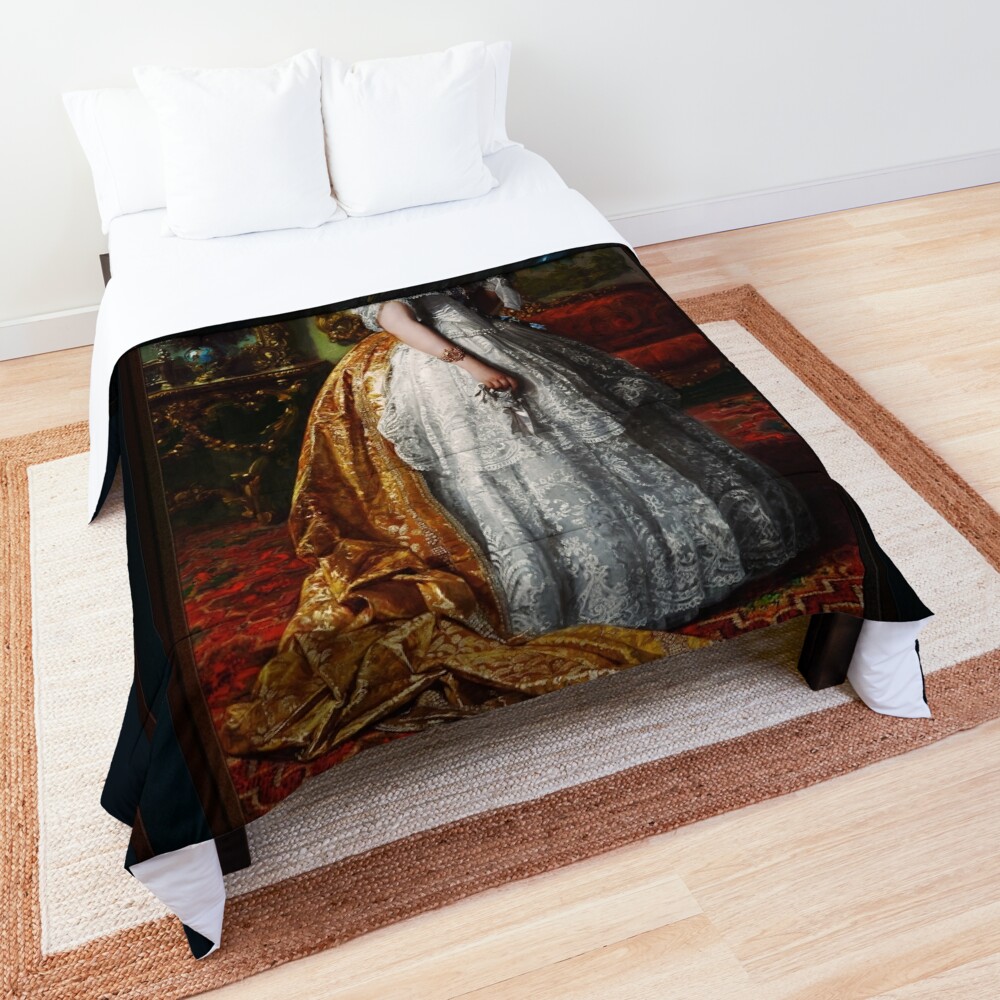
On her left hand which is positioned near the left side of her chest has a white silk evening glove on to and sheer handkerchief tucked into it; while her right hand holds the other evening clove to the right side of her body.
On her black hair, hang from the back she has a silk white lace kerchief that matches her dress; and around her head she is wearing a tiara comprised of silver and gold, with ruby gemstone.
The tiara is complemented with earrings, a necklace, a bracelet, a large brooch on the front of her dress and two smaller ones on the shoulders of the dress that bear the same and similar pattern.
La infanta Lluïsa Fernanda de Borbó, Duquesa de Montpensier is a remastered digital art old masters reproduction of a public domain image that is available as a metall, acrílic, fusta, impressió de tela en línia.
Informació a continuació derivada de Wikipedia.org
Federico was born in Rome to José de Madrazo i Agudo (1781 – 1859), pintor i antic director del Museu del Prado; and was part of a line of great artists, that included his grandfather on his mother side; Tadeusz Kuntze (1733 – 1793), un pintor polonès.
Other members of this creative family include his brothers, who were the painter Luis de Madrazo (1825 – 1897), Pedro de Madrazo (1816 – 1898), an art critic and Juan de Madrazo (1829 – 1880), un arquitecte.
Among Federico’s his children were the painter Ricardo de Madrazo (1851 – 1917), Raimundo de Madrazo y Garreta (1841 – 1920) and Cecilia de Madrazo y Garreta (1846 – 1932) who married the great Orientalist artist, Marià Fortuny (1838 – 1874).
The Madrazo family has been described as one of the most important painting Spanish painting dynasties of the 19th century; which completely dominated painting in Spain during that period.
Federico va començar a prendre lliçons d'art del seu pare, i encara assistint a la Reial Acadèmia de San Fernando, va pintar el seu primer quadre La resurrecció de Crist c1829; que va ser comprat per la reina Cristina.
Poc després d'aquell quadre va crear Aquil·les a la seva tenda, i després va presentar a l'Acadèmia La continència d'Escipió, que li va assegurar l'admissió com a membre “pel mèrit”.
Tres anys més tard, Federico va marxar a París on va estudiar el Franz Winterhalter i va pintar retrats del baró Taylor i Ingres. (un pintor neoclàssic francès).
En 1837 va rebre l'encàrrec de crear un quadre per a la galeria de Versalles, per a la qual va pintar “Godfrey de Bouillon proclamat rei de Jerusalem”; poc després va tornar a Roma i va assumir projectes de creació de retrats per a l'aristocràcia espanyola.