

Infanta Luisa Fernanda de Borbon, Duquesa de Montpensier
Infanta Luisa Fernanda de Borbon, Duquesa de Montpensier c1851 by Spanish Painter Federico de Madrazo e Kuntz (1815 – 1894); anche litografo, scrittore e politico.
This is an elegant portrait of Luisa Fernanda de Borbón (1832 – 1897) the youngest daughter of King Ferdinand VII (1784 – 1833) of Spain and is fourth wife Maria Christina (1806 – 1878) of the Two Sicilies, the queen-regent, who also happened to be his niece.
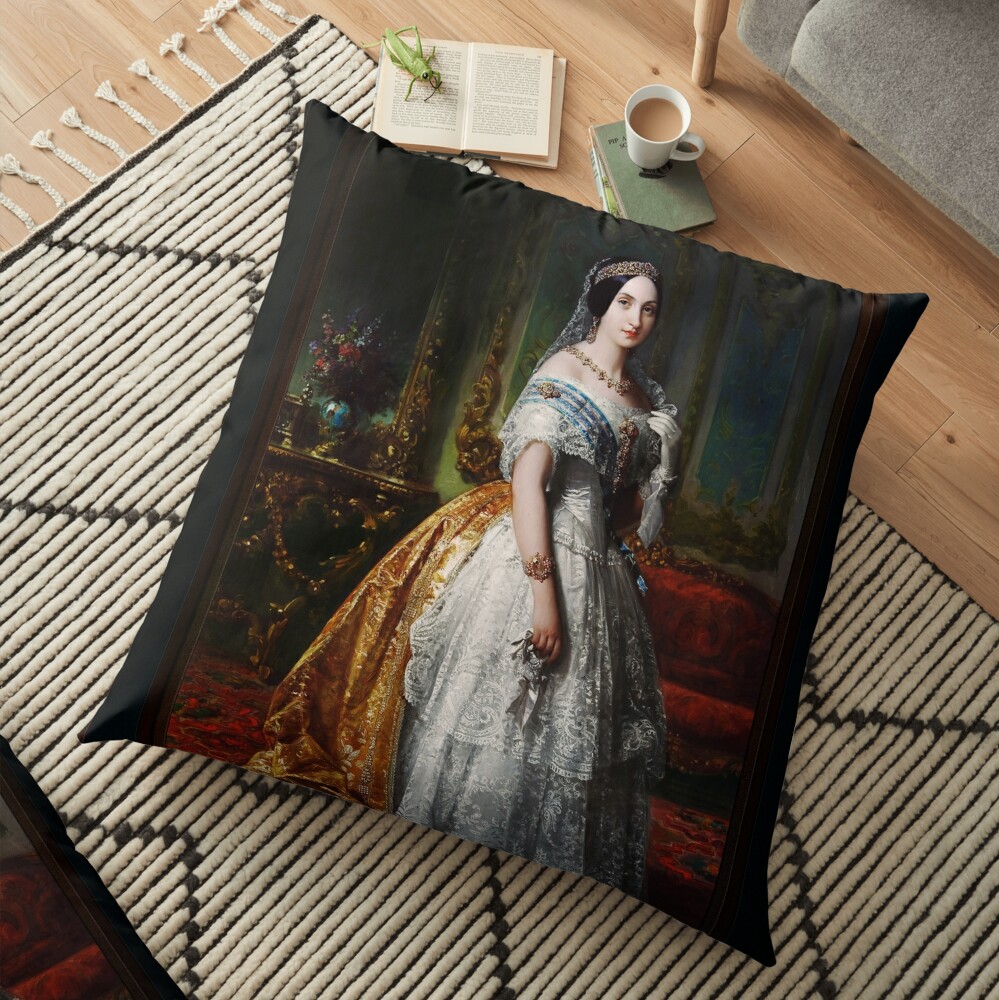
She is posed in a large lavish room standing on a colorfully patterned red carpet, which has in the background to the left of the image, a large wall mirror with gold accent gilding, that is positioned over an elaborately carved gold gilded table that has on top of it a decorative gold box, a beautiful blue spherical vase with a floral gold stand containing a bouquet of flowers.
In the middle wall panel is more decorative gilded wood work and a sculpted face high up; and on the last wall panel that has more decorative wood work is a decorative wall shelf with a blue vase on it and below that a decorative love with a gilded wood border.
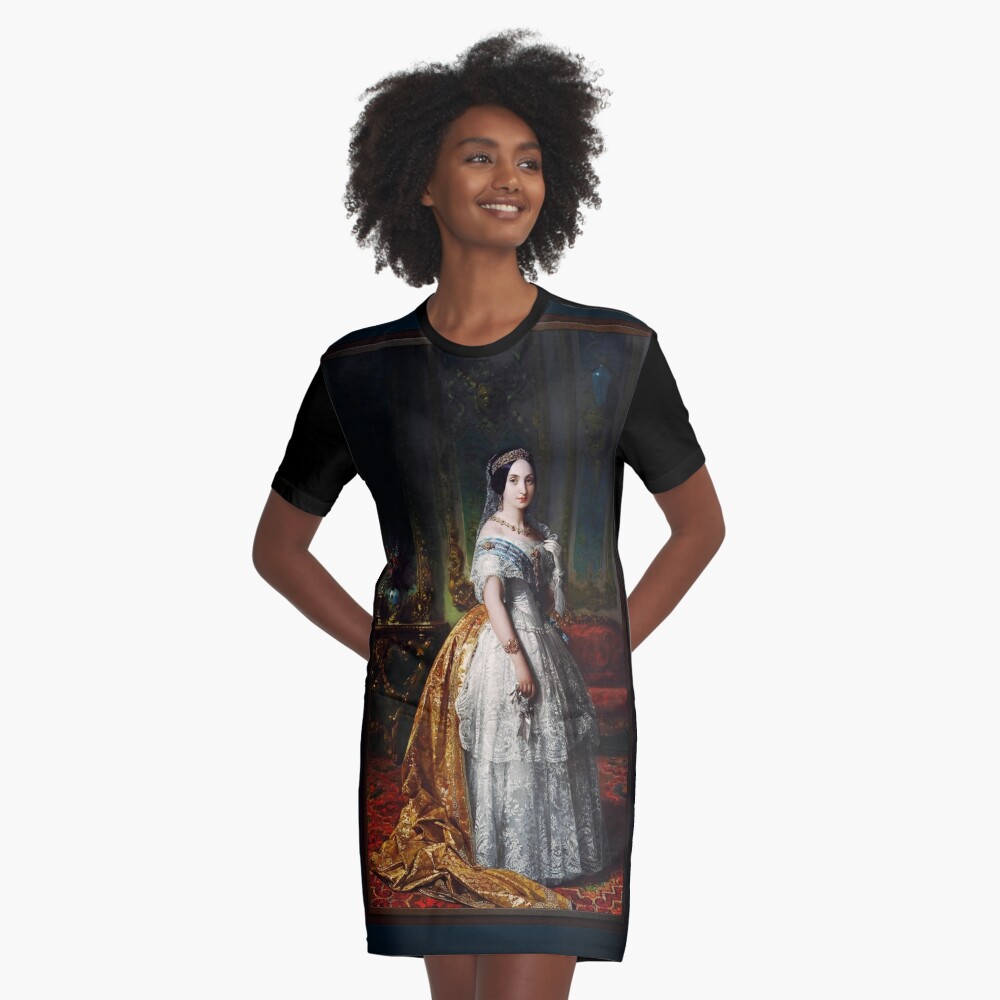
Luisa is shown wearing a full length white embroidered lace gown that is complemented by a gold tail like trailing material with silver floral embroidered details and pearls, that flows from the back of her dress at the waist and wraps around to her right side on the floor.
She has a royal blue, white and pink sash that carries from her right shoulder down to the left side of her waist with an attached blue and white ribbon hanging from her left side.
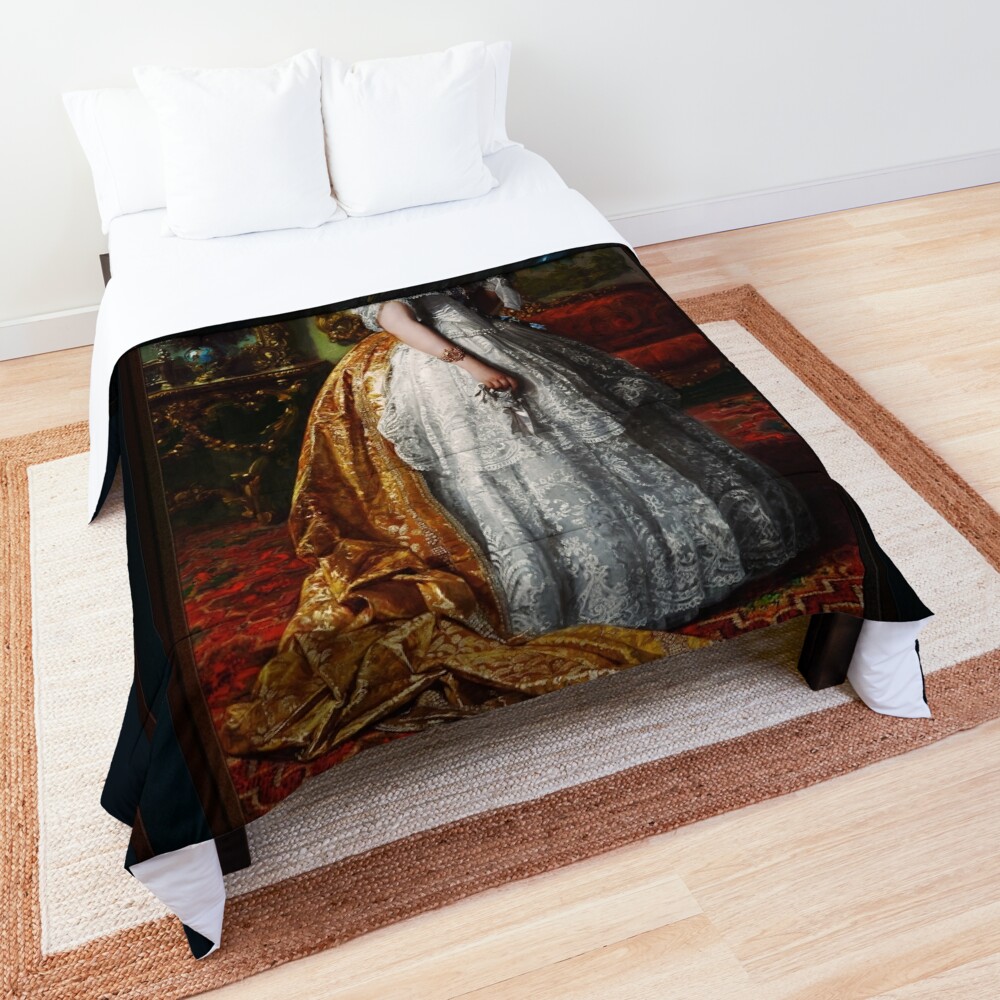
On her left hand which is positioned near the left side of her chest has a white silk evening glove on to and sheer handkerchief tucked into it; while her right hand holds the other evening clove to the right side of her body.
On her black hair, hang from the back she has a silk white lace kerchief that matches her dress; and around her head she is wearing a tiara comprised of silver and gold, with ruby gemstone.
The tiara is complemented with earrings, a necklace, a bracelet, a large brooch on the front of her dress and two smaller ones on the shoulders of the dress that bear the same and similar pattern.
Infanta Luisa Fernanda de Borbon, Duquesa de Montpensier is a remastered digital art old masters reproduction of a public domain image that is available as a metallo, acrilico, Di legno, stampa su tela in linea.
Informazioni di seguito derivate da Wikipedia.org
Federico è nato a Roma da José de Madrazo y Agudo (1781 – 1859), un pittore ed ex direttore del Museo del Prado; e faceva parte di una linea di grandi artisti, che includeva suo nonno da parte di madre; Tadeusz Kuntze (1733 – 1793), un pittore polacco.
Altri membri di questa famiglia creativa includono i suoi fratelli, che erano il pittore Luis de Madrazo (1825 – 1897), Pedro de Madrazo (1816 – 1898), un critico d'arte e Juan de Madrazo (1829 – 1880), un architetto.
Tra i suoi figli c'erano il pittore Ricardo de Madrazo (1851 – 1917), Raimundo de Madrazo e Garreta (1841 – 1920) e Cecilia de Madrazo y Garreta (1846 – 1932) che sposò il grande artista orientalista, Maria Fortuna (1838 – 1874).
La famiglia Madrazo è stata descritta come una delle più importanti dinastie pittoriche spagnole del XIX secolo; che dominò completamente la pittura in Spagna durante quel periodo.
Federico iniziò a prendere lezioni artistiche dal padre, e mentre frequentava ancora la Royal Academy of San Fernando, dipinse il suo primo quadro La risurrezione di Cristo c1829; che è stato acquistato dalla regina Cristina.
Subito dopo quel dipinto creò Achille nella sua tenda, e poi presentò all'Accademia La continenza di Scipione, che gli garantì l'ammissione come membro “per merito”.
Tre anni dopo Federico parte per Parigi dove studia sul Franz Winterhalter e dipinge i ritratti del barone Taylor e di Ingres (un pittore neoclassico francese).
Nel 1837 ha ricevuto una commissione per creare un dipinto per la galleria di Versailles, per cui ha dipinto “Goffredo di Buglione proclamato re di Gerusalemme”; poco dopo tornò a Roma e si occupò di realizzare ritratti per l'aristocrazia spagnola.