

Landscape with a Stairs and Obelisk
“Landscape with a Stairs and Obelisk” is a striking example of 18th-century French landscape painting, created by Hubert Robert kolem 1770-1780. Known for his fascination with classical ruins and grand architectural settings, Robert (1733 – 1808) captures a scene that exemplifies the romanticized aesthetic of the period. His work blends natural and man-made elements, illustrating a harmonious coexistence between the human-crafted structures and the vast, timeless landscape. This piece invites viewers to immerse themselves in a world where history, Příroda, and architecture converge.
Obsah
Hlavní předmět a složení
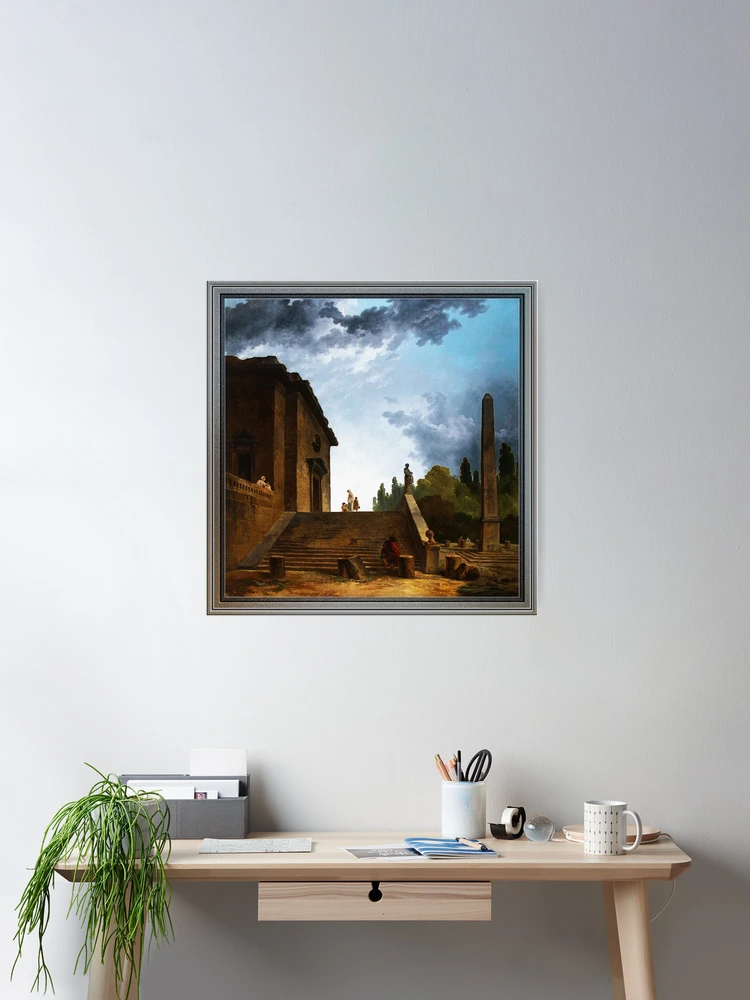
The central focus of this artwork is the majestic set of stairs leading to a grand building or temple, complemented by the towering obelisk in the background. The stairs themselves are weathered and appear to be made of stone, their steps leading upward toward a stone structure. The presence of these stairs suggests an ancient or noble setting, possibly linked to historical or mythological references, characteristic of Robert’s romanticized depictions of classical ruins.
V popředí, two individuals are depicted—one seated and another standing on the stairs. They are seemingly inconsequential to the grandeur of the setting but still play a vital role in adding a human presence that contrasts with the monumental architecture. Their placement helps balance the scale of the composition, providing a sense of human proportion amid the towering structures.
The obelisk, an ancient Egyptian monument re-imagined within a classical European setting, stands as another focal point to the right side of the composition. This object symbolizes the ancient world, evoking the sense of a lost civilization while anchoring the piece in the romantic classical themes Robert was known for. The use of the obelisk reinforces the notion of timelessness, a central theme in much of Robert’s work, where classical ruins are idealized to evoke both nostalgia and contemplation of past civilizations.
Objekty a terén
The terrain surrounding the stairs and obelisk is lush and expansive. The ground appears to be cultivated or at least managed, with well-kept paths leading through the terrain. On the right, we see a few figures in the distance, seated or walking, giving the landscape a dynamic feel while reinforcing the setting’s tranquility. The backdrop of trees, with their expansive reach toward the sky, provides a striking contrast against the harsh lines of the stone architecture. The viewer’s eye is naturally drawn toward the horizon, where the trees begin to thin out, leading to a space dominated by clouds and a slightly darker sky.
The juxtaposition of human-made elements—such as the staircase, the obelisk, and the figures—and nature highlights the tension between civilization and the natural world. Robert’s careful rendering of the foliage, combined with the crisp outlines of the architectural elements, underscores the precision of his technique. This harmony between nature and architecture is a key characteristic of the Rococo and Neoclassical periods, where the human desire for understanding and order is reflected through such meticulously designed structures amid nature’s free-flowing form.
Styl a technika
Robert’s style in this work is distinctly Rococo with elements of Neoclassicism, blending the ornate with the classical. His use of light, stín, and texture creates a sense of depth and dimension, inviting the viewer to step into the landscape. The clouds in the sky seem to swirl in dramatic motion, contrasting with the stillness of the stone objects below. This use of light and dark not only adds to the mood but also enhances the sense of timelessness that pervades the entire scene.
The application of light is masterful, with shadows creeping along the stone steps, highlighting the weathered texture of the structure. The obelisk, také, is illuminated with soft, diffuse light, giving it an almost ethereal quality. Postavy, small in comparison to the surrounding objects, are subtly shaded, further emphasizing their secondary role within the larger composition.
Robert’s technique, while focused on naturalistic detail, maintains an idealized interpretation of the ruins. The rocks and stone are not simply representations of decay but are infused with a sense of romantic nostalgia for an era gone by. The stones seem to have a timeless quality, making them not just relics of the past, but symbols of enduring beauty.
Nálada a téma
The mood of the painting is one of quiet contemplation. Nastavení, with its peaceful yet awe-inspiring structures, invites viewers to reflect on the past, plynutí času, and the impermanence of human creations. The natural landscape, in its lushness and vividness, contrasts with the stone architecture, suggesting the ephemeral nature of human achievement against the vast, enduring power of nature.
The classical ruins, while not overtly ancient in this depiction, invoke the grandeur of civilizations long past, evoking a sense of nostalgia and reverence for the lost civilizations of Rome and Egypt. The obelisk, with its Egyptian origins, stands as a reminder of these ancient powers. By choosing to depict such ruins, Robert not only preserves the legacy of these ancient structures but also elevates them, presenting them as objects of beauty rather than mere remnants of past civilizations.
The inclusion of figures adds a human touch to the scene, but their small scale and passive actions suggest that humanity, while significant, is but a fleeting moment in the timeline of history. The vast sky, dotted with dark clouds and illuminated by bursts of light, further amplifies the theme of nature’s dominance over time and human endeavors.
Závěr
“Landscape with a Stairs and Obelisk” is a masterful example of Hubert Robert’s ability to merge the beauty of nature with the elegance of classical architecture. The scene captures a moment where the monumental and the natural coexist, creating a serene yet thought-provoking atmosphere. Robert’s meticulous attention to detail, his skillful use of light and shadow, and his celebration of classical ruins all serve to reinforce the timeless theme of nature’s dominance and the fleeting nature of human achievement. This work invites the viewer not only to admire its technical brilliance but to reflect on the deeper themes of history, čas, and memory.
Landscape with a Stairs and Obelisk is a retouched digital art old masters reproduction of a public domain image that is available as a tisk na plátno v rolích online.
Životopis umělce
Níže informace odvozené z Wikipedia.org
Hubert Robert se narodil v Paříži v roce 1733. Jeho otec, Nicolas robert, byl ve službách Françoise-Josepha de Choiseula, markýz de Stainville přední diplomat z Lorraine. Mladý Robert dokončil studia u jezuitů na Collège de Navarre v r 1751 a vstoupil do ateliéru sochaře Michela-Ange Slodtze, který ho naučil designu a perspektivě, ale povzbudil ho, aby se obrátil k malbě. v 1754 odjel do Říma ve vlaku Étienne-François de Choiseul, syn zaměstnavatele jeho otce, který byl jmenován francouzským velvyslancem a stane se státním tajemníkem pro zahraniční věci Ludvíka XV 1758.
V Římě strávil celých jedenáct let, pozoruhodně dlouhou dobu; poté, co došel oficiální pobyt mladého umělce na francouzské akademii v Římě, živil se díly, které produkoval pro návštěvy fajnšmekrů jako abbé de Saint-Non, který v dubnu vzal Roberta do Neapole 1760 navštívit ruiny Pompejí. Markýz de Marigny, ředitel Bâtiments du Roi držel krok s jeho vývojem v korespondenci s Natoire, ředitel Francouzské akademie, který naléhal na důchodce, aby načrtli out-of-door, z přírody: Robert nepotřeboval žádné naléhání; kresby z jeho skicářů dokumentují jeho cesty: Villa d'Este, Caprarola.
Pohled na přístav Rippeta v Římě, C. 1766, zobrazující starověký římský panteon vedle imaginárního přístavu
Kontrast mezi ruinami starověkého Říma a životem jeho doby vzbudil jeho největší zájem. Nějakou dobu pracoval ve studiu Pannini, jehož vliv lze vidět v Imaginárním pohledu na zničenou galerii Louvre (ilustrace). Robert trávil čas ve společnosti mladých umělců v kruhu Piranesi, jehož capricci z romanticky zarostlých ruin ovlivnili natolik, že získal přezdívku Robert des ruines. Alba skic a kreseb, které sestavil v Římě, mu dodávala motivy, které zpracovával do obrazů po celou dobu své kariéry.