

Laurel
Laurel by Czech Painter Alphonse Mucha (1860 – 1939); així com un il·lustrat il·lustrador i artista gràfic que va ser una de les principals forces del període Art Nouveau; conegut pel seu estilitzat, cartells teatrals adornats i decoratius.
This is a wonderful illustration of an attractive young lady presented in the art nouveau style in a side portrait view within a circular view port.
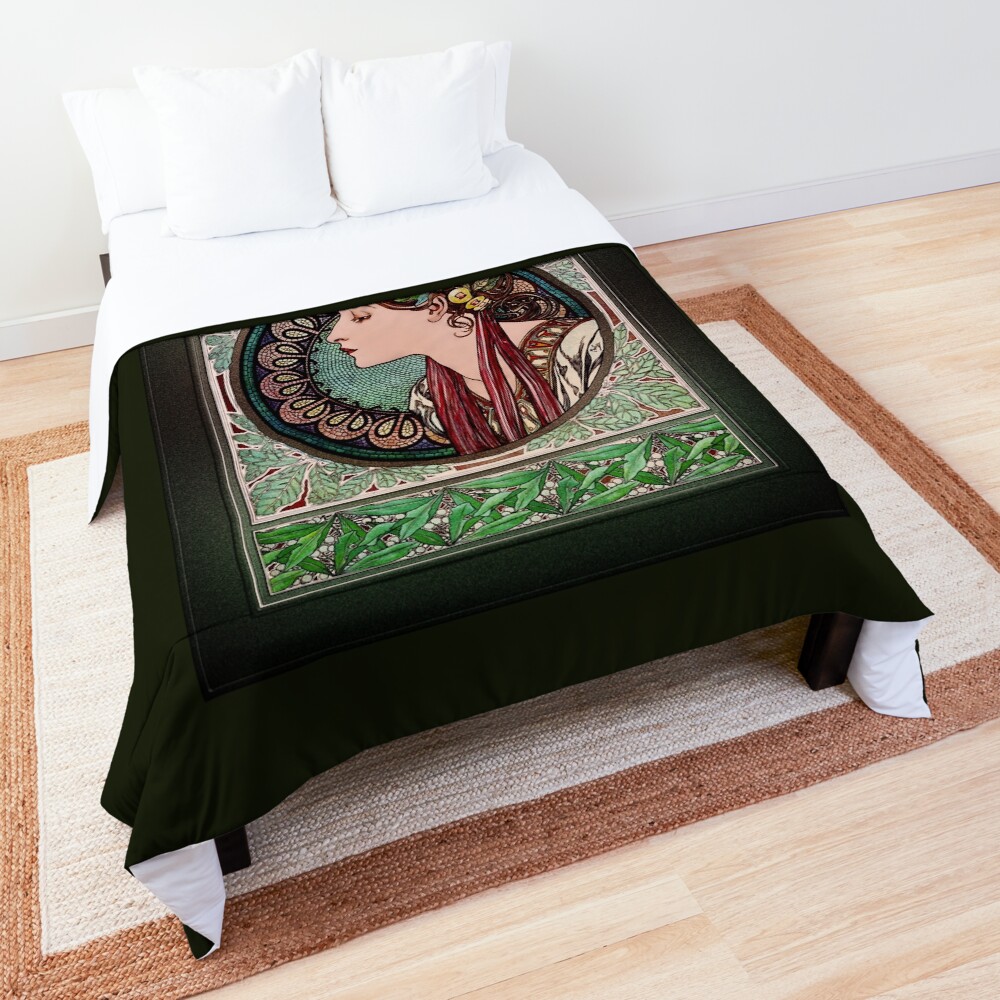
She is positioned in front of a circular tiled background at the inner core that is overlaid with wide tiled ring with with oval tiled shapes and then to a two layer tiled ring and finally a solid ring.
She has brown curly hair with yellow streaks running throughout with long strands of hair hanging on both side of her neck from the back of her head that are red and light pink.
Her hair is tied mid way on the top by a red ribbon and on the left side of her hair just above her ear is a flower with leaves; and below this is a head piece composed of disc that wraps around the back of her head.
She is wearing a white dress with a large wide collar that wraps around the entire upper portion of the dress that is decorated in colorful triangular and cone like designs.
Around this inner frame is a square frame filled with green plants that are directed to the four corners of the frame; and on the top and bottom of this frame are two rectangular boxes filled with plants and fruit, with the top box being smaller than the bottom box.

This all tied together with a separator the fits along the perimeter of the three different frames.
Aquesta és una reproducció de mestres antics d'art digital remasteritzada d'una imatge de domini públic que està disponible com a impressió de llenç en línia..
Informació a continuació de Wikipedia.org
Alfons Maria Mucha July 24, 1860 – Juliol 14, 1939), va ser conegut internacionalment com Alphonse Mucha. Va ser un destacat pintor txec, il·lustrador i artista gràfic, vivint a París durant el període Art Nouveau, i és més conegut pels seus cartells teatrals ben estilitzats i decoratius, particularment les de Sarah Bernhardt.
Va produir il·lustracions, publicitat, panells decoratius, i dissenys, que es va convertir en una de les imatges més conegudes de l'època.
A la segona part de la seva carrera, a l'edat de 43, va tornar a la seva terra natal de la regió de Bohèmia-Moràvia, a Àustria, i es va dedicar a pintar una sèrie de vint teles monumentals conegudes com L'èpica eslava, que representa la història de tots els pobles eslaus del món, que va pintar entre 1912 i 1926.
En 1928, en el desè aniversari de la independència de Txecoslovàquia, va presentar la sèrie a la nació txeca. La va considerar la seva obra més important. Ara s’exhibeix a Praga.