

Laurel
Laurel by Czech Painter Alphonse Mucha (1860 – 1939); così come un affermato illustratore e artista grafico che è stato una forza importante del periodo Art Nouveau; noto per la sua stilizzata, manifesti teatrali decorati e decorativi.
This is a wonderful illustration of an attractive young lady presented in the art nouveau style in a side portrait view within a circular view port.
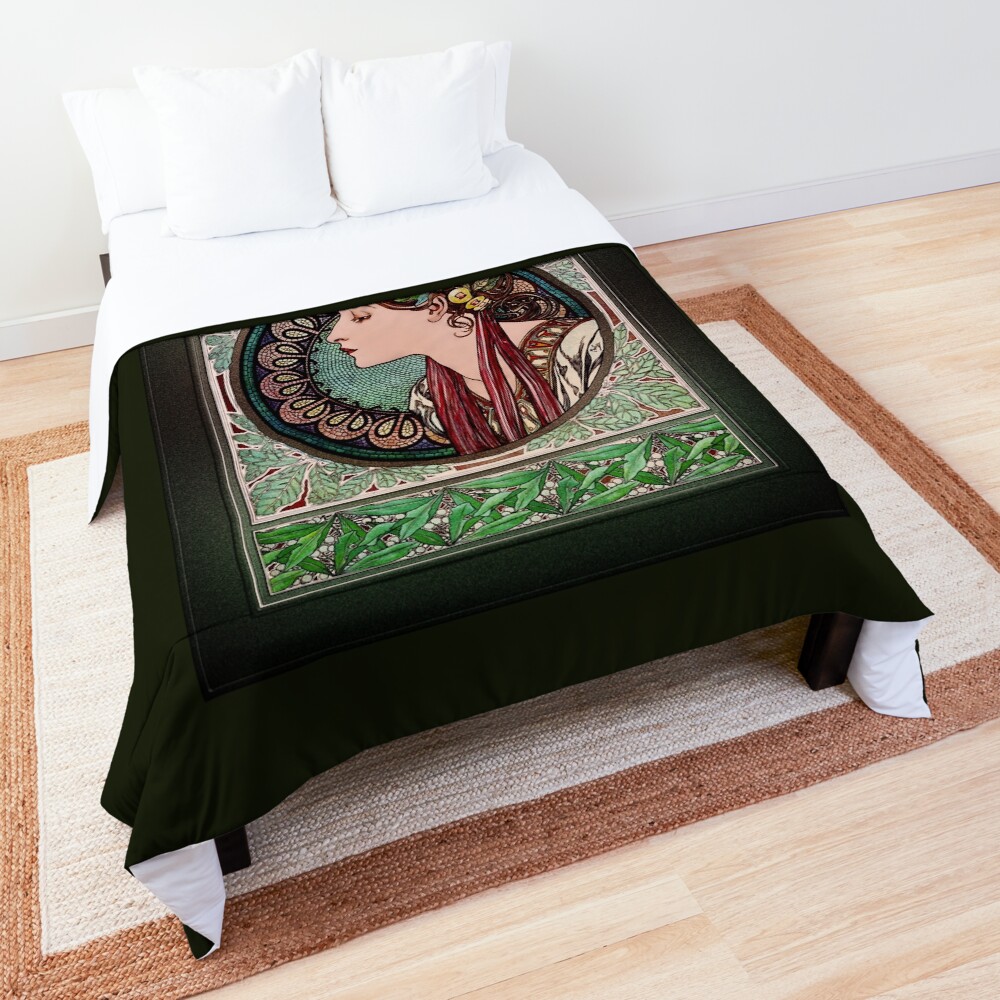
She is positioned in front of a circular tiled background at the inner core that is overlaid with wide tiled ring with with oval tiled shapes and then to a two layer tiled ring and finally a solid ring.
She has brown curly hair with yellow streaks running throughout with long strands of hair hanging on both side of her neck from the back of her head that are red and light pink.
Her hair is tied mid way on the top by a red ribbon and on the left side of her hair just above her ear is a flower with leaves; and below this is a head piece composed of disc that wraps around the back of her head.
She is wearing a white dress with a large wide collar that wraps around the entire upper portion of the dress that is decorated in colorful triangular and cone like designs.
Around this inner frame is a square frame filled with green plants that are directed to the four corners of the frame; and on the top and bottom of this frame are two rectangular boxes filled with plants and fruit, with the top box being smaller than the bottom box.

This all tied together with a separator the fits along the perimeter of the three different frames.
Questa è una riproduzione di vecchi maestri di arte digitale rimasterizzata di un'immagine di dominio pubblico disponibile come stampa su tela online.
Informazioni sotto da Wikipedia.org
Alfons Maria Mucha luglio 24, 1860 – luglio 14, 1939), era conosciuto a livello internazionale come Alphonse Mucha. Era un importante pittore ceco, illustratore e grafico, vivere a Parigi durante il periodo Art Nouveau, ed è meglio conosciuto per i suoi manifesti teatrali distintamente stilizzati e decorativi, in particolare quelli di Sarah Bernhardt.
Ha prodotto illustrazioni, annunci, pannelli decorativi, e disegni, che divenne tra le immagini più note del periodo.
Nella seconda parte della sua carriera, all'età di 43, tornò nella sua terra natale della regione della Boemia-Moravia in Austria e si dedicò alla pittura di una serie di venti tele monumentali conosciute come L'epopea slava, raffigurante la storia di tutti i popoli slavi del mondo, che ha dipinto tra 1912 e 1926.
Nel 1928, nel decimo anniversario dell'indipendenza della Cecoslovacchia, ha presentato la serie alla nazione ceca. Lo considerava il suo lavoro più importante. Ora è in mostra a Praga.