

Laurel
Laurel by Czech Painter Alphonse Mucha (1860 – 1939); evenals een ervaren illustrator en grafisch kunstenaar die een belangrijke kracht was in de Art Nouveau-periode; bekend om zijn gestileerd, sierlijke en decoratieve theatrale posters.
This is a wonderful illustration of an attractive young lady presented in the art nouveau style in a side portrait view within a circular view port.
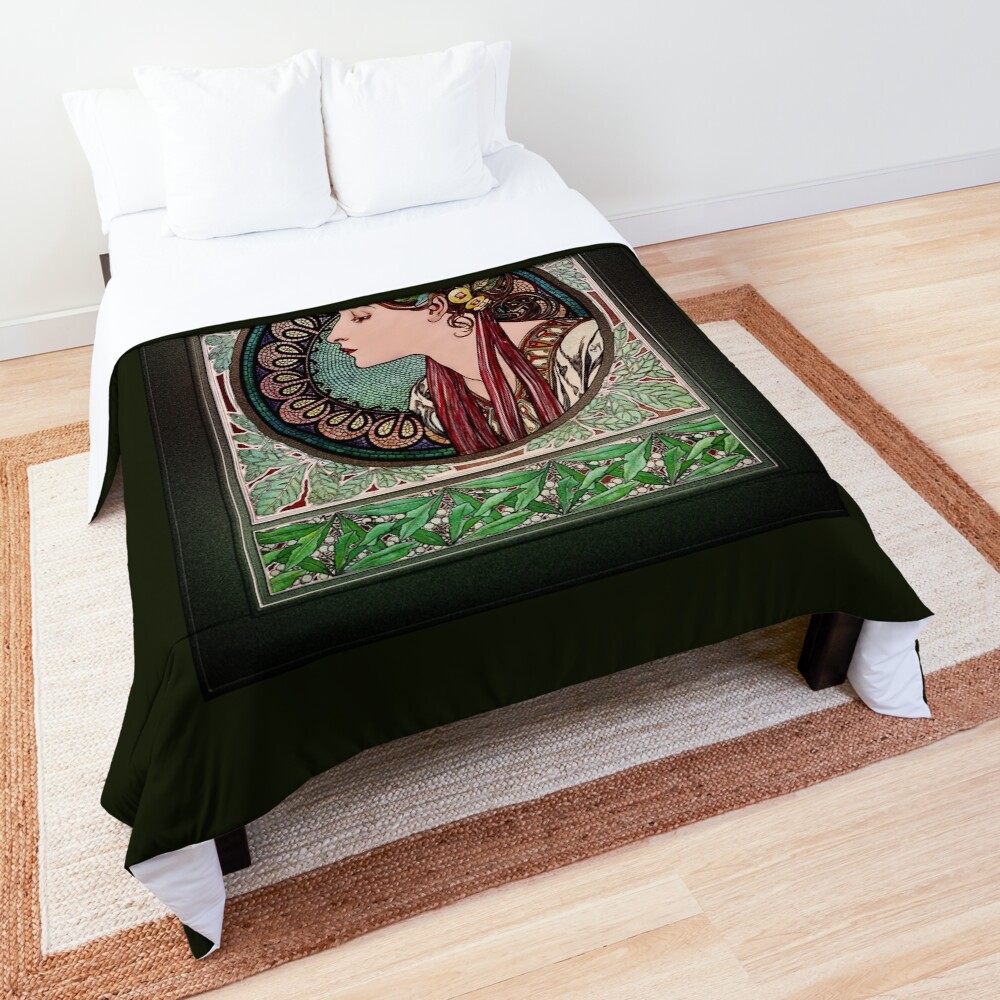
She is positioned in front of a circular tiled background at the inner core that is overlaid with wide tiled ring with with oval tiled shapes and then to a two layer tiled ring and finally a solid ring.
She has brown curly hair with yellow streaks running throughout with long strands of hair hanging on both side of her neck from the back of her head that are red and light pink.
Her hair is tied mid way on the top by a red ribbon and on the left side of her hair just above her ear is a flower with leaves; and below this is a head piece composed of disc that wraps around the back of her head.
She is wearing a white dress with a large wide collar that wraps around the entire upper portion of the dress that is decorated in colorful triangular and cone like designs.
Around this inner frame is a square frame filled with green plants that are directed to the four corners of the frame; and on the top and bottom of this frame are two rectangular boxes filled with plants and fruit, with the top box being smaller than the bottom box.

This all tied together with a separator the fits along the perimeter of the three different frames.
Dit is een remastered reproductie van digitale kunst oude meesters van een openbaar domeinafbeelding die als canvasdruk online beschikbaar is.
Info hieronder van Wikipedia.org
Alfons Maria Mucha juli 24, 1860 – juli- 14, 1939), was internationaal bekend als Alphonse Mucha. Hij was een prominente Tsjechische schilder, illustrator en graficus, woonachtig in Parijs tijdens de Art Nouveau-periode, en is vooral bekend om zijn uitgesproken gestileerde en decoratieve theatrale posters, vooral die van Sarah Bernhardt.
Hij maakte illustraties, advertenties, decoratieve panelen, en ontwerpen, die een van de bekendste afbeeldingen van die periode werd.
In het tweede deel van zijn carrière, op de leeftijd van 43, hij keerde terug naar zijn geboorteland Bohemen-Moravië in Oostenrijk en wijdde zich aan het schilderen van een serie van twintig monumentale doeken die bekend staan als The Slav Epic, beeltenis van de geschiedenis van alle Slavische volkeren van de wereld, waar hij tussen schilderde 1912 en 1926.
In 1928, op de 10e verjaardag van de onafhankelijkheid van Tsjechoslowakije, hij presenteerde de serie aan de Tsjechische natie. Hij beschouwde het als zijn belangrijkste werk. Het is nu te zien in Praag.