

Leisure Time
Leisure Time c1874 by German Painter Ludwig Thiersch-Niedziela (1825 – 1909); yn bennaf o bynciau crefyddol a mytholegol.
Mae hwn yn brydferth tirwedd painting of a young couple setting on the bank of a river, with their rowboat just off to the right of the scene and others rowing on the river.
The young man in a dress jacket, gray vest and pants and white shirt with bow tie is resting near a large tree with a sketch book, looking at is subject, the young lady that he is with who is dressed in a full length white dress with a high neck and ruffles and long sleeves also with ruffles and black choker.
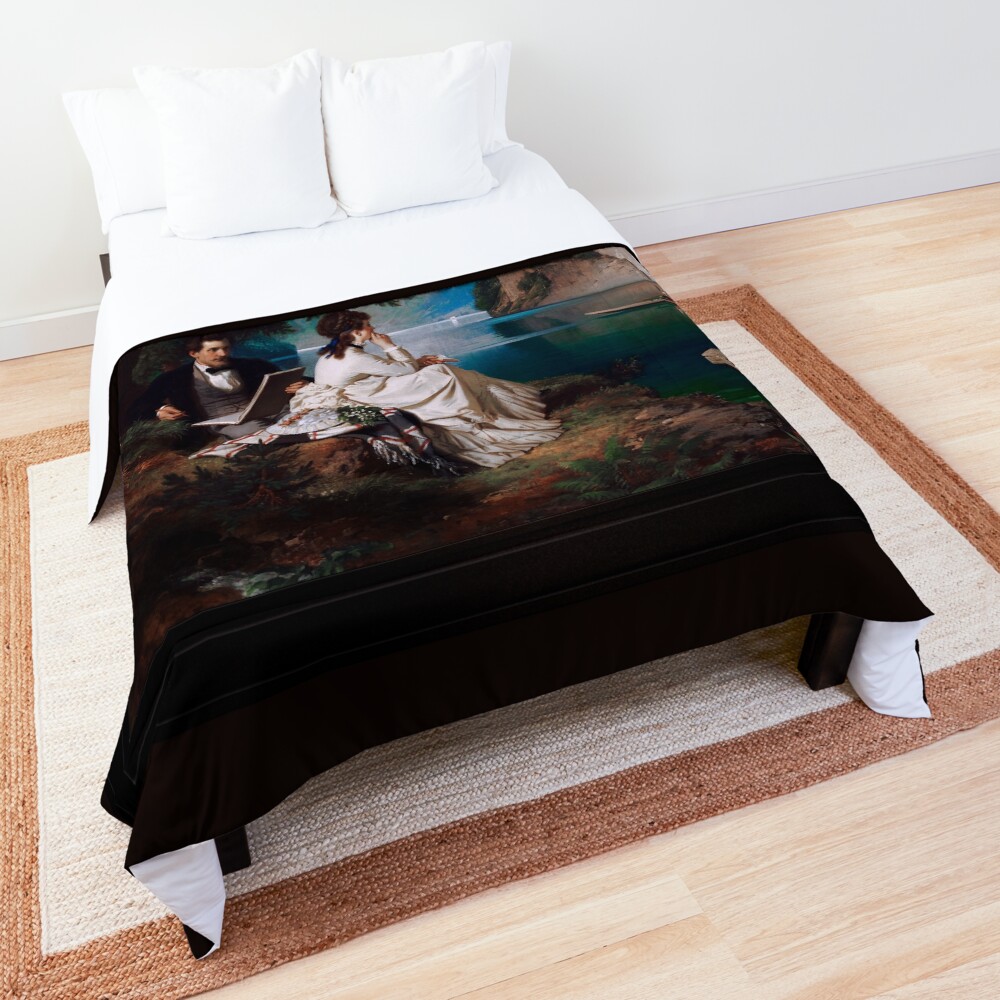
Her hair is braided and wrapped around her head, held in place with a blue ribbon with a red accent on the side, and beside her is her shawl with tassels; that have a large gray and white stripe pattern accented with dual thin red stripes along the edges of the white part of the shawl; with her hat that is embellished with flowers resting on the shawl.
In the scene we see plants, shrubs and flowers along with the trees as well as the large expanse of the river, huge cliffs and mountains in the far distance.
Leisure Time is a retouched digital art old masters reproduction of a public domain image.
Gwybodaeth Islaw sy'n Deillio o Wikipedia.org
Mab i'r clasurwr oedd Ludwig (astudiaeth glasurol o hynafiaeth) a philhellene (symudiad deallusol er edmygedd Gwlad Groeg ar droad y 19eg ganrif) Friedrich Thiersch, a anwyd ym Munich Germany yn 1825.
Roedd ganddo ddau frawd hŷn; un oedd y llawfeddyg Karl Thiersch (1822 – 1895) a'r llall oedd y diwinydd H. W. J.. Thiersch (1817 – 1885).
Dechreuodd Ludwig ei addysg artistig fel un o fynychwyr Academi'r Celfyddydau Cain ym Munich, astudio cerflunwaith; ond ymhen rhai blynyddoedd newidiodd i beintio a daeth yn fyfyriwr i dri o baentwyr Almaenig; Heinrich Maria von Hess (1798 – 1863) o'r Mudiad Nasaread (Mudiad Rhamantaidd Almaenig a’i nod oedd adfywio ysbrydolrwydd mewn celf); Julius Schnorr von Carolsfeld (1794 – 1872 ), peintiwr pynciau Beiblaidd yn bennaf, a Karl Scorn (1803 – 1850), yn ogystal â phaentiwr roedd hefyd yn feistr gwyddbwyll.
Ar ôl cwblhau ei astudiaethau yn yr Academi Celfyddydau Cain 1848, peintiodd y darnau Sakuntala (yn wraig i Dushyanta ac yn fam i'r Ymerawdwr Bharata), a golygfa o Camissards (oedd Huguenotiaid neu Brotestaniaid Ffrengig a ddaliodd at y Diwygiedig, neu Galfin, traddodiad Protestaniaeth. n y 1700au cynnar, codasant wrthwynebiad yn erbyn yr erlidiau a ddilynodd Edict Fontainebleau gan Louis XIV, gwneud Protestaniaeth yn anghyfreithlon.)
Wedi cwblhau'r gweithiau hyn mentrodd i Rufain, Yr Eidal; where he sketched scenes of the daily lives of the Italian people and painted the piece Hiob unter seinen Freunden (Job among his friends ).
Yn 1852 he made he traveled to Athens, Greece with his father, where he replaced Italian Painter, Physician and amateur Archaeologist Rafaello Ceccoli (1800 – 1850); at the Athens School of Fine Arts; becoming interested in Byzantine Art.
During this from 1852 – 1855 Ludwig would painting several frescoes in Greek Churches and was a leading member of the movement to modernize Byzantine Art by introducing Western elements, such as naturalistic perspective and anatomy; which met with fierce Greek opposition from those that saw such reforms as a means of replacing longstanding Greek Traditions with foreign ones.
Trwy weddill ei oes byddai Ludwig yn teithio i wahanol ddinasoedd yn peintio i noddwyr ac yn creu ffresgoau i eglwysi, which was particularly notable along with the wor done by Italian Painter Ludwig Seitz (1844 – 1908) a Jean-Hippolyte Flandrin o Ffrainc (1809 – 1864); ystyrir ei fod wedi arwain y diwygiad yng Nghelfyddyd Eglwysig Gorllewin Ewrop.