

Leisure Time
Leisure Time c1874 by German Painter Ludwig Thiersch-Niedziela (1825 – 1909); primarily of religious and mythological subjects.
Ĉi tio estas bela pejzaĝo painting of a young couple setting on the bank of a river, with their rowboat just off to the right of the scene and others rowing on the river.
The young man in a dress jacket, gray vest and pants and white shirt with bow tie is resting near a large tree with a sketch book, looking at is subject, the young lady that he is with who is dressed in a full length white dress with a high neck and ruffles and long sleeves also with ruffles and black choker.
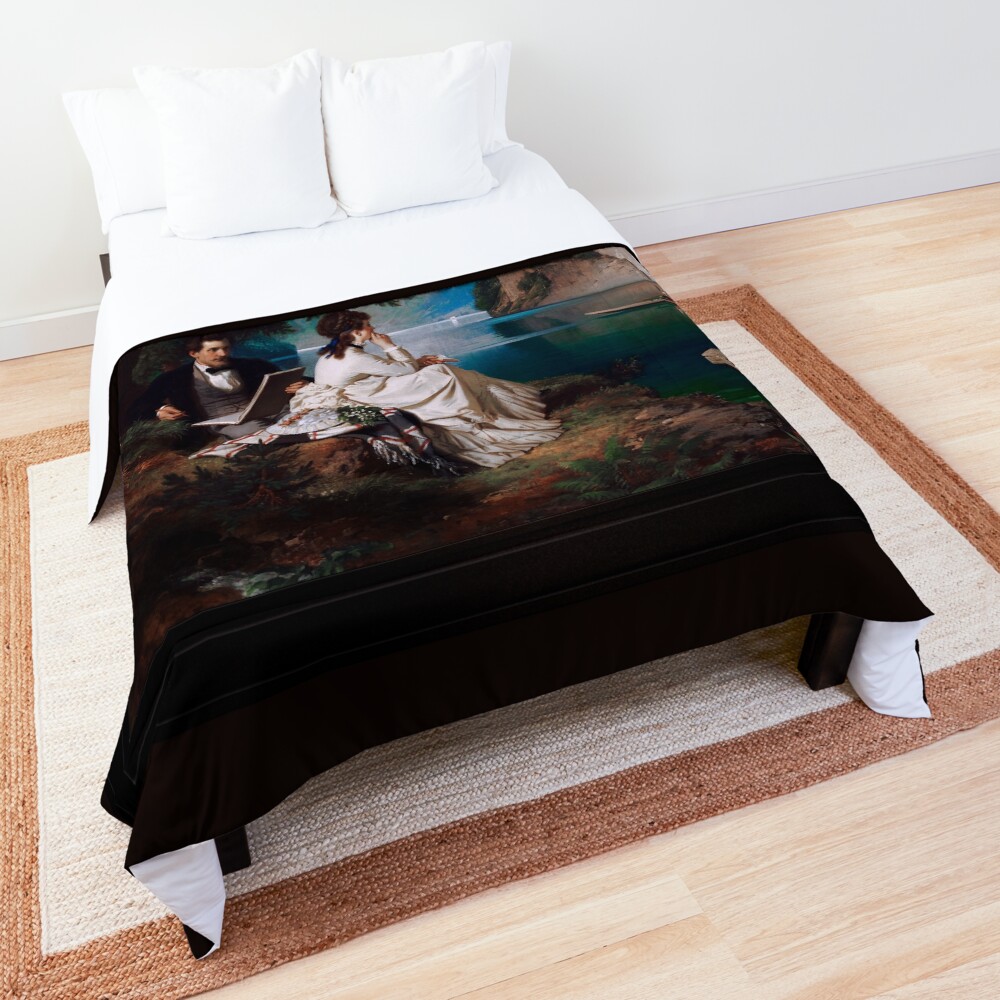
Her hair is braided and wrapped around her head, held in place with a blue ribbon with a red accent on the side, and beside her is her shawl with tassels; that have a large gray and white stripe pattern accented with dual thin red stripes along the edges of the white part of the shawl; with her hat that is embellished with flowers resting on the shawl.
In the scene we see plants, shrubs and flowers along with the trees as well as the large expanse of the river, huge cliffs and mountains in the far distance.
Leisure Time is a retouched digital art old masters reproduction of a public domain image.
Informoj Malsupre Derivita De Vikipedio.org
Ludwig was the son of the classicist (classical study of antiquity) and philhellene (intellectual movement for the admiration of Greece at the turn of 19th century) Friedrich Thiersch, who was born in Munich Germany in 1825.
He had two older brothers; one was the surgeon Karl Thiersch (1822 – 1895) and the other was the theologian H. W. J. Thiersch (1817 – 1885).
Ludwig began is artistic education as an attendee of the Academy of Fine Arts in Munich, studying sculpture; but after a few years changed over to painting and became the student of three German Painters; Heinrich Maria von Hess (1798 – 1863) of the Nazarene Movement (a German Romantic Movement who’s aim was to revive spirituality in art); Julius Schnorr von Carolsfeld (1794 – 1872 ), primarily a painter of biblical subjects, and Karl Schorn (1803 – 1850), as well as a painter he was also a chess master.
After completing his studies at the Academy of Fine Arts 1848, he painted the pieces Sakuntala (is the wife of Dushyanta and the mother of Emperor Bharata), and a scene of Camissards (were Huguenots or French Protestants who held to the Reformed, or Calvinist, tradition of Protestantism. n the early 1700s, they raised a resistance against the persecutions which followed Louis XIV’s Edict of Fontainebleau, making Protestantism illegal.)
On the completion of these works he then ventured off to Rome, Italio; kie li skizis scenojn de la ĉiutaga vivo de la itala popolo kaj pentris la pecon Hiob unter seinen Freunden (Ijob inter siaj amikoj ).
En 1852 li igis li vojaĝi al Ateno, Grekio kun sia patro, kie li anstataŭigis italan Pentriston, Kuracisto kaj amatora Arkeologo Rafaello Ceccoli (1800 – 1850); ĉe la Atena Lernejo de Belartoj; iĝante interesita pri Bizanca Arto.
Dum ĉi de 1852 – 1855 Ludwig pentrus plurajn freskojn en grekaj preĝejoj kaj estis gvida membro de la movado por modernigi bizancan arton enkondukante okcidentajn elementojn., kiel naturalisma perspektivo kaj anatomio; kiu renkontis furiozan grekan opozicion de tiuj kiuj vidis tiajn reformojn kiel rimedon de anstataŭigi delongajn grekajn Tradiciojn kun fremdaj..
Throughout the rest of his life Ludwig would travel to different cities painting for patrons and creating frescoes for churches, which was particularly notable along with the wor done by Italian Painter Ludwig Seitz (1844 – 1908) and French Jean-Hippolyte Flandrin (1809 – 1864); he is considered to have led the revival in Western European Ecclesiastical Art.