

Vapaa-aika
Leisure Time c1874, saksalainen taidemaalari Ludwig Thiersch-Niedziela (1825 – 1909); pääasiassa uskonnollisista ja mytologisista aiheista.
Tämä on kaunis maisema maalaus nuoresta parista istumassa joen rannalla, with their rowboat just off to the right of the scene and others rowing on the river.
The young man in a dress jacket, gray vest and pants and white shirt with bow tie is resting near a large tree with a sketch book, looking at is subject, the young lady that he is with who is dressed in a full length white dress with a high neck and ruffles and long sleeves also with ruffles and black choker.
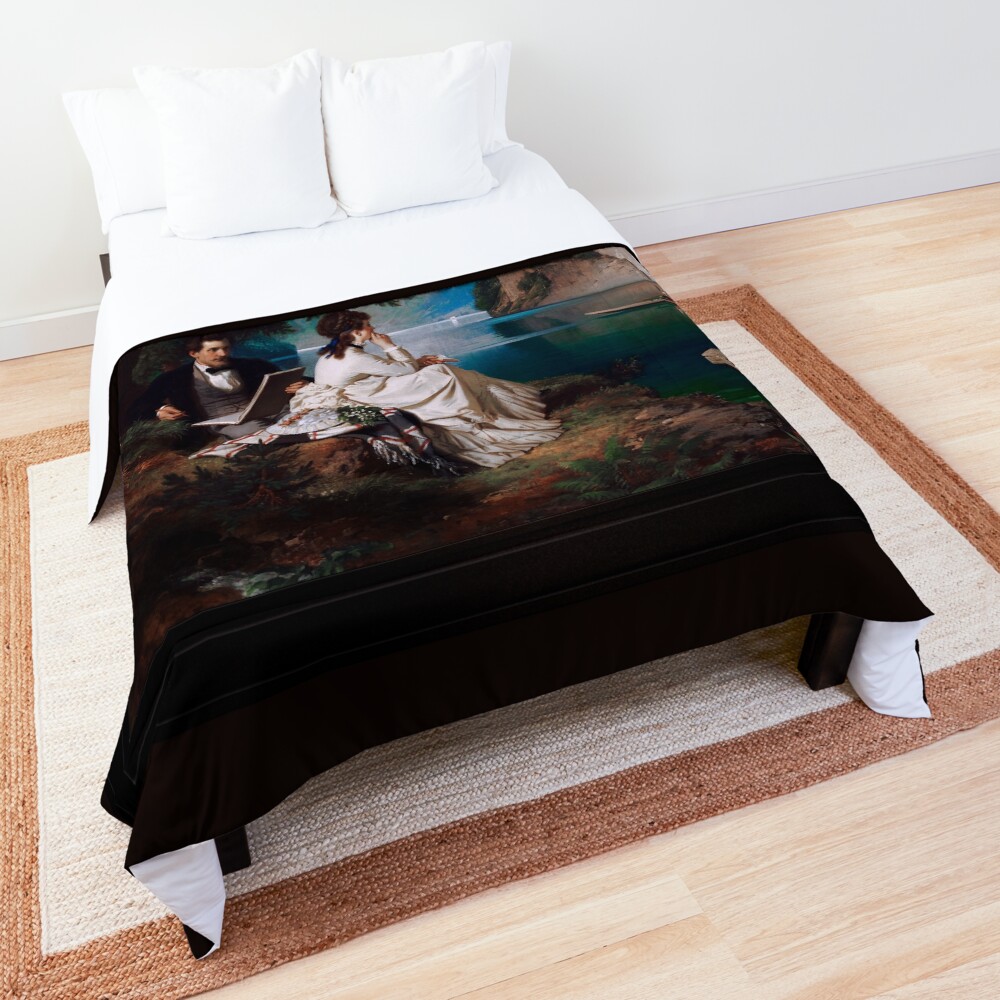
Her hair is braided and wrapped around her head, held in place with a blue ribbon with a red accent on the side, and beside her is her shawl with tassels; joissa on suuri harmaa ja valkoinen raitakuvio, jossa on kaksi ohutta punaista raitaa huivin valkoisen osan reunoilla; hänen hattunsa, joka on koristeltu huivissa lepäävillä kukilla.
Kohtauksessa näemme kasveja, pensaat ja kukat puiden ohella sekä joen suuri lakeus, valtavia kallioita ja vuoria kaukana.
Leisure Time on retusoitu digitaalisen taiteen vanhojen mestareiden kopio julkisessa käytössä olevasta kuvasta.
Alla olevat tiedot ovat peräisin Wikipedia.org
Ludwig oli klassismin poika (klassinen antiikin tutkimus) ja philhellen (intellektuaalinen liike Kreikan ihailuksi 1800-luvun vaihteessa) Friedrich Thiersch, joka syntyi Münchenissä Saksassa 1825.
Hänellä oli kaksi vanhempaa veljeä; yksi oli kirurgi Karl Thiersch (1822 – 1895) ja toinen oli teologi H. W. J. Thiersch (1817 – 1885).
Ludwig began is artistic education as an attendee of the Academy of Fine Arts in Munich, studying sculpture; but after a few years changed over to painting and became the student of three German Painters; Heinrich Maria von Hess (1798 – 1863) of the Nazarene Movement (a German Romantic Movement who’s aim was to revive spirituality in art); Julius Schnorr von Carolsfeld (1794 – 1872 ), primarily a painter of biblical subjects, and Karl Schorn (1803 – 1850), as well as a painter he was also a chess master.
After completing his studies at the Academy of Fine Arts 1848, he painted the pieces Sakuntala (is the wife of Dushyanta and the mother of Emperor Bharata), and a scene of Camissards (were Huguenots or French Protestants who held to the Reformed, or Calvinist, tradition of Protestantism. n the early 1700s, they raised a resistance against the persecutions which followed Louis XIV’s Edict of Fontainebleau, making Protestantism illegal.)
On the completion of these works he then ventured off to Rome, Italia; where he sketched scenes of the daily lives of the Italian people and painted the piece Hiob unter seinen Freunden (Job among his friends ).
Sisään 1852 he made he traveled to Athens, Greece with his father, where he replaced Italian Painter, Physician and amateur Archaeologist Rafaello Ceccoli (1800 – 1850); at the Athens School of Fine Arts; becoming interested in Byzantine Art.
During this from 1852 – 1855 Ludwig would painting several frescoes in Greek Churches and was a leading member of the movement to modernize Byzantine Art by introducing Western elements, such as naturalistic perspective and anatomy; joka kohtasi ankaran kreikkalaisen vastustuksen niiltä, jotka pitivät tällaisia uudistuksia keinona korvata pitkäaikaiset kreikkalaiset perinteet ulkomaisilla..
Koko loppuelämänsä Ludwig matkusti eri kaupunkeihin maalaamalla suojelijoita ja luomassa freskoja kirkkoihin, joka oli erityisen merkittävä italialaisen taidemaalari Ludwig Seitzin tekojen ohella (1844 – 1908) ja ranskalainen Jean-Hippolyte Flandrin (1809 – 1864); hänen katsotaan johtaneen Länsi-Euroopan kirkollisen taiteen herätystä.