

Frístund
Leisure Time c1874 eftir þýska málarann Ludwig Thiersch-Niedziela (1825 – 1909); fyrst og fremst trúarleg og goðafræðileg efni.
Þetta er fallegt landslag málverk af ungu pari við árbakka, með árabátinn sinn rétt hægra megin við vettvang og aðrir róa á ánni.
Ungi maðurinn í jakkafötum, Grátt vesti og buxur og hvít skyrta með slaufu hvílir nálægt stóru tré með skissubók, að horfa á er efni, unga konan sem hann er með sem er klædd í hvítan kjól í fullri lengd með háan háls og úlpur og langar ermar líka með úlfum og svörtum choker.
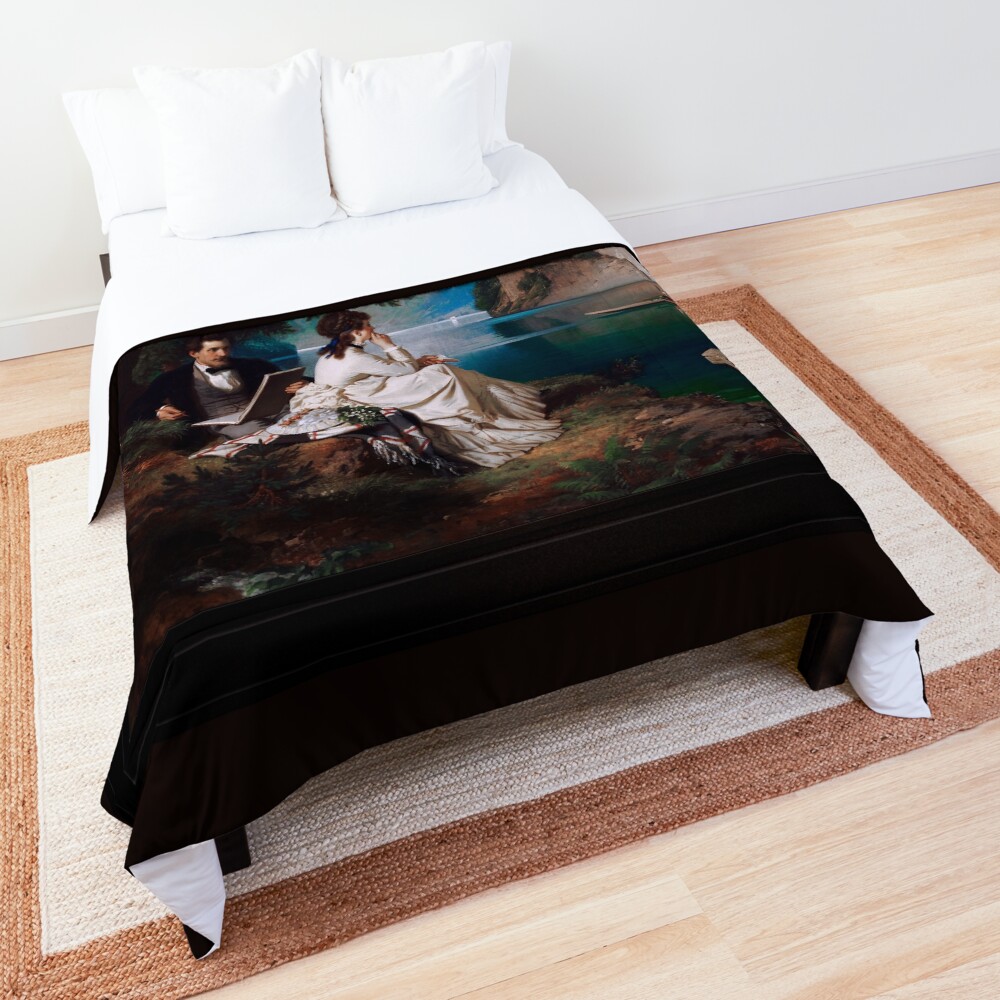
Hárið er fléttað og vafið um höfuðið, haldið á sínum stað með bláu borði með rauðum hreim á hliðinni, og við hlið hennar er sjalið með skúfum; sem eru með stóru gráu og hvítu röndamynstri með áherslu með tvöföldum þunnum rauðum röndum meðfram brúnum hvíta hluta sjalsins; með hattinn hennar sem er skreyttur blómum sem hvíla á sjalinu.
Í atriðinu sjáum við plöntur, runnar og blóm ásamt trjánum sem og stór víðátta árinnar, risastórir klettar og fjöll í fjarska.
Leisure Time er lagfærð stafræn list af gömlum meistara eftirgerð af mynd í almenningseign.
Upplýsingar hér að neðan fengnar af Wikipedia.org
Ludwig var sonur klassíkistans (klassísk rannsókn á fornöld) og philhellene (vitsmunahreyfing fyrir aðdáun Grikklands um aldamótin 19) Friedrich Thiersch, sem fæddist í München í Þýskalandi 1825.
Hann átti tvo eldri bræður; einn var skurðlæknirinn Karl Thiersch (1822 – 1895) and the other was the theologian H. W. J. Thiersch (1817 – 1885).
Ludwig began is artistic education as an attendee of the Academy of Fine Arts in Munich, studying sculpture; but after a few years changed over to painting and became the student of three German Painters; Heinrich Maria von Hess (1798 – 1863) of the Nazarene Movement (a German Romantic Movement who’s aim was to revive spirituality in art); Julius Schnorr von Carolsfeld (1794 – 1872 ), primarily a painter of biblical subjects, and Karl Schorn (1803 – 1850), as well as a painter he was also a chess master.
After completing his studies at the Academy of Fine Arts 1848, he painted the pieces Sakuntala (is the wife of Dushyanta and the mother of Emperor Bharata), and a scene of Camissards (were Huguenots or French Protestants who held to the Reformed, or Calvinist, tradition of Protestantism. n the early 1700s, they raised a resistance against the persecutions which followed Louis XIV’s Edict of Fontainebleau, making Protestantism illegal.)
On the completion of these works he then ventured off to Rome, Ítalíu; where he sketched scenes of the daily lives of the Italian people and painted the piece Hiob unter seinen Freunden (Job among his friends ).
Í 1852 he made he traveled to Athens, Greece with his father, where he replaced Italian Painter, Physician and amateur Archaeologist Rafaello Ceccoli (1800 – 1850); at the Athens School of Fine Arts; becoming interested in Byzantine Art.
During this from 1852 – 1855 Ludwig would painting several frescoes in Greek Churches and was a leading member of the movement to modernize Byzantine Art by introducing Western elements, such as naturalistic perspective and anatomy; which met with fierce Greek opposition from those that saw such reforms as a means of replacing longstanding Greek Traditions with foreign ones.
Throughout the rest of his life Ludwig would travel to different cities painting for patrons and creating frescoes for churches, which was particularly notable along with the wor done by Italian Painter Ludwig Seitz (1844 – 1908) and French Jean-Hippolyte Flandrin (1809 – 1864); he is considered to have led the revival in Western European Ecclesiastical Art.