

Lily Fairy c1888
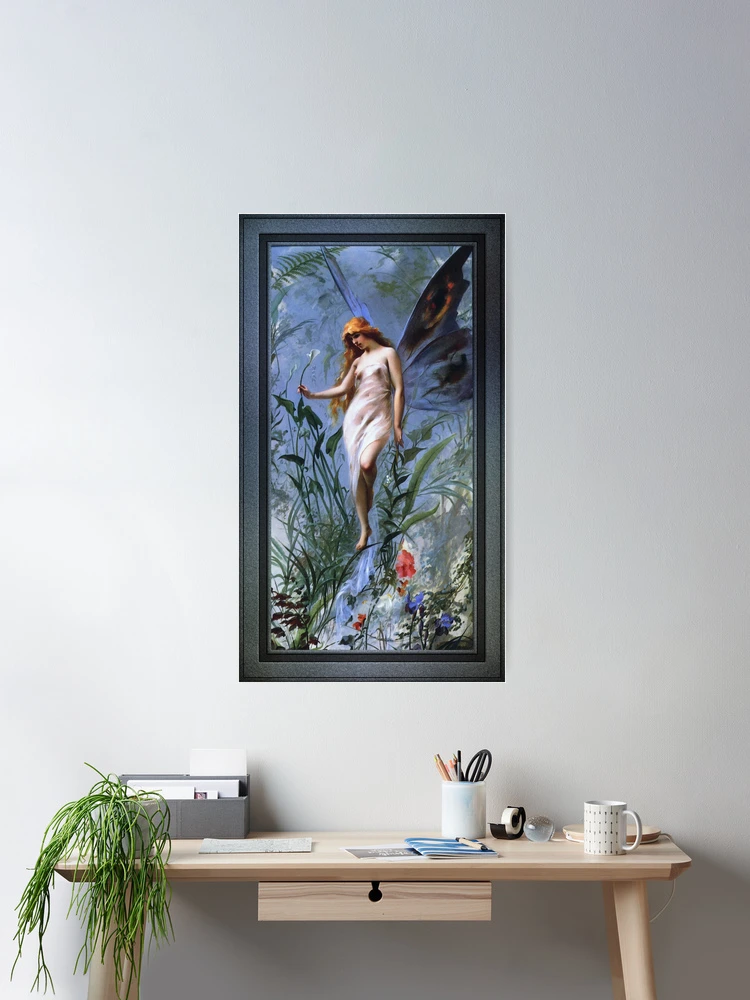
Luis Ricardo Falero, jaiotako 1851 eta bertan hiltzea 1896, was a Spanish painter of remarkable skill, and his artwork titled Lily Fairy, sortua 1888, stands as a testament to his expertise in rendering ethereal subjects. Known for his romantic and mythical approach, Falero often depicted women in a range of fantasy and allegorical settings. Lan jakin honetan, Lily Fairy, he captures the beauty of a mythical creature, a fairy who embodies both the ethereal and the terrestrial, her form blending seamlessly into the natural surroundings that encircle her. The piece merges the dreamlike quality of the mythical world with the meticulous attention to natural detail typical of the artist’s style.
Edukien taula
Gai nagusia: The Lily Fairy
Erdiko irudia Lily Fairy is a delicate, ethereal fairy standing amidst a lush forested backdrop. Bere luzea, golden hair flows freely, a visual extension of her otherworldly essence. This character, draped in a translucent, soineko lehorra, carries a subtle air of vulnerability and grace. The gown itself is a delicate white, nearly blending into the light surroundings of the forest, reflecting the diaphanous nature of the fairy. Falero’s skillful use of light and shade accentuates her lithe form, almost making her appear to float, caught between the realms of fantasy and reality.
The fairy’s wings, which rise gently behind her, are painted with a mix of bright and muted hues, shimmering in a way that suggests the fragility of her presence. These wings are depicted with a certain detail, resembling that of a butterfly’s delicate texture, ikuslea bere edertasuna miresteko eta bere indar delikatuaz harritzera gonbidatzen du. Artistak bere hegoak manipulatzeak naturarekin naturaz gaindiko lotura bat iradokitzen du, maitagarria bera inguruko landare-bizitzaren eta loreen gorpuzte bat balitz bezala. Bere jarrera, beso bat apur bat altxatuta eta lili lore bati eusten dio, lasaitasun dotoreko airea ematen dio, are gehiago bere irudia naturaren garbitasunarekin eta graziarekin lotuz.
Lurra: A Lush Garden of Life
Ingurua barruan Lily Fairy bizitzaz beteriko mundu natural baten irudikapen bizia da. Maitagarriaren inguruan hainbat landare daude, loreak, eta hosto berdea berarekin bat egiten duela dirudi. Paisaia berdez trinkoa da, leun miaketa iratze eta lodiak, belar-ondo ondulatuak, lore koloretsuen multzoak tartekatuta. Lore hauek, gehienetan gorri tonuetan, morea, eta zuria, contribute to the dreamlike atmosphere, their bright petals stark against the more muted greens of the foliage. Falero’s meticulous brushwork brings these elements of nature to life, each leaf and flower rendered with a clarity and precision that showcases his ability to capture the organic beauty of the world around him.
The background is soft and blurred, creating a sense of depth and a feeling that the fairy is standing at the boundary between the known and the unknown, between the familiar world of flora and the mystical world that she inhabits. This boundary is marked subtly by the slight distortion of the plants surrounding her, suggesting that they, ere bai, are part of the enchanted realm that the fairy occupies.
Estiloa eta gaia
Falero’s style in Lily Fairy reflects a combination of Romanticism and Symbolism, genres that often explore the intersection between the natural world and the supernatural. This fairy, like many of the mythological subjects depicted by Falero, is shown as a creature of beauty and grace, yet her fragile form and connection to nature hint at an ephemeral existence. The artist’s technique, a combination of fine brushwork and gentle transitions of color, evokes a sense of movement and breath within the stillness of the painting. His use of soft, blended light against darker shadows enhances the mystical atmosphere, creating a soft halo around the fairy’s figure.
The theme of the artwork is one of harmony between the magical and the natural, illustrating a world where the two are intimately connected. The fairy seems to emerge from the very earth itself, her form perfectly integrated with the flora that surrounds her. This suggests that Falero was interested not only in the beauty of women but also in exploring their symbolic relationship with nature. The fairy, in this light, is more than a mythical being; she represents a harmonious integration between humanity and the environment, an idealized version of purity and beauty.
Aldartea eta Giroa
ren aldartea Lily Fairy is serene and tranquil, with an underlying sense of delicate mysticism. The soft color palette dominated by pastel tones and gentle greens, evokes a feeling of peacefulness, as though the viewer has been transported into a quiet, enchanted glade. The fairy herself embodies an air of calm, her gaze downward, almost wistful, as though lost in a reverie. The surrounding flora further enhances this quiet mood, its lush, abundant growth suggesting a peaceful, undisturbed natural world where everything is in balance.
Alabaina, beneath the peaceful serenity, there is also a subtle sense of fleetingness. The fairy’s translucent dress, the soft light surrounding her, and the ephemeral nature of her wings all contribute to a feeling that this moment is precious and will not last forever. This transient quality is a hallmark of Falero’s approach, capturing a snapshot of a world that exists only in the viewer’s imagination.
Bukaera
Luis Ricardo Falero’s Lily Fairy is a captivating example of his ability to merge realism with fantasy, creating a magical, ethereal world that is both grounded in nature and transcendent of it. The delicate fairy, surrounded by a lush, lorategi bizia, becomes a symbol of the harmony between the supernatural and the natural world. Through his meticulous attention to detail and his ethereal handling of light and color, Falero invites the viewer to step into a world of tranquility and beauty, where the boundaries between the real and the fantastical blur into a singular, harmonious vision.
Lily Fairy is a retouched digital art old masters reproduction of a public domain image.
Artistaren bio eratorria Wikipedia.org
Falero Granadan jaio zen eta jatorriz Espainiako Armadan egin zuen karrera, baina gurasoen etsipenari utzi zion; Parisera bidaiatzea erabaki baitzuen, non artea ikasi zuen, kimika eta ingeniaritza mekanikoa.
Kimika eta ingeniaritza mekanikoko ikasketak egiten ditu; arriskutsuegitzat jo zituen berak egin behar zituen esperimentuak, horrela, arreta pinturan bakarrik zentratzera eraman zuen.
Ondorioz, Gabriel-Joseph-Marie-Augustin Ferrier frantses erretratu-margolari eta orientalistaren ikasle bihurtu zen. (1847 – 1914). Parisen ondoren, Londresera joan zen bizitzera, bertan jarraitu zituen ikasketak, eta azkenean finkatu.
Falerok astronomiarekiko interes berezia zuen eta zeruko konstelazioa sartu zuen bere lan askotan, esaterako “Kometa baten ezkontza” eta “Izar bikiak”. Astronomiarekiko interesak eta ezagutzak Camille Flammarionen lanak ilustratzera ere eraman zuten.
In 1896, bere heriotzaren urtea, Maud Harveyk aitatasunagatik auzitara eraman zuen Falero. Trajeak Falerok Harvey liluratu zuela esaten zuen hura zegoenean 17, lehenik bere etxeko neskame gisa, eta gero bere eredua. Haurdun zegoela jakin zuenean, baztertu egin zuen.
Kasua irabazi zuen eta astean bost txelin ematen zizkioten haien seme-alaben alde. Falero University College ospitalean hil zen, Londres, urterekin 45