

Cerchendu Trouble
“Cerchendu Trouble” is an iconic artwork created by the renowned American painter Gil Elvgren. Known for his mastery in depicting the female form with a blend of charm and wit, Elvgren’s works often embody a distinct style that is at once nostalgic, playful, and highly evocative. natu in 1914 and passing away in 1980, Elvgren’s legacy as a prominent pin-up artist remains firmly entrenched in the American art scene. This particular piece exemplifies his talent for capturing the timeless allure of mid-20th-century pin-up art while telling a story full of suspense and intrigue.
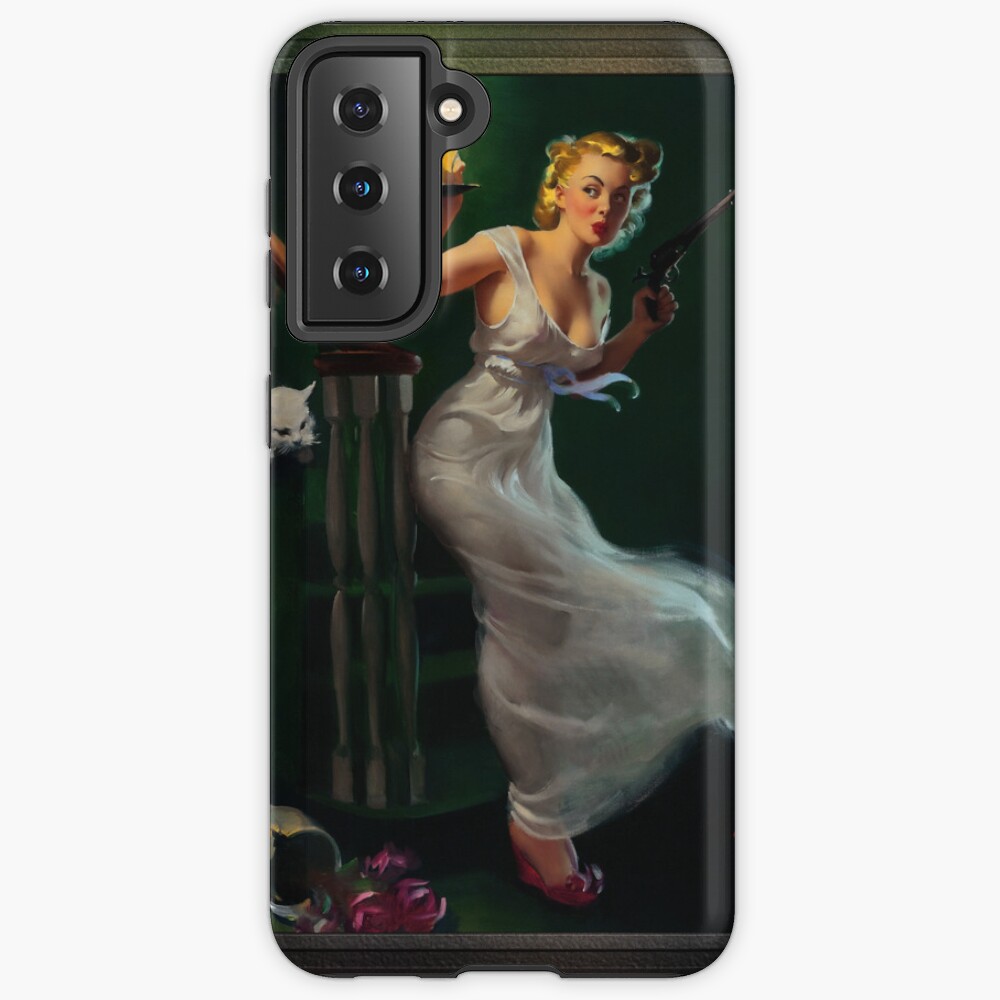
Table of Contents
Sugettu principale
At the forefront of “Cerchendu Trouble” is a young woman poised on a staircase in an act that speaks to both vulnerability and determination. Her appearance is meticulously crafted, with every detail—from her flowing white nightgown to her disheveled blonde hair—imbuing the scene with a sense of dynamism. U so vestitu, a simple yet elegant slip, is slightly transparent, enhancing the subtle sensuality of the artwork. Her body is captured in mid-motion, her right leg lifted, as if she is either stepping down or preparing to flee.
Her expression is one of cautious intrigue, with wide eyes and an upturned mouth, evoking a mixture of surprise and daring. She holds a lamp in her left hand, the warm light spilling from the glass vessel, contrasting with the shadowy background. In a so manu diritta, she grips a small revolver, held in a defensive yet somewhat unsure manner. The juxtaposition of the lamp, which symbolizes safety, and the gun, an instrument of possible danger, creates an atmosphere of tension and uncertainty.
Objects and Symbolism
The objects within the scene serve as symbolic elements that amplify the mood of the painting. The small white cat on the floor beneath the woman adds an element of domesticity, but its casual placement by the stairs also contrasts with the woman’s apparent alertness. This animal might suggest innocence or the possibility of an unnoticed danger. The gun, da l'altra parte, introduces an element of suspense, signaling that the woman might be reacting to an unseen threat.
The candlelight is another important object in the piece. It not only illuminates her face and casts dramatic shadows across her form, but it also serves as a metaphor for vulnerability and fragility. The flame, burning brightly in a world of dark shadows, offers both literal and figurative light in a tense moment of uncertainty.
The presence of the staircase itself is a key architectural detail. It conveys a sense of upward or downward movement, suggesting that the woman may be trapped in her current position or on the verge of making a quick escape. L'ambiente, cloaked in darkness and illuminated only by the soft light of the lamp, adds to the mysterious nature of the scene. The walls, dark and textured, amplify the sense of being confined or isolated.
Terrain and Environment
The terrain in “Cerchendu Trouble” is minimal but significant. The staircase and the hallway surrounding the woman suggest an interior domestic setting, perhaps an old mansion or a cozy home. U bughju, rich tones of the woodwork, along with the shadows that seem to envelop the space, contribute to the overall mysterious and somewhat foreboding mood of the scene. The shadows in the background hint at an unseen world outside the woman’s immediate area, adding an element of suspense.
The way the light spills from the lantern in her hand creates pools of bright clarity in an otherwise dark environment, guiding the viewer’s eye directly to the woman’s form. The shadows that cling to the walls add depth to the scene, creating a sense of three-dimensionality that draws the viewer into the space. This clever manipulation of light and dark allows Elvgren to weave tension into the narrative of the painting.
Stile è tecnica
Gil Elvgren’s style in “Cerchendu Trouble” is rooted in the traditional techniques of realism, yet it is infused with an unmistakable sense of glamour and drama typical of mid-century pin-up art. His precise attention to detail, particularly in his rendering of the woman’s figure, emphasizes the sensual curves of her body, which was characteristic of his pin-up portraits. Tuttavia, beyond mere physical beauty, Elvgren’s ability to capture a moment of emotional tension—one in which the woman might be confronted by danger or intrigue—elevates the work from a simple portrait into a narrative.
The rendering of light and shadow is masterful, with Elvgren’s use of chiaroscuro enhancing the dramatic impact of the scene. The way he plays with the contrasting elements of light from the lamp and the surrounding shadows helps reinforce the suspenseful and mysterious mood of the piece. The texture of the woman’s gown, the soft curls of her hair, and the delicate features of her face demonstrate Elvgren’s technical skill and understanding of human anatomy.
Umore è tema
L'umore di “Cerchendu Trouble” is one of suspense and intrigue, capturing a brief moment of potential danger. The young woman’s startled yet bold posture, combined with the symbolic elements of the gun and lantern, creates a narrative of tension, misteru, and possible trouble ahead. Her wide-eyed expression suggests that she may be confronted by an unseen foe, while her gun and poised stance indicate that she is ready to face whatever challenges arise. There is a sense of vulnerability in her posture—yet also a sense of control, as she seems ready to act in an uncertain situation.
The theme of this painting revolves around the concept of danger and the unexpected. The woman’s appearance in a vulnerable setting—her nightgown, her home—suggests a break from the ordinary into the realm of the unknown. The combination of innocence and threat, encapsulated by the woman’s attire and her readiness with a firearm, brings to mind the themes of adventure and bravery that were often woven into the tales of the era.
Elvgren’s use of color, cumpusizioni, and light enhances the sense of drama, while the intimate setting adds an underlying layer of personal tension to the work. The atmosphere is thick with anticipation, as if the viewer is witnessing the very moment before a crucial decision is made, making it a powerful narrative piece.
Cunclusione
In cunclusioni, “Cerchendu Trouble” is a compelling work that captures the essence of mid-century American pin-up art, while also delving deeper into a moment of personal drama and suspense. Through his technical skill and careful composition, Gil Elvgren is able to transport the viewer into a world where beauty, periculu, and mystery intersect in a captivating and timeless narrative.
Questa hè una ripruduzzione di l'antichi maestri d'arte digitale rimasterizzata di una maghjina di duminiu publicu chì hè dispunibule cum'è a stampa su tela in linea.
Biografia di l'artista derivata da Wikipedia.org
Gillette A. Elvgren hè natu in St. Paulu, Minnesota, è hà assistitu à u liceu universitariu. Dopu a graduazione, hà cuminciatu à studià l'arti à l'Istitutu di l'Arti di Minneapolis.
Dopu si trasfirìu in Chicago per studià à l'Accademia Americana di l'Arte, è graduatu da l'Accademia durante a grande depressione, à l'età di vinti-dui anni.
Dopu a graduazione, Elvgren s'unì à a stalla di artisti in Stevens è Gross, L'agenza di publicità più prestigiosa di Chicago, è divintò un prutettu di l'artista Haddon Sundblom.
In 1937, Gil hà cuminciatu à dipinge pin-up di calendariu per Louis F. Dow, unu di i principali cumpagnii edituri americani, duranti quali tempu hà creatu circa 60 pin-up girl travaglia nantu à tela 22 "× 28" è li distingue da una firma stampata.
Parechji di i so pin-ups sò stati riprodutti cum'è arte di u nasu nantu à l'aviò militari durante a Siconda Guerra Munniali; è era circa stu tempu in 1944, chì Elvgren hè statu avvicinatu da a Brown and Bigelow Publishing Company; una ditta chì domina sempre u campu in a produzzione di calendari, spicialità di publicità è merchandise promozionale.
L'annu dopu da 1945 finu à 1972, Elvgren era assuciatu cù u Brown & Editrice Bigelow, è hà cuminciatu à travaglià cun 24 inch by 30 tele di centimetri, un formatu chì ellu aduprà per u prossimu 30 anni, è hà firmatu u so travagliu in cursiva.
Elvgren hè statu un successu cummerciale. Hà campatu in parechji lochi, è era attivu da l'anni 1930 à l'anni 1970. In 1951 cuminciò a pittura in un studio in casa soia, poi in Winnetka, Illinois, usendu un assistente per stabilisce l'illuminazione, custruite puntelli è scene, set di fotografia, è preparanu i so vernici.
I so clienti includenu cumpagnie famose cum'è Brown è Bigelow, Coca, General Electric è Sealy Mattress Company, per citarne uni pochi. In più, duranti l'anni 1940 è 1950 hà illustratu storie per una mansa di riviste, cum'è The Saturday Evening Post è Good Housekeeping.
Trà i mudelli è e leggende di Hollywood Elvgren hà pittatu durante a so carriera include Myrna Hansen, Donna Reed, Barbara Hale, Arlene Dahl, Lola Albright è Kim Novak.