

Leter du etter problemer
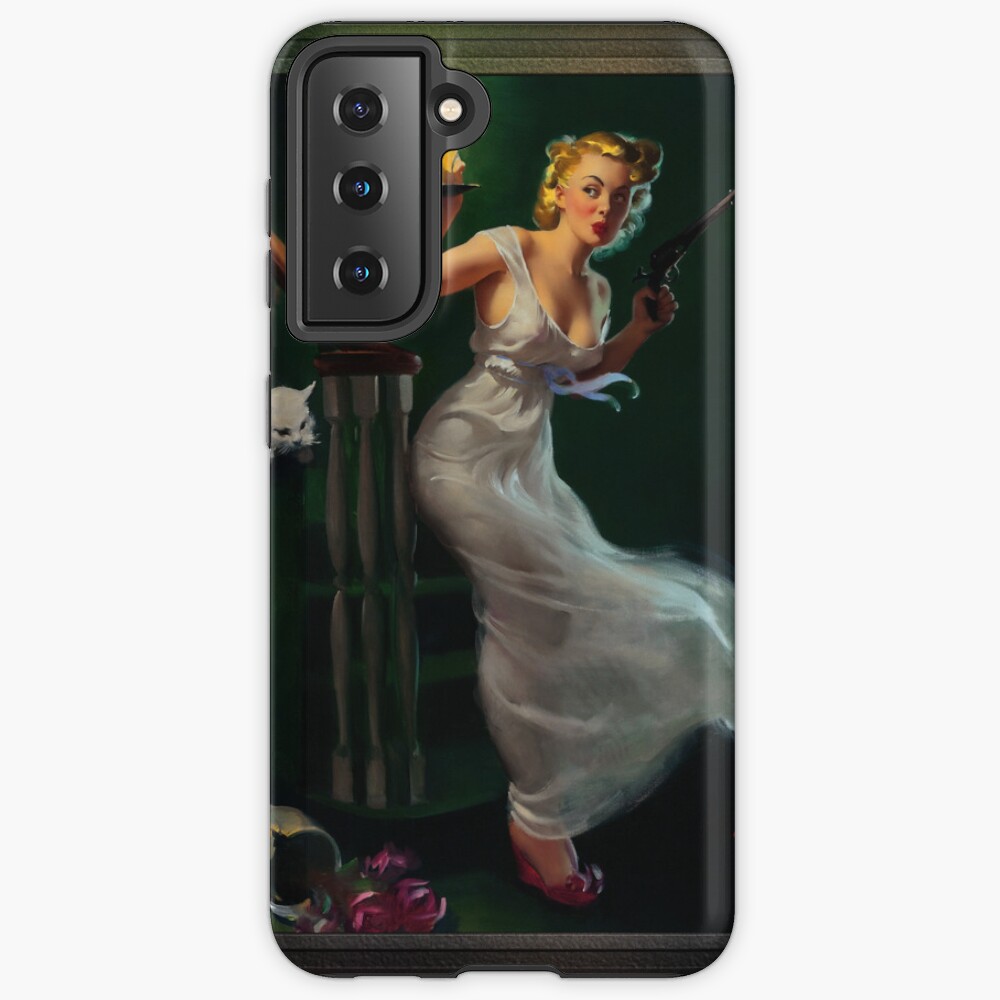
“Leter du etter problemer” er et ikonisk kunstverk laget av den anerkjente amerikanske maleren Gil Elvgren. Kjent for sin mestring i å skildre den kvinnelige formen med en blanding av sjarm og vidd, Elvgrens verk legemliggjør ofte en distinkt stil som samtidig er nostalgisk, leken, og svært stemningsfulle. Født i 1914 og går bort i 1980, Elvgrens arv som en fremtredende pin-up artist er fortsatt solid forankret i den amerikanske kunstscenen. Dette spesielle stykket eksemplifiserer talentet hans for å fange den tidløse lokket til pin-up-kunst fra midten av 1900-tallet mens han forteller en historie full av spenning og intriger.
Innholdsfortegnelse
Hovedfag
I spissen for “Leter du etter problemer” is a young woman poised on a staircase in an act that speaks to both vulnerability and determination. Her appearance is meticulously crafted, with every detail—from her flowing white nightgown to her disheveled blonde hair—imbuing the scene with a sense of dynamism. Antrekket hennes, a simple yet elegant slip, is slightly transparent, enhancing the subtle sensuality of the artwork. Her body is captured in mid-motion, her right leg lifted, as if she is either stepping down or preparing to flee.
Her expression is one of cautious intrigue, with wide eyes and an upturned mouth, evoking a mixture of surprise and daring. She holds a lamp in her left hand, the warm light spilling from the glass vessel, contrasting with the shadowy background. I høyre hånd, she grips a small revolver, held in a defensive yet somewhat unsure manner. The juxtaposition of the lamp, which symbolizes safety, and the gun, an instrument of possible danger, creates an atmosphere of tension and uncertainty.
Objekter og symbolikk
The objects within the scene serve as symbolic elements that amplify the mood of the painting. The small white cat on the floor beneath the woman adds an element of domesticity, but its casual placement by the stairs also contrasts with the woman’s apparent alertness. This animal might suggest innocence or the possibility of an unnoticed danger. The gun, på den andre siden, introduces an element of suspense, signaling that the woman might be reacting to an unseen threat.
The candlelight is another important object in the piece. It not only illuminates her face and casts dramatic shadows across her form, but it also serves as a metaphor for vulnerability and fragility. The flame, burning brightly in a world of dark shadows, offers both literal and figurative light in a tense moment of uncertainty.
The presence of the staircase itself is a key architectural detail. It conveys a sense of upward or downward movement, suggesting that the woman may be trapped in her current position or on the verge of making a quick escape. The environment, cloaked in darkness and illuminated only by the soft light of the lamp, adds to the mysterious nature of the scene. The walls, dark and textured, amplify the sense of being confined or isolated.
Terreng og miljø
Terrenget i “Leter du etter problemer” is minimal but significant. The staircase and the hallway surrounding the woman suggest an interior domestic setting, perhaps an old mansion or a cozy home. Det mørke, rich tones of the woodwork, along with the shadows that seem to envelop the space, contribute to the overall mysterious and somewhat foreboding mood of the scene. The shadows in the background hint at an unseen world outside the woman’s immediate area, adding an element of suspense.
The way the light spills from the lantern in her hand creates pools of bright clarity in an otherwise dark environment, guiding the viewer’s eye directly to the woman’s form. The shadows that cling to the walls add depth to the scene, creating a sense of three-dimensionality that draws the viewer into the space. This clever manipulation of light and dark allows Elvgren to weave tension into the narrative of the painting.
Stil og teknikk
Gil Elvgren’s style in “Leter du etter problemer” is rooted in the traditional techniques of realism, yet it is infused with an unmistakable sense of glamour and drama typical of mid-century pin-up art. His precise attention to detail, particularly in his rendering of the woman’s figure, emphasizes the sensual curves of her body, which was characteristic of his pin-up portraits. derimot, beyond mere physical beauty, Elvgren’s ability to capture a moment of emotional tension—one in which the woman might be confronted by danger or intrigue—elevates the work from a simple portrait into a narrative.
The rendering of light and shadow is masterful, with Elvgren’s use of chiaroscuro enhancing the dramatic impact of the scene. The way he plays with the contrasting elements of light from the lamp and the surrounding shadows helps reinforce the suspenseful and mysterious mood of the piece. The texture of the woman’s gown, the soft curls of her hair, and the delicate features of her face demonstrate Elvgren’s technical skill and understanding of human anatomy.
Stemning og tema
Stemningen av “Leter du etter problemer” is one of suspense and intrigue, capturing a brief moment of potential danger. The young woman’s startled yet bold posture, combined with the symbolic elements of the gun and lantern, creates a narrative of tension, mysterium, and possible trouble ahead. Her wide-eyed expression suggests that she may be confronted by an unseen foe, while her gun and poised stance indicate that she is ready to face whatever challenges arise. There is a sense of vulnerability in her posture—yet also a sense of control, as she seems ready to act in an uncertain situation.
The theme of this painting revolves around the concept of danger and the unexpected. The woman’s appearance in a vulnerable setting—her nightgown, her home—suggests a break from the ordinary into the realm of the unknown. The combination of innocence and threat, encapsulated by the woman’s attire and her readiness with a firearm, brings to mind the themes of adventure and bravery that were often woven into the tales of the era.
Elvgren’s use of color, Sammensetning, and light enhances the sense of drama, while the intimate setting adds an underlying layer of personal tension to the work. Atmosfæren er tykk av forventning, as if the viewer is witnessing the very moment before a crucial decision is made, making it a powerful narrative piece.
Konklusjon
Avslutningsvis, “Leter du etter problemer” is a compelling work that captures the essence of mid-century American pin-up art, while also delving deeper into a moment of personal drama and suspense. Through his technical skill and careful composition, Gil Elvgren is able to transport the viewer into a world where beauty, fare, and mystery intersect in a captivating and timeless narrative.
Dette er en remastret digital kunst-gamle mesterreproduksjon av et offentlig domenebilde som er tilgjengelig som en lerretstrykk online.
Artistbio avledet fra Wikipedia.org
Gillette A.. Elvgren ble født i St.. Paul, Minnesota, og gikk på University High School. Etter endt utdanning, han begynte å studere kunst ved Minneapolis Institute of Arts.
Senere flyttet han til Chicago for å studere ved American Academy of Art, og ble uteksaminert fra akademiet under den store depresjonen, i en alder av tjue-to.
Etter eksamen ble Elvgren med i kunstnerstallen på Stevens og Gross, Chicagos mest prestisjefylte reklamebyrå, og ble en protégé av kunstneren Haddon Sundblom.
I 1937, Gil begynte å male kalender-pin-ups for Louis F. Dow, et av USAs ledende forlag, i løpet av den tiden han skapte ca. 60 pin-up girl jobber på 22 ″ × 28 ″ lerret og utmerker dem med en trykt signatur.
Mange av pin-upsene hans ble gjengitt som nesekunst på militære fly under andre verdenskrig; og det var rundt denne gangen 1944, at Elvgren ble oppsøkt av Brown and Bigelow Publishing Company; et firma som fremdeles dominerer feltet innen produksjon av kalendere, annonseringsspesialiteter og salgsfremmende varer.
Neste år fra 1945 før 1972, Elvgren var knyttet til Brown & Bigelow forlag, og begynte å jobbe med 24 tomme av 30 tommers lerret, et format som han ville bruke til det neste 30 år, og signerte arbeidet sitt kursivt.
Elvgren var en kommersiell suksess. Han bodde på forskjellige steder, og var aktiv fra 1930 -årene til 1970 -årene. I 1951 han begynte å male i et studio i hjemmet sitt, deretter i Winnetka, Illinois, bruker en assistent til å sette opp belysning, bygge rekvisitter og scener, fotograferingssett, og forberede malingen.
Kundene hans inkluderte kjente selskaper som Brown og Bigelow, Cola, General Electric og Sealy Mattress Company, for å nevne noen. I tillegg, i løpet av 1940- og 1950 -årene illustrerte han historier for en rekke blader, som The Saturday Evening Post og Good Housekeeping.
Blant modellene og Hollywood -legendene som Elvgren malte i løpet av karrieren, inkluderte Myrna Hansen, Donna Reed, Barbara Hale, Arlene Dahl, Lola Albright og Kim Novak.