

Looking For Trouble
“Looking For Trouble” is an iconic artwork created by the renowned American painter Gil Elvgren. Known for his mastery in depicting the female form with a blend of charm and wit, Elvgren’s works often embody a distinct style that is at once nostalgic, playful, and highly evocative. Född i 1914 och går bort i 1980, Elvgren’s legacy as a prominent pin-up artist remains firmly entrenched in the American art scene. This particular piece exemplifies his talent for capturing the timeless allure of mid-20th-century pin-up art while telling a story full of suspense and intrigue.
Innehållsförteckning
Huvudämne
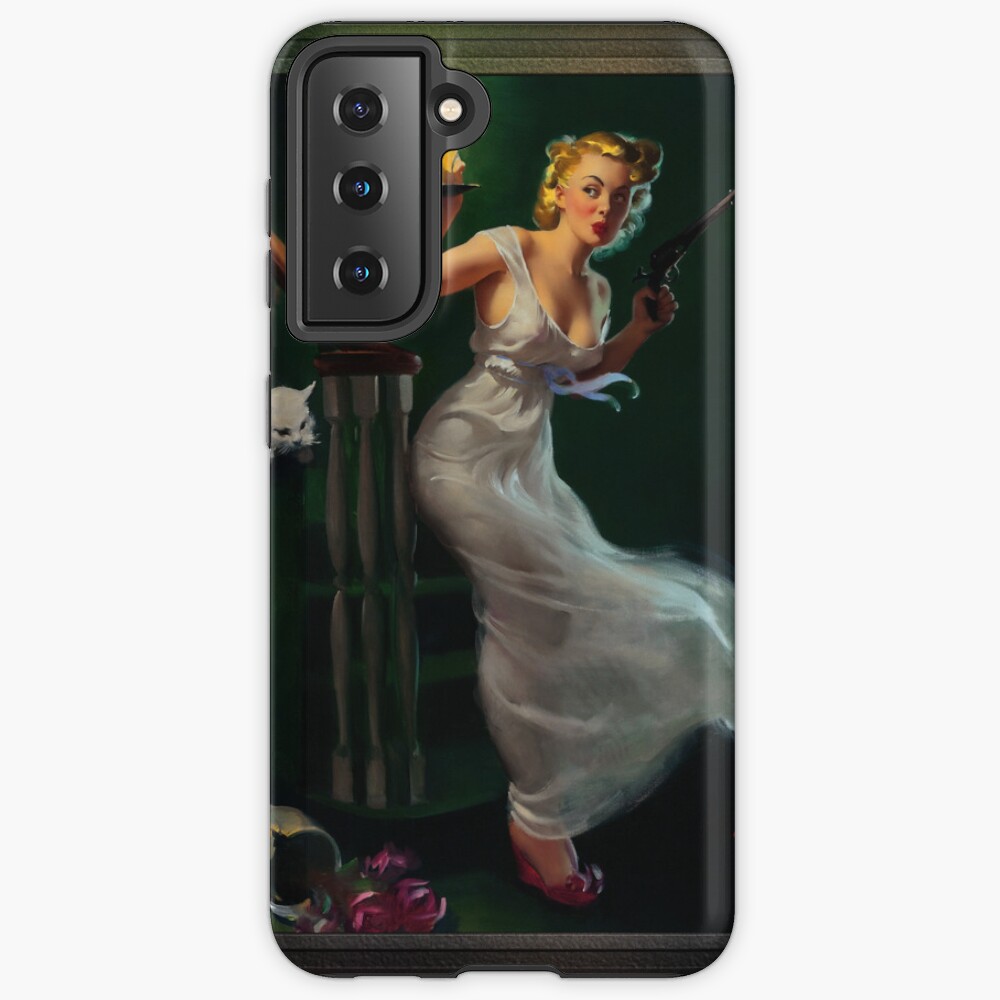
At the forefront of “Looking For Trouble” is a young woman poised on a staircase in an act that speaks to both vulnerability and determination. Her appearance is meticulously crafted, with every detail—from her flowing white nightgown to her disheveled blonde hair—imbuing the scene with a sense of dynamism. Hennes klädsel, a simple yet elegant slip, is slightly transparent, enhancing the subtle sensuality of the artwork. Her body is captured in mid-motion, her right leg lifted, as if she is either stepping down or preparing to flee.
Her expression is one of cautious intrigue, with wide eyes and an upturned mouth, evoking a mixture of surprise and daring. She holds a lamp in her left hand, the warm light spilling from the glass vessel, contrasting with the shadowy background. I hennes högra hand, she grips a small revolver, held in a defensive yet somewhat unsure manner. The juxtaposition of the lamp, which symbolizes safety, and the gun, an instrument of possible danger, creates an atmosphere of tension and uncertainty.
Föremål och symbolik
The objects within the scene serve as symbolic elements that amplify the mood of the painting. The small white cat on the floor beneath the woman adds an element of domesticity, but its casual placement by the stairs also contrasts with the woman’s apparent alertness. This animal might suggest innocence or the possibility of an unnoticed danger. The gun, å andra sidan, introduces an element of suspense, signaling that the woman might be reacting to an unseen threat.
The candlelight is another important object in the piece. It not only illuminates her face and casts dramatic shadows across her form, but it also serves as a metaphor for vulnerability and fragility. The flame, burning brightly in a world of dark shadows, offers both literal and figurative light in a tense moment of uncertainty.
The presence of the staircase itself is a key architectural detail. It conveys a sense of upward or downward movement, suggesting that the woman may be trapped in her current position or on the verge of making a quick escape. Miljön, cloaked in darkness and illuminated only by the soft light of the lamp, adds to the mysterious nature of the scene. The walls, dark and textured, amplify the sense of being confined or isolated.
Terräng och miljö
Terrängen i “Looking For Trouble” is minimal but significant. The staircase and the hallway surrounding the woman suggest an interior domestic setting, perhaps an old mansion or a cozy home. Det mörka, rich tones of the woodwork, along with the shadows that seem to envelop the space, contribute to the overall mysterious and somewhat foreboding mood of the scene. The shadows in the background hint at an unseen world outside the woman’s immediate area, adding an element of suspense.
The way the light spills from the lantern in her hand creates pools of bright clarity in an otherwise dark environment, guiding the viewer’s eye directly to the woman’s form. The shadows that cling to the walls add depth to the scene, creating a sense of three-dimensionality that draws the viewer into the space. This clever manipulation of light and dark allows Elvgren to weave tension into the narrative of the painting.
Stil och teknik
Gil Elvgren’s style in “Looking For Trouble” is rooted in the traditional techniques of realism, yet it is infused with an unmistakable sense of glamour and drama typical of mid-century pin-up art. His precise attention to detail, particularly in his rendering of the woman’s figure, emphasizes the sensual curves of her body, which was characteristic of his pin-up portraits. i alla fall, beyond mere physical beauty, Elvgren’s ability to capture a moment of emotional tension—one in which the woman might be confronted by danger or intrigue—elevates the work from a simple portrait into a narrative.
The rendering of light and shadow is masterful, with Elvgren’s use of chiaroscuro enhancing the dramatic impact of the scene. The way he plays with the contrasting elements of light from the lamp and the surrounding shadows helps reinforce the suspenseful and mysterious mood of the piece. The texture of the woman’s gown, the soft curls of her hair, and the delicate features of her face demonstrate Elvgren’s technical skill and understanding of human anatomy.
Humör och tema
Stämningen av “Looking For Trouble” is one of suspense and intrigue, capturing a brief moment of potential danger. The young woman’s startled yet bold posture, combined with the symbolic elements of the gun and lantern, creates a narrative of tension, mysterium, and possible trouble ahead. Her wide-eyed expression suggests that she may be confronted by an unseen foe, while her gun and poised stance indicate that she is ready to face whatever challenges arise. There is a sense of vulnerability in her posture—yet also a sense of control, as she seems ready to act in an uncertain situation.
The theme of this painting revolves around the concept of danger and the unexpected. The woman’s appearance in a vulnerable setting—her nightgown, her home—suggests a break from the ordinary into the realm of the unknown. The combination of innocence and threat, encapsulated by the woman’s attire and her readiness with a firearm, brings to mind the themes of adventure and bravery that were often woven into the tales of the era.
Elvgren’s use of color, sammansättning, and light enhances the sense of drama, while the intimate setting adds an underlying layer of personal tension to the work. Atmosfären är tjock av förväntan, as if the viewer is witnessing the very moment before a crucial decision is made, making it a powerful narrative piece.
Slutsats
Sammanfattningsvis, “Looking For Trouble” is a compelling work that captures the essence of mid-century American pin-up art, while also delving deeper into a moment of personal drama and suspense. Through his technical skill and careful composition, Gil Elvgren is able to transport the viewer into a world where beauty, fara, and mystery intersect in a captivating and timeless narrative.
Detta är en remastrad digital konst-gamla mästare-reproduktion av en offentlig egendomsbild som är tillgänglig som en canvastavla online.
Artist Bio härledd från Wikipedia.org
Gillette A.. Elvgren föddes i St.. Paul, Minnesota, och gick på University High School. Efter studenten, han började studera konst vid Minneapolis Institute of Arts.
Senare flyttade han till Chicago för att studera vid American Academy of Art, och tog examen från akademin under den stora depressionen, vid 22 års ålder.
Efter examen gick Elvgren med i konstnärens stall i Stevens och Gross, Chicagos mest prestigefyllda reklambyrå, och blev en protegé av konstnären Haddon Sundblom.
I 1937, Gil började måla pin-ups i kalendern för Louis F. Dow, ett av USA: s ledande förlag, under vilken tid han skapade ungefär 60 pin-up girl arbetar på 22 ″ × 28 ″ duk och utmärkte dem med en tryckt signatur.
Många av hans pin-ups reproducerades som näskonst på militära flygplan under andra världskriget; och det var vid den här tiden 1944, att Elvgren kontaktades av Brown and Bigelow Publishing Company; ett företag som fortfarande dominerar fältet när det gäller att ta fram kalendrar, reklamspecialiteter och reklamartiklar.
Nästa år från 1945 fram tills 1972, Elvgren var associerad med Brown & Bigelow förlag, och började arbeta med 24 tum förbi 30 tum dukar, ett format som han skulle använda för nästa 30 år, och undertecknade sitt arbete i kursiv.
Elvgren var en kommersiell framgång. Han bodde på olika platser, och var aktiv från 1930-talet till 1970-talet. I 1951 han började måla i en studio i sitt hem, sedan i Winnetka, Illinois, med hjälp av en assistent för att ställa in belysning, bygg rekvisita och scener, fotograferar uppsättningar, och förbereda sina färger.
Hans kunder inkluderade välkända företag som Brown och Bigelow, Koks, General Electric och Sealy Madrass Company, för att nämna några. Dessutom, under 1940- och 1950 -talen illustrerade han berättelser för en mängd tidskrifter, som The Saturday Evening Post och Good Housekeeping.
Bland modellerna och Hollywoodlegenderna som Elvgren målade under sin karriär inkluderade Myrna Hansen, Donna Reed, Barbara Hale, Arlene Dahl, Lola Albright och Kim Novak.