

Madame Philippe Panon Desbassayns de Richemont and Her Son, Eugène
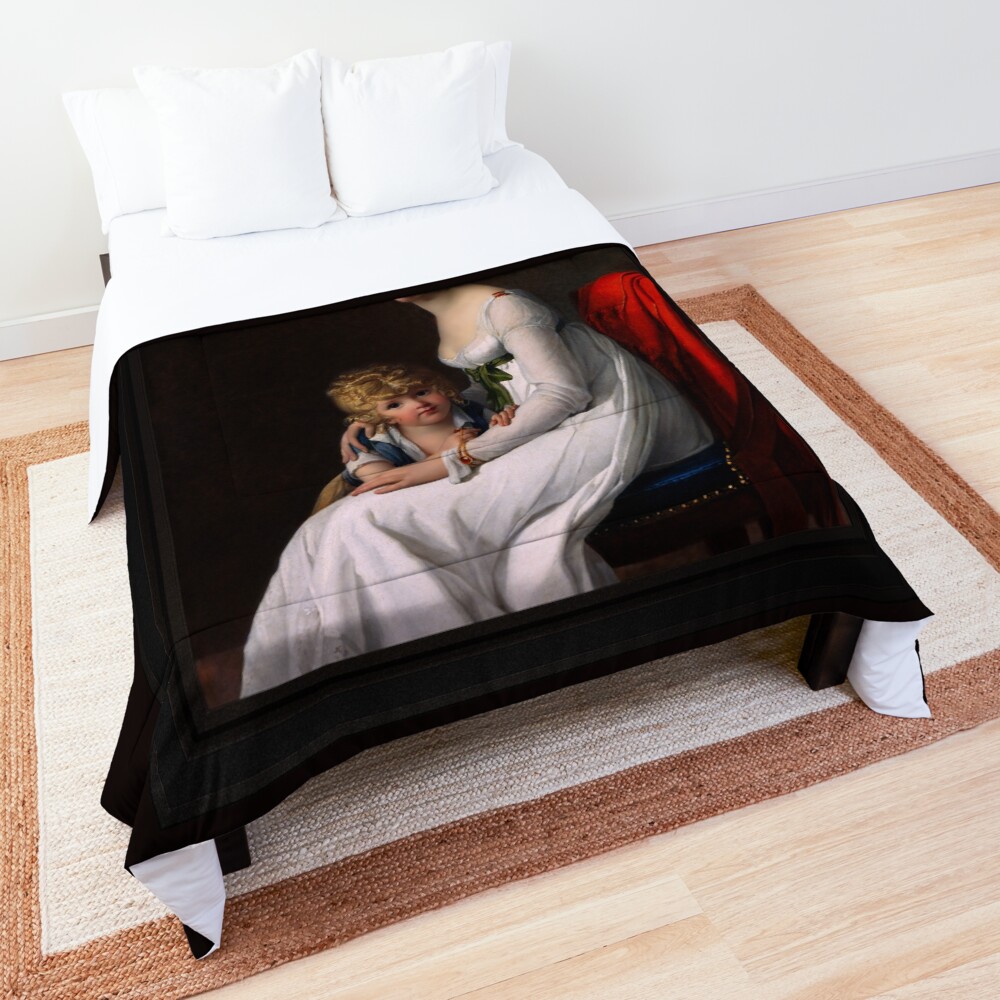
Madame Philippe Panon Desbassayns de Richemont (Jeanne Eglé Mourgue) et son fils, Eugène c1802 probablement par le peintre français Marie-Guillemine Benoist (1768 – 1826); un néoclassique, Historique, Genre and Portrait Painter.
C'est un merveilleux portrait of Jeanne Eglé Mourgue (1778 – 1855) and her sone Eugène (1800 – 1859), the wife of diplomat Philippe Panon Desbassayns de Richemont (1774 – 1840).
She is depicted sitting in a wooden chair with a blue silk seat trimmed with brass buttons, that has a shawl draped over the back rest.

She is wearing a long white dress that has two red gemstones on the shoulder, that match the gold braided string bracelet with a round gemstone that she is wearing on her left wrist; and she also has a green sash tied just below her breast line.
She also is wearing a gold head piece attached to the back of her brown folded hair with curls that fall over her forehead and sides of her face and gold loop earrings.
Her son, who is is leaning on her lap has his left hand on her left forearm and is holding in his hand part of her bracelet by another gemstone; and he is wearing a white-bluish shirt, blue vest, and gold tone shorts that complement his blonde colored hair.
Il s'agit d'une reproduction de maîtres anciens d'art numérique remasterisée d'une image du domaine public qui est disponible sous forme d'impression sur toile en ligne.
Informations ci-dessous dérivées de Wikipedia.org
Marie began her artistic training under the French Portrait Painter Élisabeth Vigée Le Brun (1755 – 1842), à l'âge de 13; puis 5 des années plus tard dans 1786, along with her sister Marie-Élisabeth Laville-Leroux (1770 – 1826), began studying with the French Painter Jacques-Louis David (1748 – 1825).
She began exhibiting her artwork in 1791 at the Paris Salon with the mythological inspired piece Psyché faisant ses adieux à sa famille; et 9 years later at the Salon exhibited Portrait d’une Négresse (qui dans 2019 a été rebaptisé Portrait de Madeleine), qui est devenu un symbole de l’émancipation des femmes et des droits des peuples noirs; car l'esclavage avait été aboli en 1794.
Dans 1803 Marie a reçu une importante commande pour créer un portrait en pied de Napoléon Buonaparte (1769 – 1821) Premier Consul de France (Premier Consul Français), puis un an plus tard, elle reçoit la Médaille d'Or au Salon de Paris, cela lui a valu de recevoir une allocation gouvernementale; et c'est à cette époque qu'elle ouvre son propre atelier (atelier d'art), dans le but de former les femmes à l'art.