

Frú Philippe Panon Desbassayns de Richemont og sonur hennar, Eugène
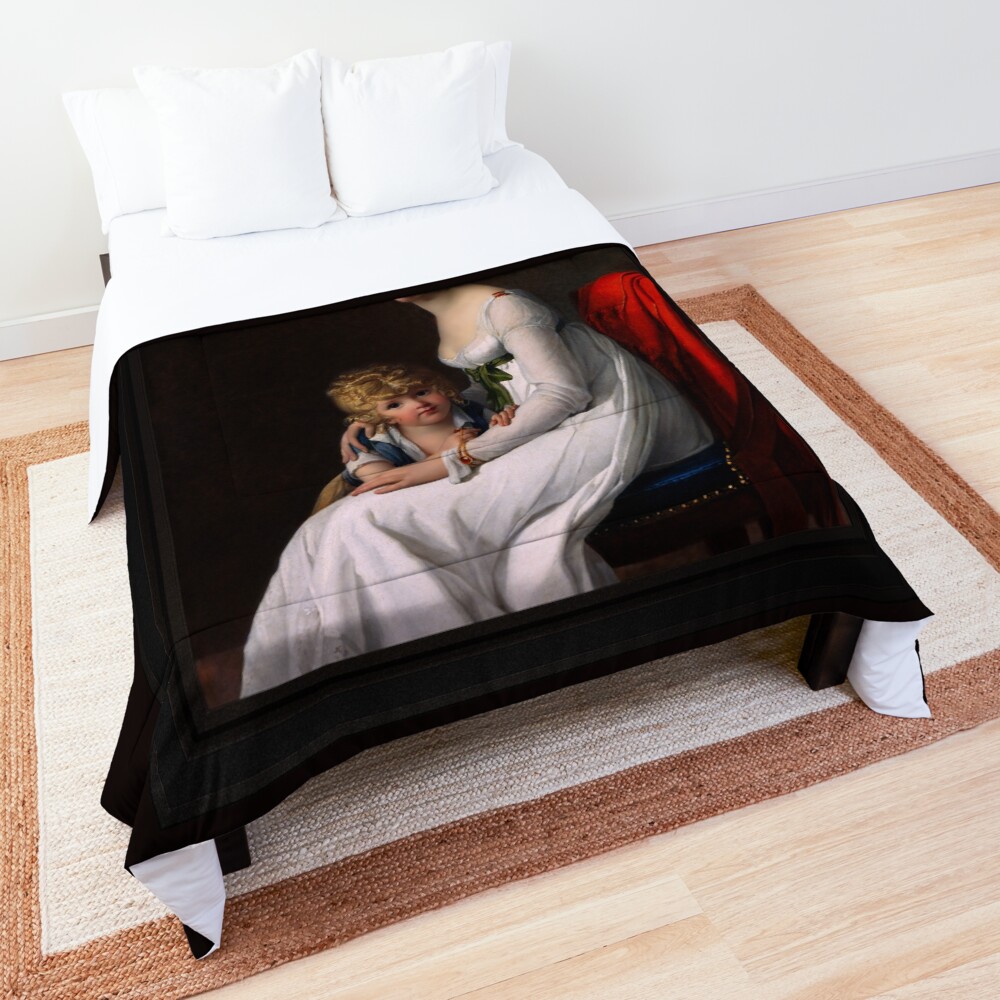
Madame Philippe Panon Desbassayns de Richemont (Jeanne Egle Mourgue) and Her Son, Eugène probably c1802 by French Painter Marie-Guillemine Benoist (1768 – 1826); a Neoclassical, Historical, Genre and Portrait Painter.
Þetta er dásamlegt andlitsmynd of Jeanne Eglé Mourgue (1778 – 1855) and her sone Eugène (1800 – 1859), the wife of diplomat Philippe Panon Desbassayns de Richemont (1774 – 1840).
She is depicted sitting in a wooden chair with a blue silk seat trimmed with brass buttons, that has a shawl draped over the back rest.

She is wearing a long white dress that has two red gemstones on the shoulder, that match the gold braided string bracelet with a round gemstone that she is wearing on her left wrist; and she also has a green sash tied just below her breast line.
Hún er líka með gyllt höfuðstykki sem er fest aftan á brúnt samanbrotið hárið með krullur sem falla yfir ennið og hliðar andlitsins og gyllta lykkjueyrnalokka.
Sonur hennar, hver er sem hallar sér í kjöltu hennar er með vinstri höndina á vinstri framhandleggnum og heldur í hendinni hluta af armbandinu sínu við annan gimstein; og hann er í hvítblárri skyrtu, blátt vesti, og gulltóna stuttbuxur sem bæta við ljósa hárið hans.
Þetta er endurgerð stafræn list af gömlum meistara eftirgerð af mynd í almenningseign sem er fáanleg sem strigaprentun á netinu.
Upplýsingar hér að neðan fengnar af Wikipedia.org
Marie hóf listnám sitt undir franska portrettmálaranum Élisabeth Vigée Le Brun (1755 – 1842), á aldrinum 13; og svo 5 árum síðar í 1786, ásamt systur sinni Marie-Élisabeth Laville-Leroux (1770 – 1826), hóf nám hjá franska málaranum Jacques-Louis David (1748 – 1825).
Hún byrjaði að sýna listaverk sín í 1791 at the Paris Salon with the mythological inspired piece Psyché faisant ses adieux à sa famille; og 9 years later at the Salon exhibited Portrait d’une Négresse (which in 2019 was renamed Portrait de Madeleine), which became a symbol of women’s emancipation and black peoples rights; as slavery had been abolished in 1794.
Í 1803 Marie received an important commission to create a full length portrait of Napoleone Buonaparte (1769 – 1821) First French Consul (Premier Consul Français), then a year later she was awarded the Gold Medal at the Paris Salon, that led to her receiving a governmental allowance; and it was during this time that she opened her own atelier (art studio), for the purpose of training women in art.