

Mademoiselle de Lancey c1876
Mademoiselle de Lancey c1876 is an exquisite portrait painted by the renowned French artist Carolus-Duran (Charles Auguste Émile Durant – 1837 – 1917). The painting showcases the artist’s mastery of portrait and his ability to capture the essence of 19th-century aristocratic life through his detailed representation of the subject. Duran, celebrated for his precise and lifelike depictions of his sitters, infuses this work with a rich sense of elegance and refinement that transports the viewer to the golden era of French high society.
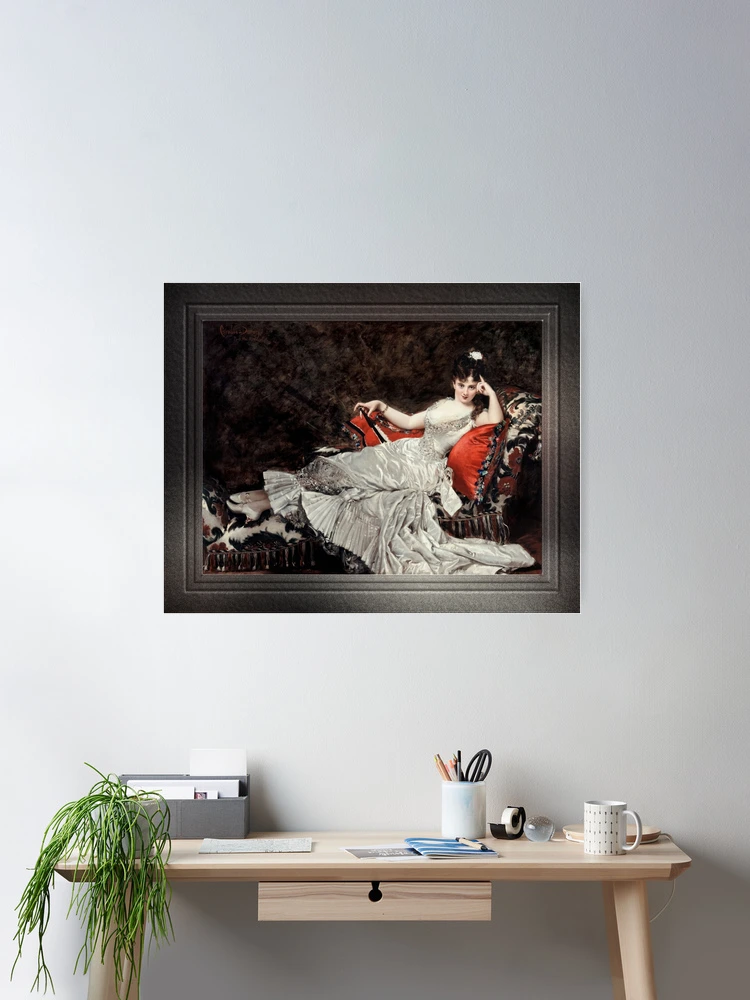
Table des matières
Le sujet
At the center of the composition is Mademoiselle de Lancey, the young woman whose captivating beauty and poised demeanor take center stage. The subject reclines casually on a luxurious, ornate sofa, her posture graceful yet relaxed, embodying the aristocratic confidence typical of women in the late 19th century. Elle regarde directement le spectateur, her expression one of thoughtful contemplation, which suggests a quiet, reserved intelligence. Son regard, coupled with her subtle smile, creates a balance between openness and reserve, inviting the viewer into her world without fully revealing her innermost thoughts.
The woman’s attire is as much a reflection of her social standing as it is a key element of the painting. She is dressed in a sumptuous white gown adorned with delicate lace and shimmering embellishments, a testament to the fashion of the time. La robe, which seems to almost glow against the dark backdrop of the painting, perfectly complements her fair complexion. The layers of fabric, with their intricate folds and delicate texture, are rendered in a way that emphasizes the tactile nature of the materials. The artist has paid careful attention to the fine details, capturing the delicacy of the fabric and the way it clings to the body, showcasing Duran’s exceptional skill in portraying the human form.
Sa coiffure, styled with elegant curls and soft waves, is topped with a small white flower that adds a subtle touch of femininity. The adornment, though small, enhances her graceful appearance, further elevating her aristocratic charm. The overall effect of Mademoiselle de Lancey’s attire and appearance suggests a refined, cultivated woman, fully aware of her status and the expectations placed upon her by society.
Le cadre
The setting in which Mademoiselle de Lancey is portrayed is equally important in defining her character. She reclines on an opulent, plush sofa that is covered in rich, patterned fabric. The cushions are arranged with meticulous care, their colors—deep reds and golds—contrasting beautifully with the whiteness of her gown. The sofa serves as a symbol of wealth and luxury, its intricate patterns and rich textures suggesting the social status that the subject holds.
Derrière elle, the dark background, painted in deep browns and blacks, contrasts with the brightness of her gown, creating a striking visual effect that draws the eye directly to her. The background is not overtly detailed, but rather serves as a backdrop that enhances the focus on the figure. It exudes a sense of timelessness, as though the setting itself is secondary to the woman’s presence. The simplicity of the background emphasizes the subject’s prominence in the composition, drawing the viewer’s attention solely to her and her attire.
Matériaux et techniques
Carolus-Duran’s technique in this portrait is remarkable for its precision and fluidity. The use of oil paints allows the artist to achieve the depth of color and fine detail for which he is known. The rich textures of the fabric, from the silk of the gown to the velvet of the cushions, are portrayed with remarkable accuracy. The play of light and shadow is masterfully handled, particularly in the way it falls across Mademoiselle de Lancey’s face and gown, giving the figure a sense of volume and presence. The folds of the gown, carefully painted to show the weight and texture of the fabric, demonstrate Duran’s ability to depict clothing with exceptional realism.
The brushwork is delicate, with soft transitions between light and shadow that create a sense of three-dimensionality. Le lisse, almost velvety texture of the skin, the sheen of the fabric, and the subtle reflections in the eyes are rendered with exquisite detail. The artist’s handling of light—both the highlights on the skin and the soft shadows under the chin—adds to the lifelike quality of the portrait. Duran’s ability to convey the softness of the skin and the detailed textures of the fabric speaks to his exceptional training and his understanding of the materials he was working with.
Ambiance et thème
L'ambiance de “Mademoiselle de Lancey” is one of serene elegance and quiet sophistication. The subject’s calm and contemplative expression, combined with her luxurious surroundings, evokes a sense of aristocratic refinement. Le doux, natural lighting enhances this mood, adding a warmth to the figure and making her appear approachable, despite her aristocratic attire. There is a subtle tension between the subject’s inner world—her contemplation—and the external world of high society, which is represented through her elaborate dress and the opulence of the setting.
The theme of the painting is closely tied to the social realities of 19th-century French aristocracy. It captures the cultural ideals of beauty, grâce, et l'équilibre, embodying the expectations placed upon women of the upper classes during that period. The portrait speaks to the roles women were expected to play—elegant, reserved, and composed—while also hinting at the private world that lay beneath the public exterior. De cette façon, the painting subtly reflects the tension between outward appearances and inner lives, a theme that resonates with viewers even today.
Conclusion
Carolus-Duran’s “Mademoiselle de Lancey” (1876) is a masterful example of 19th-century portraiture, showcasing the artist’s skill in capturing both the physical likeness and the emotional depth of his subject. Through meticulous attention to detail, a refined sense of light and shadow, and an elegant composition, Duran succeeds in immortalizing the grace and beauty of Mademoiselle de Lancey. The portrait is not just a depiction of a young woman; it is a reflection of a specific moment in time—an era of elegance, sophistication, and societal expectations. The painting stands as a testament to the skill of its creator and the timeless allure of its subject.
Mademoiselle de Lancey (1851 – 1913) c1876 par le peintre français Carolus-Duran (Charles Auguste Émile Durant – 1837 – 1917); fut l'un des portraitistes les plus renommés de la haute société de la IIIe République française.
Mademoiselle de Lancey est une reproduction de maîtres anciens d'art numérique retouchée d'une image du domaine public.
Artiste Bio de Wikipedia.org
Carolus-Duran était le fils d'un hôtelier. Ses premières leçons de dessin étaient avec un sculpteur local nommé Augustin-Phidias Cadet de Beaupré (1800 – ?) at the Académie de Lille; puis se met à la peinture avec François Souchon,[2] un élève de Jacques Louis David. Il est allé à Paris en 1853, où il a adopté le nom “Carolus-Duran”.
Dans 1859, il fait sa première exposition au Salon. Cette même année, he began attending the Académie Suisse, où il a étudié jusqu'à 1861. L'une de ses premières influences fut le réalisme de Gustave Courbet.
De 1862 à 1866, il a voyagé à Rome et en Espagne, grâce à une bourse accordée par sa ville natale. Pendant ce temps, il s'éloigne du style de Courbet et s'intéresse davantage à Diego Velázquez. De retour en France, il obtient sa première médaille d'or au Salon.
Dans 1867, il est devenu l'un des neuf membres de la “Société Japonaise du Jinglar” (un type de vin); un groupe qui comprenait Henri Fantin-Latour, Félix Bracquemond et Marc-Louis Solon. Ils se retrouvaient une fois par mois à Sèvres pour un dîner “à la Japonaise”.
Il a épousé Pauline Croizette, un pastelliste et miniaturiste qui avait posé pour sa peinture “La dame aux gants” dans 1869.[6] Ils ont eu trois enfants. Leur fille aînée, Marie-Anne, épousa le dramaturge Georges Feydeau.
Après 1870, il se consacre presque entièrement aux portraits. Son succès lui a permis d'ouvrir un atelier boulevard du Montparnasse, où il a également donné des cours de peinture. Il a été nommé chevalier de la Légion d'honneur en 1872; être promu officier en 1878, Commandant en 1889 et Grand Officier en 1900.
Dans 1889 et 1900 il a fait partie des jurys des Expositions Universelles. Dans 1890, il a été l'un des co-fondateurs de la deuxième Société Nationale des Beaux-Arts et il a été élu membre de l'Académie des Beaux-Arts en 1904. L'année suivante, il est nommé directeur de l'Académie française à Rome, un poste qu'il a occupé jusqu'à 1913.
Il fréquentait fréquemment la station de Fréjus, où il possédait une petite villa. Suite à sa mort, le complexe a nommé une place et une plage en son honneur.