

Mademoiselle de Lancey c1876
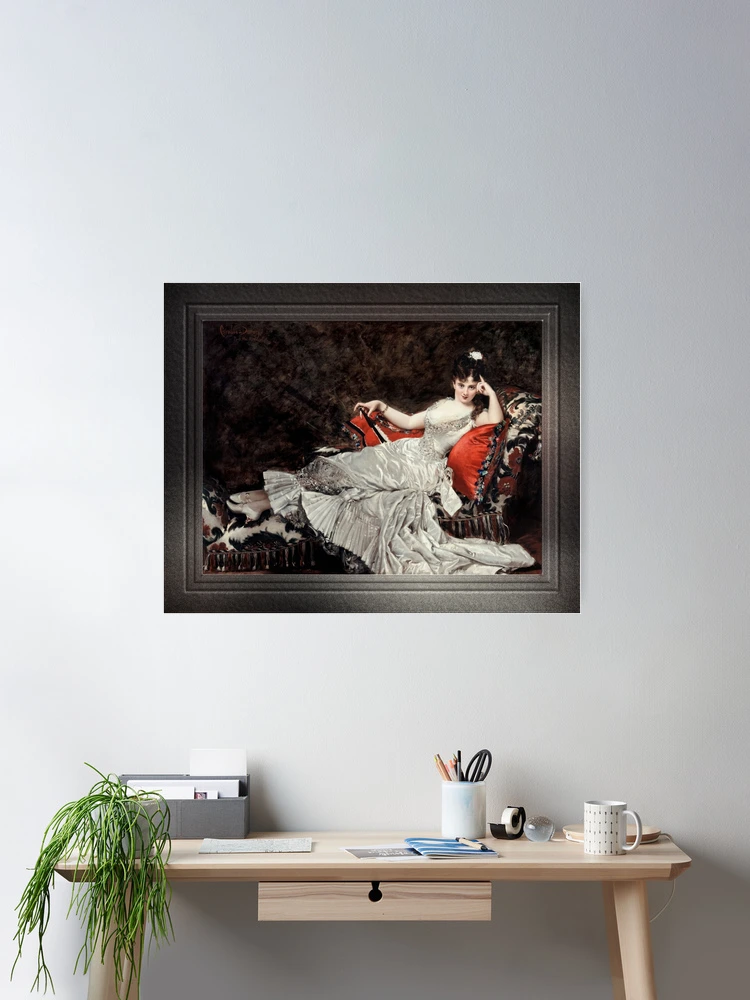
Mademoiselle de Lancey c1876 is an exquisite portrait painted by the renowned French artist Carolus-Duran (Teàrlach Auguste Émile Durant – 1837 – 1917). The painting showcases the artist’s mastery of dealbhan and his ability to capture the essence of 19th-century aristocratic life through his detailed representation of the subject. Duran, celebrated for his precise and lifelike depictions of his sitters, infuses this work with a rich sense of elegance and refinement that transports the viewer to the golden era of French high society.
Clàr-innse
An cuspair
At the center of the composition is Mademoiselle de Lancey, the young woman whose captivating beauty and poised demeanor take center stage. The subject reclines casually on a luxurious, ornate sofa, her posture graceful yet relaxed, embodying the aristocratic confidence typical of women in the late 19th century. Bidh i a’ coimhead gu dìreach air an neach-coimhead, her expression one of thoughtful contemplation, which suggests a quiet, reserved intelligence. A h-gòrach aice, coupled with her subtle smile, creates a balance between openness and reserve, inviting the viewer into her world without fully revealing her innermost thoughts.
The woman’s attire is as much a reflection of her social standing as it is a key element of the painting. She is dressed in a sumptuous white gown adorned with delicate lace and shimmering embellishments, a testament to the fashion of the time. An gùn, which seems to almost glow against the dark backdrop of the painting, perfectly complements her fair complexion. The layers of fabric, with their intricate folds and delicate texture, are rendered in a way that emphasizes the tactile nature of the materials. The artist has paid careful attention to the fine details, capturing the delicacy of the fabric and the way it clings to the body, showcasing Duran’s exceptional skill in portraying the human form.
A stoidhle gruaige, styled with elegant curls and soft waves, is topped with a small white flower that adds a subtle touch of femininity. The adornment, Ged a tha e beag, enhances her graceful appearance, further elevating her aristocratic charm. The overall effect of Mademoiselle de Lancey’s attire and appearance suggests a refined, cultivated woman, fully aware of her status and the expectations placed upon her by society.
An suidheachadh
Tha an suidheachadh anns a bheil Mademoiselle de Lancey air a riochdachadh a cheart cho cudromach ann a bhith a’ mìneachadh a caractar. Bidh i a 'laighe air opulent, sòfa plush a tha còmhdaichte le beairteach, aodach le pàtran. Tha na cuiseanan air an rèiteachadh le cùram faiceallach, an dathan — deargan domhain agus òir — an coimeas gu breagha ri gile a gùn. Tha an sòfa mar shamhla air beairteas agus sòghalachd, tha na pàtrain toinnte agus na h-inneach beairteach aige a’ moladh an inbhe shòisealta a tha aig a’ chuspair.
Air a cùlaibh, an cùl-raon dorcha, air a pheantadh ann an donn is dubh, coimeas ri soilleireachd a ghùn, a 'cruthachadh buaidh lèirsinneach iongantach a tharraingeas an t-sùil gu dìreach thuice. Chan eil an cùl-raon ro mhionaideach, ach an àite sin tha e na chùl-raon a chuireas ri fòcas an fhigear. Tha e a’ nochdadh mothachadh air ùine, as though the setting itself is secondary to the woman’s presence. The simplicity of the background emphasizes the subject’s prominence in the composition, drawing the viewer’s attention solely to her and her attire.
Stuthan agus innleachd
Carolus-Duran’s technique in this portrait is remarkable for its precision and fluidity. The use of oil paints allows the artist to achieve the depth of color and fine detail for which he is known. The rich textures of the fabric, from the silk of the gown to the velvet of the cushions, are portrayed with remarkable accuracy. The play of light and shadow is masterfully handled, particularly in the way it falls across Mademoiselle de Lancey’s face and gown, giving the figure a sense of volume and presence. The folds of the gown, carefully painted to show the weight and texture of the fabric, demonstrate Duran’s ability to depict clothing with exceptional realism.
Tha an obair bhruis fìnealta, with soft transitions between light and shadow that create a sense of three-dimensionality. An rèidh, almost velvety texture of the skin, the sheen of the fabric, and the subtle reflections in the eyes are rendered with exquisite detail. The artist’s handling of light—both the highlights on the skin and the soft shadows under the chin—adds to the lifelike quality of the portrait. Duran’s ability to convey the softness of the skin and the detailed textures of the fabric speaks to his exceptional training and his understanding of the materials he was working with.
Mood agus cuspair
Faireachdainn de “Mademoiselle de Lancey” is one of serene elegance and quiet sophistication. The subject’s calm and contemplative expression, combined with her luxurious surroundings, evokes a sense of aristocratic refinement. Am bog, natural lighting enhances this mood, adding a warmth to the figure and making her appear approachable, despite her aristocratic attire. There is a subtle tension between the subject’s inner world—her contemplation—and the external world of high society, which is represented through her elaborate dress and the opulence of the setting.
The theme of the painting is closely tied to the social realities of 19th-century French aristocracy. It captures the cultural ideals of beauty, gràs, agus posadh, embodying the expectations placed upon women of the upper classes during that period. The portrait speaks to the roles women were expected to play—elegant, reserved, and composed—while also hinting at the private world that lay beneath the public exterior. San dòigh seo, the painting subtly reflects the tension between outward appearances and inner lives, a theme that resonates with viewers even today.
Co-dhùnadh
Carolus-Duran’s “Mademoiselle de Lancey” (1876) is a masterful example of 19th-century portraiture, showcasing the artist’s skill in capturing both the physical likeness and the emotional depth of his subject. Tro aire mhionaideach gu mion-fhiosrachadh, a refined sense of light and shadow, and an elegant composition, Duran succeeds in immortalizing the grace and beauty of Mademoiselle de Lancey. The portrait is not just a depiction of a young woman; it is a reflection of a specific moment in time—an era of elegance, sòghalachd, and societal expectations. The painting stands as a testament to the skill of its creator and the timeless allure of its subject.
Mademoiselle de Lancey (1851 – 1913) c1876 leis a’ pheantair Frangach Carolus-Duran (Teàrlach Auguste Émile Durant – 1837 – 1917); was one of the most renownes portrait painters of high society in the French Third Republic.
Mademoiselle de Lancey is a retouched digital art old masters reproduction of a public domain image.
Neach-ealain Bios bho Wikipedia.org
Carolus-Duran was the son of a hotel owner. His first drawing lessons were with a local sculptor named Augustin-Phidias Cadet de Beaupré (1800 – ?) at the Académie de Lille; then took up painting with François Souchon,[2] a student of Jacques Louis David. He went to Paris in 1853, where he adopted the name “Carolus-Duran”.
Ann an 1859, he had his first exhibition at the Salon. That same year, he began attending the Académie Suisse, where he studied until 1861. One of his early influences was the Realism of Gustave Courbet.
Bho 1862 gu 1866, he travelled to Rome and Spain, thanks to a scholarship granted by his hometown. During that time, he moved away from Courbet’s style and became more interested in Diego Velázquez. Upon returning to France, he was awarded his first gold medal at the Salon.
Ann an 1867, he became one of the nine members of the “Société Japonaise du Jinglar” (a type of wine); a group that included Henri Fantin-Latour, Félix Bracquemond and Marc-Louis Solon. They would meet once a month in Sèvres for a dinner “à la Japonaise”.
He married Pauline Croizette, a pastellist and miniaturist who had posed for his painting “The Lady in Gloves” a-steach 1869.[6] They had three children. Their eldest daughter, Marie-Anne, married the playwright Georges Feydeau.
Às deidh 1870, cha mhòr nach do choisich e e fhèin gu dealbhan. Leig a shoirbheachadh leis stiùidio fhosgladh air an Boulevard du Montparnasse, far an tug e leasanan peantaidh cuideachd. Chaidh ainmeachadh mar Ridire anns an Légion d’honneur ann an 1872; air àrdachadh gu Oifigear ann an 1878, Comanndair a-steach 1889 agus Prìomh Oifigear ann an 1900.
Ann an 1889 agus 1900 rinn e seirbheis air na diùraidhean aig na Expositions Universelles. Ann an 1890, bha e air aon den cho-stèidheadairean air an dàrna Société Nationale des Beaux-Arts agus chaidh a thaghadh mar bhall den Académie des Beaux-Arts ann an 1904. An ath bhliadhna, chaidh a chur an dreuchd mar Stiùiriche air Acadamaidh na Frainge anns an Ròimh, dreuchd a chum e gus 1913.
Bhiodh e tric a’ tadhal air baile-turasachd Fréjus, far an robh baile beag aige. Às deidh a bhàis, thug am baile-turasachd ainm air plaza agus tràigh às a dhèidh.