

Maria Antoniette of Austria
Maria Antoniette na hOstaire c1767 leis an bPéintéir Dúitseach-Sualainnis Martin van Meytens (1695 – 1770); péintéir cúirte agus péintéir an uaisle lena n-áirítear daoine aitheanta mar Marie Antoinette, Maria Theresa na hOstaire, Francis I., Impire Naofa Rómhánach agus a theaghlach chomh maith le baill de Chúirt Ríoga na hOstaire.
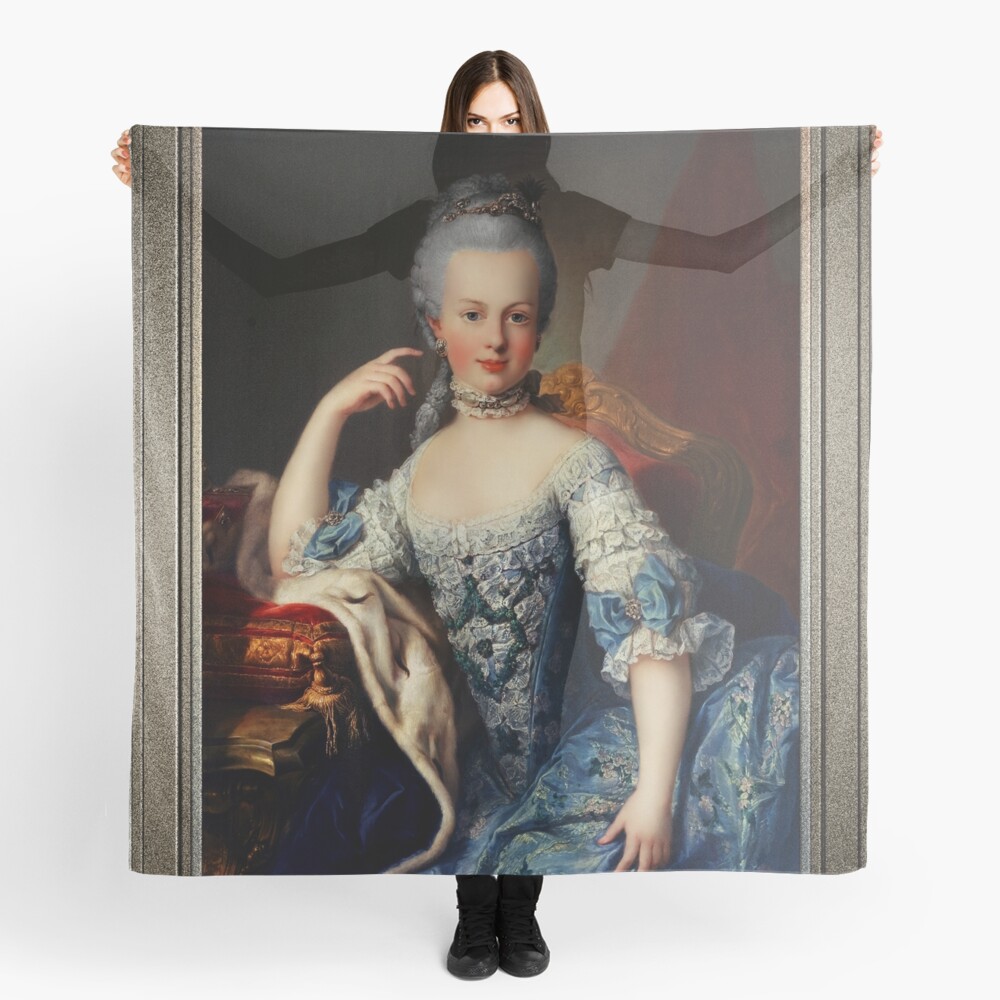
Is álainn í Maria Antoniette na hOstaire portráid de Maria Antoniette óg ag caitheamh gúna gorm bróidnithe bláthanna ina suí i gcathaoir dearg padded, resting her right elbow on a fur lined cobalt blue cape and Royal Red gold accented with tassel pillow that are resting on a table.
Maria Antoniette of Austria is a retouched digital art old masters reproduction of a public domain image that is available for purchase online as a priontáil chanbhás rollta.
Eolas Thíos Ó Wikipedia.org
Martin van Meytens was a Swedish-Austrian painter who painted members of the Royal Court of Austria such as Marie Antoinette, Maria Theresa na hOstaire, Francis I., Holy Roman Emperor, the Emperor’s family and members of the local aristocracy. His painting style inspired many other painters to paint in a similar format.
Martin van Meytens was born and baptised in Stockholm, an tSualainn, son of the painter Martin Meytens the Elder, who had moved around 1677 from The Hague to Sweden. He went early in his career on an extended study trip. He visited London, Paris and Vienna, then he lived and worked for a long time in Italy (An Róimh, Turin). At the beginning he painted little enamel miniature portraits, and he changed to oil painting only around 1730, having settled in Vienna.
Here he became very popular as a portrait painter in the circles of the court and the aristocracy. I 1732 he became a court painter, agus i 1759 the director of the Viennese Academy of Fine Arts. Franz Xaver Messerschmidt was his protégé.
Meytens was one of the most significant Austrian painters of representative Baroque courtly portrait, and through his pupils and followers his influence remained alive and widespread for a long time throughout the whole Empire. His personal virtues, varied interests, erudition and pleasant manners were highly appreciated by his contemporaries.
The Wedding Supper depicts the wedding of Princess Isabella of Parma and Joseph II, Holy Roman Emperor, 5 Deireadh Fómhair 1760, at Hofburg Palace’s Redoutensaele (Redoute Hall). The moment depicted is when the dessert is served, in the middle of the table is a garden made by sugar crust.