

Maureen O'Hara
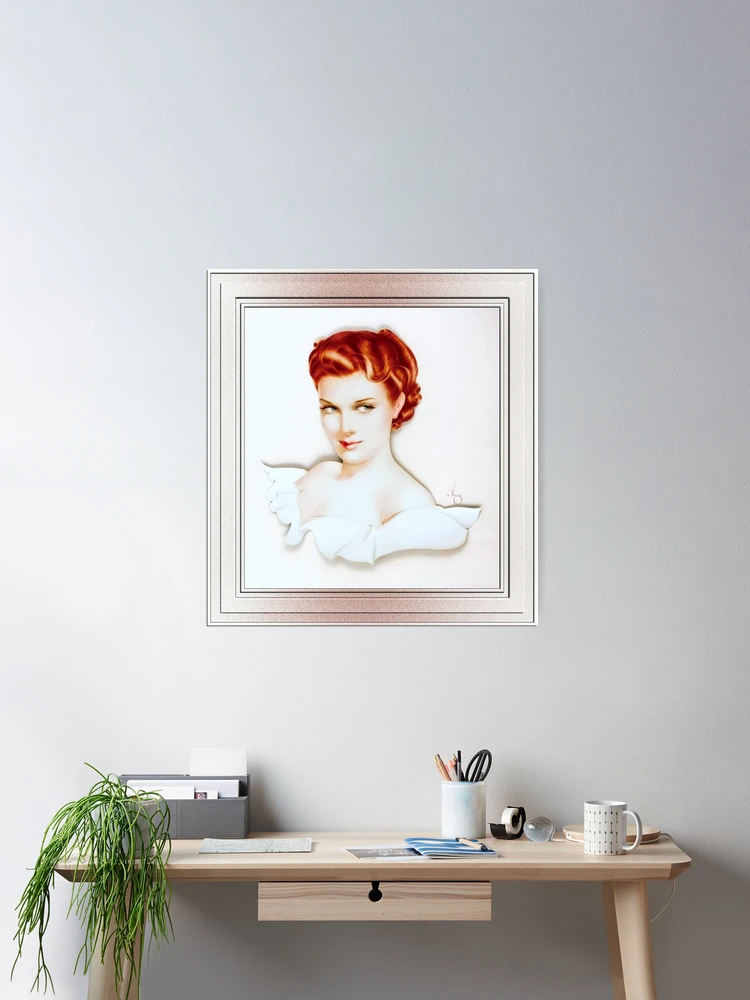
Maureen O'Hara by the celebrated Peruvian artist Tijdelijke afbeelding voor Alberto Vargas, renowned for his captivating and sensual portrayals of women, in het midden van de 20e eeuw. Geboren in 1896 and active for much of the 20th century until his death in 1982, Vargas brought a unique style to pin-up and portrait art that highlighted the idealized form of beauty. Op dit portret, he captures the famous actress Maureen O’Hara in an intimate and glamorous manner, reflecting both her allure and the timeless charm of classic Hollywood.
Vargas’s depiction of Maureen O’Hara is done in a soft, yet highly detailed manner that emphasizes the delicacy of the human form while maintaining a sense of naturalism. The work showcases his characteristic airbrush technique, wherein he utilized smooth, almost ethereal transitions of light and shadow to create an almost dreamlike representation of the subject. The figure of O’Hara is presented in a close-up portrait, her face framed by soft curls of red hair and delicate makeup that highlights her striking features—her sharp eyebrows, volle lippen, and intense gaze. The warm tones of her skin are complemented by the soft, neutral background, which ensures that the viewer’s attention remains solely on her serene expression.
Inhoudsopgave
Het belangrijkste onderwerp: Maureen O'Hara
At the heart of this piece is the famed Irish-American actress Maureen O’Hara, widely recognized for her roles in Hollywood classics such as The Quiet Man en Miracle on 34th Street. Her signature fiery red hair, as portrayed in this artwork, remains one of her most iconic attributes, and Vargas renders it with great care and attention to detail. The hair cascades in soft waves around her face, creating a fluid and almost graceful movement that adds to the dynamic quality of the composition.
Her facial expression is one of quiet confidence, tinged with a slight hint of a smile that suggests mystery and warmth. The gaze that O’Hara directs toward the viewer is compelling and magnetic, further enhancing the portrait’s allure. The artist has captured her in a moment of vulnerability and strength, an eternal quality that speaks to her larger-than-life presence as a film star. O’Hara’s features are depicted in delicate yet exaggerated forms—her cheeks flushed, lips slightly parted, and eyes slightly narrowed—as though she is caught in the midst of a moment, frozen in time.
The Materials and Techniques
Alberto Vargas was known for his exquisite use of airbrushing, a technique he mastered to perfection. His use of smooth gradients and soft transitions between highlights and shadows allows the subject to appear almost luminescent, as if glowing. De achtergrond, rendered in soft, muted tones of beige and light cream, contrasts delicately with the vibrancy of O’Hara’s red hair and the warmer tones of her skin. The fine details of her collarbone and shoulders are emphasized with precise brushstrokes, giving the work a three-dimensional quality that heightens the realism of the subject.
The medium of Vargas’s work often combined airbrush and watercolor, which allowed for the fine detail and soft transitions seen in this portrait. His understanding of color, particularly the warm tones of the skin and the coolness of the background, reflects his mastery of light and shadow. The careful rendering of the fabric of O’Hara’s gown—soft, voluminous ruffles in white—conveys a sense of refinement and elegance. The contrast of her white attire against the beige background further accentuates the richness of her features and the glowing quality of her skin.
Stijl en stemming
Vargas’s style is often associated with the glamour and sensuality of the 1940s and 1950s pin-up art, yet it transcends mere eroticism by focusing on the beauty and elegance of the human form. His figures are often idealized, exuding a sense of grace, verfijning, and feminine strength. In Maureen O'Hara, the artist takes these qualities and applies them to a portrait that is both intimate and reverential, as though capturing a moment of pure beauty.
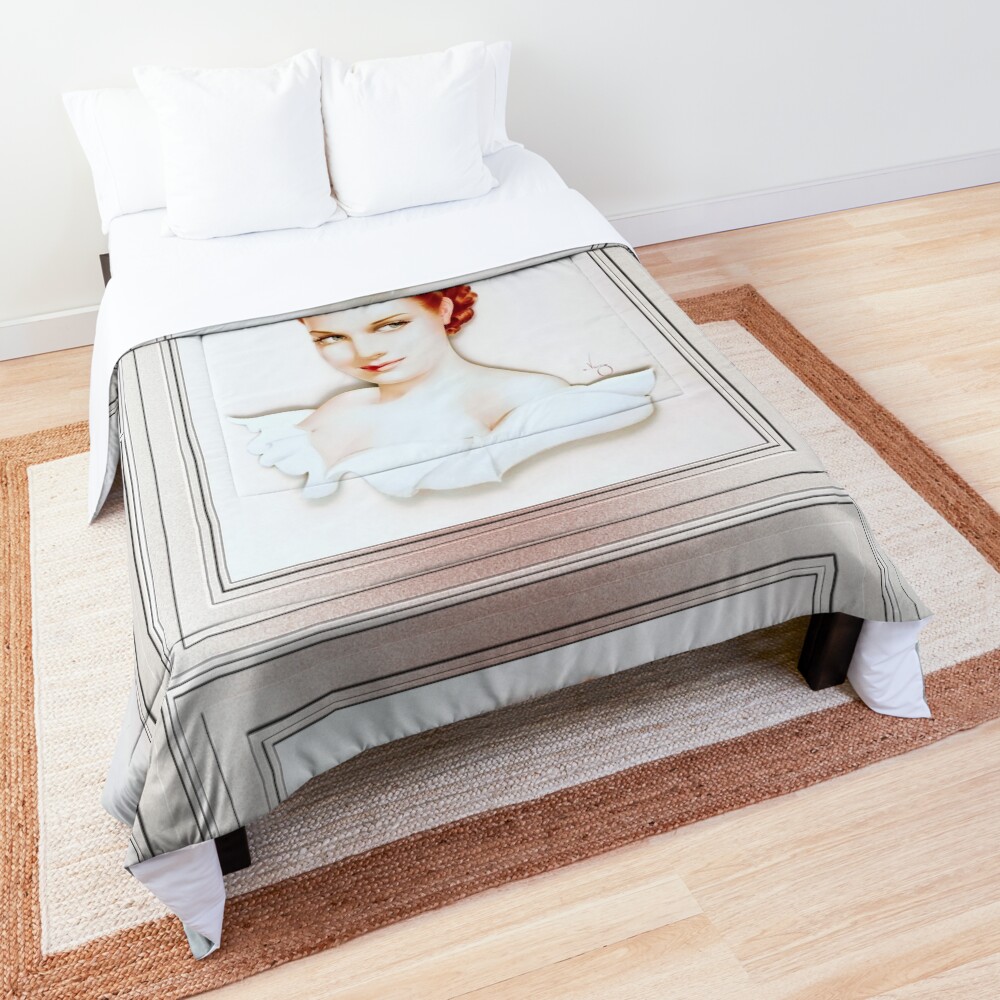
The mood of the artwork is both serene and alluring, striking a balance between tenderness and seduction. De zachte, subtle lighting that Vargas applies to O’Hara’s face lends the portrait an almost ethereal quality, inviting the viewer to not only admire the subject’s external beauty but also to feel a connection with the person portrayed. The calmness of her demeanor contrasts with the underlying sensuality of her appearance, emphasizing the complexity of her persona as both a film star and an icon.
Vargas’s rendering of Maureen O’Hara could be seen as an homage to the actress’s cinematic roles, where she often portrayed strong, spirited characters. The softness of the image, paired with the strength of her gaze, conveys the duality of her on-screen persona—elegant and graceful, yet undeniably powerful.
Overall Theme
The overall theme of the portrait reflects the Hollywood glamor and the Golden Age of cinema. Maureen O’Hara’s timeless beauty is preserved here not just as a movie star, but as an embodiment of the cultural ideal of feminine allure that permeated the mid-20th century. Vargas captures the essence of O’Hara’s star power, making her a muse in his work. The image speaks to the way in which Hollywood icons were immortalized through art, capturing not just their physical appearance but the emotional resonance they carried as symbols of beauty, kracht, en genade.
Conclusie
Alberto Vargas’s Maureen O'Hara is a portrait that transcends the simple act of likeness; it is an exploration of the complex emotions and ideals that the actress represented. The airbrushed delicacy, the soft rendering of her face, and the subtle interplay of light and shadow invite the viewer into a world of vintage glamour. As with many of Vargas’s works, this piece is a celebration of femininity, elegantie, en sensualiteit, capturing a moment in time that forever immortalizes O’Hara’s presence both on and off the screen.
Dit is een geretoucheerde digitale kunst oude meesters reproductie van een afbeelding in het publieke domein die beschikbaar is voor aankoop als een canvas print online.
Bio -kunstenaar
Info hieronder van Wikipedia.org
Geboren in Arequipa, Peru, hij was de zoon van de bekende Peruaanse fotograaf Max T. Vargas. Alberto Vargas verhuisde in 2004 naar de Verenigde Staten 1916 na een studie kunst in Europa, Zürich, en Genève voorafgaand aan de Eerste Wereldoorlog.
Terwijl hij in Europa was, stuitte hij op het Franse tijdschrift La Vie Parisienne, met een omslag van Raphael Kirchner, waarvan hij zei dat het een grote invloed had op zijn werk.
Zijn vroege carrière in New York omvatte werk als kunstenaar voor de Ziegfeld Follies en voor veel Hollywood-studio's. Ziegfeld hing zijn schilderij van Olive Thomas in het theater, en ze werd gezien als een van de eerste Vargas Girls.
Vargas’ meest bekende stuk filmwerk was voor de poster van de 1933 film De zonde van Nora Moran, die een bijna naakte Zita Johann toont in een wanhoopshouding. De poster wordt vaak genoemd als een van de beste filmposters ooit gemaakt.
Hij werd in de jaren veertig algemeen bekend als de maker van iconische pin-ups uit de Tweede Wereldoorlog voor het tijdschrift Esquire, bekend als “Vargas-meisjes.” Tussen 1940 en 1946 Vargas geproduceerd 180 schilderijen voor het tijdschrift.
De neuskunst van veel Amerikaanse en geallieerde vliegtuigen uit de Tweede Wereldoorlog is geïnspireerd en aangepast van deze Esquire-pin-ups, evenals die van George Petty, en andere artiesten.