

Melancholie
Melancholie c1841-42 od italského malíře Francesca Hayeze (1791 – 1882); který byl považován za předního malíře období romantismu v polovině 19. století v Miláně v Itálii. Byl známý svými velkolepými historickými obrazy, politické alegorie a výjimečné jemné portréty.
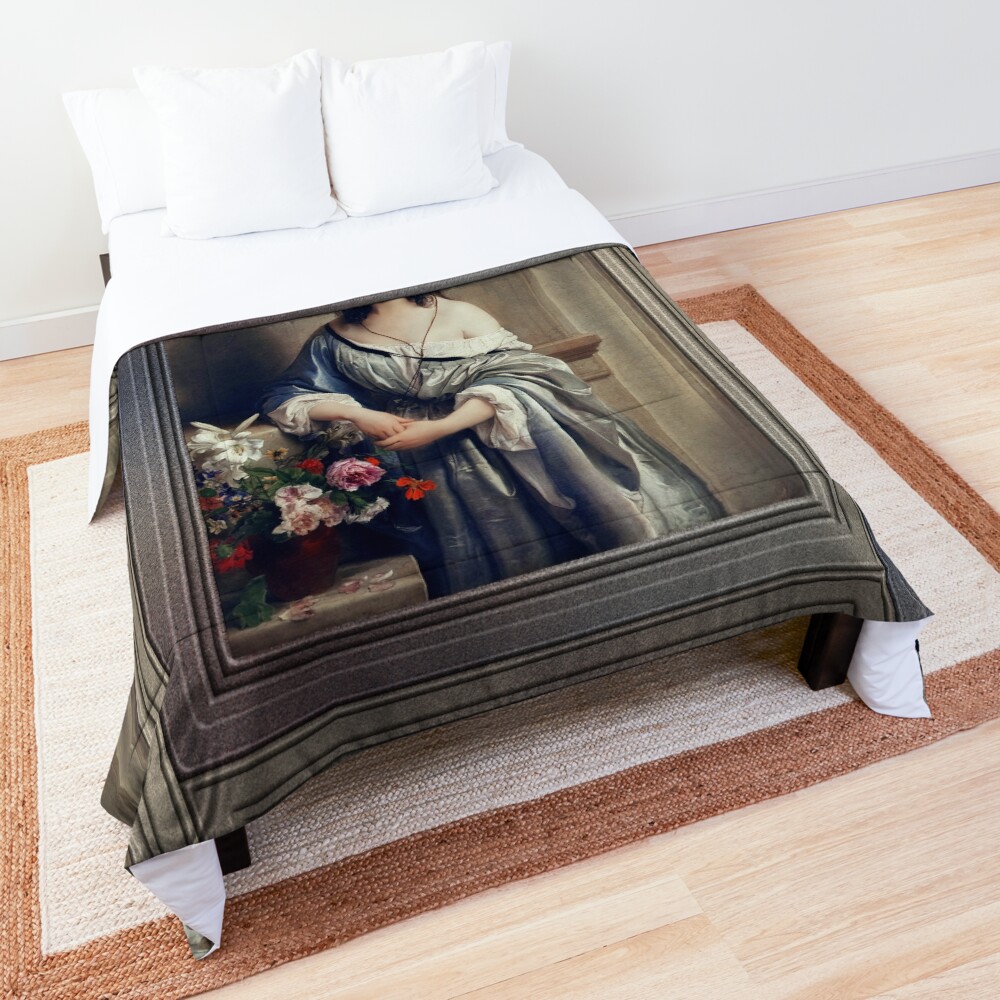
Francesco Hayez, a prominent Italian painter of the Romantic period, captured the emotive power of human expression and drama in his renowned work “Melancholie”. This poignant portrait, vytvořeno kolem 1841-42, epitomizes the Romantic ideals of intense emotional depth, bohatá symbolika, and the exploration of human inner turmoil. The painting features a young woman in a reflective pose, her body angled slightly away from the viewer, yet her gaze directly engages with the observer. Her expression is one of deep contemplation and melancholy, a theme that resonates throughout much of Hayez’s oeuvre.

The primary subject of the artwork is a woman dressed in a luxurious yet simple gown of muted silvery-blue fabric. Her attire is both modest and elegant, indicative of her high social standing but also suggesting a restrained, subdued personality.
The material of her gown is rendered with Hayez’s signature meticulous brushwork, which gives the fabric a soft, almost translucent quality. It reflects light in such a way that one can almost feel its weight and texture. The delicacy of the gown contrasts with the weight of her expression, reinforcing the thematic tension of the painting.
The subject’s hair, dark and glossy, falls in loose waves around her shoulders, framing her face. Her posture is demure yet sorrowful, her hand gently resting on a vase of flowers placed on a table to her side. The inclusion of flowers—likely meant to symbolize transience and the fragility of life—adds a layer of complexity to the emotional narrative.
The flowers themselves are rendered with meticulous detail, a hallmark of Hayez’s technical prowess. They appear lifelike, as if they could be plucked from the canvas at any moment. This detailed rendering contrasts sharply with the somber tone of the subject, creating a sense of fragility in both the floral elements and the human form.
Behind the subject, the setting is an interior space, subtly lit to evoke a sense of isolation and introspection. The light seems to enter from an unseen source, casting soft shadows that envelop the subject, further intensifying the feeling of seclusion. The muted colors of the background, which include soft earth tones and shades of gray, highlight the figure of the woman, dělá z ní ústřední bod kompozice.
The architectural features of the room, particularly the classical columns that frame the space, suggest a timeless quality. This classical influence also evokes a sense of the past and the passage of time, which ties in with the theme of melancholy.
Nálada “Melancholie” is one of introspective sadness. The woman’s expression is not one of overt grief or despair but rather a quiet, contemplative sorrow. Její pohled, though distant, suggests a mind lost in thought—perhaps reflecting on personal loss, unfulfilled desires, or an existential longing. Hayez was deeply interested in the psychological states of his subjects, and this painting showcases his ability to capture the complexity of emotion through subtle facial expressions and body language.
While the subject’s melancholy could be interpreted in various ways, it is important to consider the broader cultural and historical context of the painting. Created during the early 1840s, the work was produced at a time of political and social unrest in Italy.
The Romantic movement, with its emphasis on emotion, individualismus, and rebellion against societal norms, had a profound impact on the intellectual climate of the time. Hayez’s “Melancholie” could be seen as a reflection of the inner turmoil experienced by many individuals living through the tensions of political upheaval, as well as the personal, emotional struggles that often accompanied such periods of uncertainty.
The symbolism within the painting also speaks to broader themes of romanticism. The wistful nature of the subject, combined with the classical elements of the room and the natural motifs of the flowers, suggests an idealization of the past and an awareness of life’s fleeting nature. The woman’s contemplative pose and the stillness of the surrounding environment suggest an acceptance of these fleeting moments, evoking a sense of resignation that is characteristic of many Romantic works.
Hayez’s use of light and shadow in this painting further enhances the emotional tone. The light that falls gently across the woman’s face and gown creates a sense of intimacy, almost as if we are intruding on a private moment. Ještě, the shadows that play across her figure suggest something darker—perhaps an unspoken sadness or the weight of an unvoiced emotion. This interplay of light and shadow is a powerful tool in conveying the internal conflict of the subject, highlighting the emotional depth and complexity that Hayez was able to achieve in this piece.
Z hlediska stylu, “Melancholie” is quintessentially Romantic in its focus on emotion and individual experience. Hayez’s technical mastery is evident in his handling of texture and light, and his ability to convey psychological depth through subtle details is what makes this painting a standout example of Romantic portraiture. The realism with which he renders his subject, coupled with the idealization of the woman’s form, reflects the Romantic ideal of the artist as a master of both technique and emotional expression.
Nakonec, “Melancholie” is a masterpiece of emotional and psychological depth. Through the figure of the young woman, Hayez explores themes of introspection, loss, and the complexity of human emotion. His masterful use of light, barva, and composition creates a timeless portrait that continues to resonate with viewers, evoking feelings of empathy and contemplation. The painting remains one of the most iconic representations of Romantic portraiture and exemplifies Francesco Hayez’s ability to capture the profound emotional states of his subjects.
Info níže z Wikipedia.org
Francesco Hayez pocházel z relativně chudé rodiny z Benátek. Jeho otec, Giovanni, byl francouzského původu, zatímco jeho matka, Chiara Torcella, byl z Murana. Francesco byl nejmladší z pěti synů.
Byl vychován sestrou jeho matky, který se oženil s Giovanni Binascem, dobře situovaný rejdař a sběratel umění. Hayez projevoval predispozici ke kreslení již od dětství. Jeho strýc, když si všiml jeho předčasného talentu, vyučil ho restaurátorem umění v Benátkách. Hayez se později stal žákem malíře Francesca Maggiotto, u kterého pokračoval ve studiu po dobu tří let..
V r byl přijat do malířského kurzu Nové akademie výtvarných umění v Benátkách 1806, kde studoval u Teodora Matteiniho. v 1809 vyhrál soutěž Benátské akademie na roční pobyt na Accademia di San Luca v Římě.
V Římě zůstal až do r 1814, poté se přestěhoval do Neapole, kde byl pověřen Joachimem Muratem, aby namaloval velké dílo zobrazující Odyssea na dvoře Alcinousa.. V polovině 30. let 19. století navštěvoval Maffei Salon v Miláně, pořádá Clara Maffei. Maffeiův manžel později objednal Hayezovi portrét jeho manželky. v 1850 Hayez byl jmenován ředitelem Akademie Brera.
V průběhu dlouhé kariéry, Hayez se ukázal jako obzvláště plodný. Jeho tvorba zahrnovala historické obrazy navržené tak, aby apelovaly na vlastenecké cítění jeho patronů, stejně jako díla odrážející touhu doprovázet neoklasicistní styl k velkým tématům., buď z biblické nebo klasické literatury.
Maloval také výjevy z divadelních představení. Nápadně chybí v jeho tvorbě, nicméně, jsou oltářní obrazy – možná kvůli napoleonským invazím, které odsvětily mnoho kostelů a klášterů v severní Itálii. Historik umění Corrado Ricci popsal Hayeze jako klasicistu, který se poté vyvinul ve styl emocionálního zmatku. Francesco Hayez, Polibek (1859)
Jeho portréty mají intenzitu Ingrese a nazarénského hnutí. Často sedí, Hayezovi subjekty jsou často oblečeny stroze, černé a bílé oblečení, s malým až žádným vybavením. Zatímco Hayez dělal portréty pro šlechtu, prozkoumal také další témata, jako jsou umělci a hudebníci. Pozdě v kariéře, je známo, že pracoval s fotografiemi.
Jedním z Hayezových oblíbených témat byla polooblečená Odaliska evokující orientální témata – oblíbené téma romantických malířů.[3] Zobrazení harémů a jejich žen umožnilo umělcům malovat scény, které by jinak nebyly ve společnosti přijatelné. I Hayezova Marie Magdalena má více smyslnosti než náboženského zápalu.
Hayezův obraz Polibek byl jeho současníky považován za jeho nejlepší dílo, a je možná jeho nejznámějším úsilím. Anonym, neovlivněné gesto páru nevyžaduje k výkladu znalost mýtu nebo literatury, a oslovuje moderní pohled.
Vědecké hodnocení Hayezovy kariéry bylo zkomplikováno jeho sklonem nepodepisovat svá díla a nedatovat je. Data na jeho obrazech často naznačují, kdy bylo dílo získáno nebo prodáno, ne doba jeho vzniku. Navíc, často maloval stejné kompozice několikrát s minimálními variacemi, pokud vůbec nějaké.
Mezi jeho žáky z Brera Academy patřili Carlo Belgioioso, Amanzio Cattaneo, Alessandro Focosi, Giovanni Battista Lamperti, Livo Pecora, Angelo Pietrasanta, Antonio Silo, Carlo Antonio Tavella, Ismaele Teglio Milla a Francesco Valaperta.
Hayez zemřel v Miláně, stáří 91. Jeho ateliér na Akademii Brera je označen štítkem.
Tato digitální umělecká tvorba, stejně jako všechna umělecká díla, která lze nalézt na webu Xzendor7, je k dispozici ke koupi online v různých materiálových formátech včetně tisků na plátno, akrylové tisky, kovové potisky, otisky dřeva, zarámované tisky, plakáty, a jako rolované obrazy na plátně v různých velikostech od 12 palce až 72 palce v závislosti na velikosti skutečného uměleckého díla a obchodu s tiskem na vyžádání, ve kterém se rozhodnete umění koupit.