

Melancholy
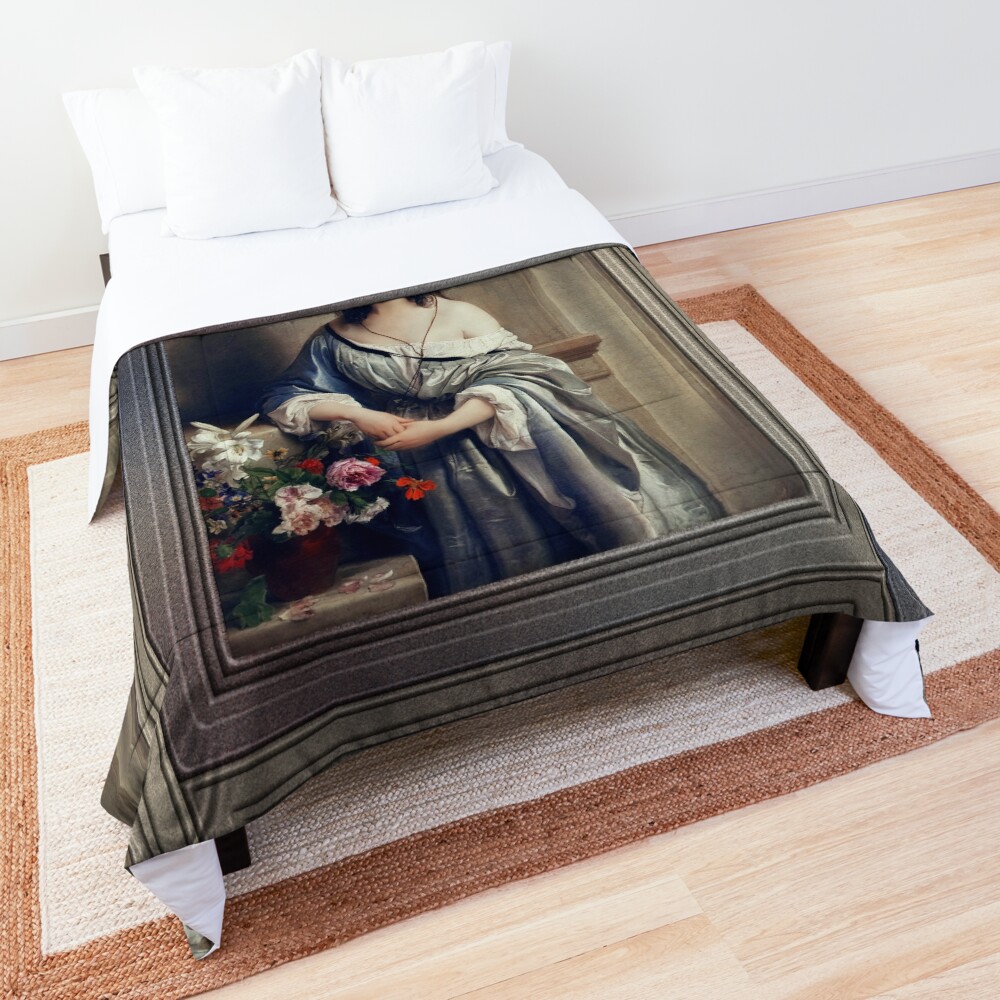
Melancholy c1841-42 by Italian Painter Francesco Hayez (1791 – 1882); who was viewed as the leading painter of the Romanticism Period in the mid 19th Century in Milan Italy. He was well known for his grand historical paintings, political allegories and exceptional fine portraits.
Francesco Hayez, a prominent Italian painter of the Romantic period, captured the emotive power of human expression and drama in his renowned work “Melancholy”. This poignant portrait, kreita ĉirkaŭe 1841-42, epitomizes the Romantic ideals of intense emotional depth, riĉa simboleco, and the exploration of human inner turmoil. The painting features a young woman in a reflective pose, her body angled slightly away from the viewer, yet her gaze directly engages with the observer. Her expression is one of deep contemplation and melancholy, a theme that resonates throughout much of Hayez’s oeuvre.

The primary subject of the artwork is a woman dressed in a luxurious yet simple gown of muted silvery-blue fabric. Her attire is both modest and elegant, indicative of her high social standing but also suggesting a restrained, subdued personality.
The material of her gown is rendered with Hayez’s signature meticulous brushwork, which gives the fabric a soft, preskaŭ travidebla kvalito. It reflects light in such a way that one can almost feel its weight and texture. The delicacy of the gown contrasts with the weight of her expression, reinforcing the thematic tension of the painting.
La haroj de la subjekto, dark and glossy, falls in loose waves around her shoulders, framing her face. Her posture is demure yet sorrowful, her hand gently resting on a vase of flowers placed on a table to her side. The inclusion of flowers—likely meant to symbolize transience and the fragility of life—adds a layer of complexity to the emotional narrative.
The flowers themselves are rendered with meticulous detail, a hallmark of Hayez’s technical prowess. They appear lifelike, as if they could be plucked from the canvas at any moment. This detailed rendering contrasts sharply with the somber tone of the subject, creating a sense of fragility in both the floral elements and the human form.
Malantaŭ la temo, the setting is an interior space, subtly lit to evoke a sense of isolation and introspection. The light seems to enter from an unseen source, casting soft shadows that envelop the subject, further intensifying the feeling of seclusion. The muted colors of the background, which include soft earth tones and shades of gray, highlight the figure of the woman, making her the focal point of the composition.
The architectural features of the room, particularly the classical columns that frame the space, suggest a timeless quality. This classical influence also evokes a sense of the past and the passage of time, which ties in with the theme of melancholy.
La humoro de “Melancholy” is one of introspective sadness. The woman’s expression is not one of overt grief or despair but rather a quiet, contemplative sorrow. Ŝia rigardo, though distant, suggests a mind lost in thought—perhaps reflecting on personal loss, unfulfilled desires, or an existential longing. Hayez was deeply interested in the psychological states of his subjects, and this painting showcases his ability to capture the complexity of emotion through subtle facial expressions and body language.
While the subject’s melancholy could be interpreted in various ways, it is important to consider the broader cultural and historical context of the painting. Created during the early 1840s, the work was produced at a time of political and social unrest in Italy.
The Romantic movement, with its emphasis on emotion, individuismo, and rebellion against societal norms, had a profound impact on the intellectual climate of the time. Hayez’s “Melancholy” could be seen as a reflection of the inner turmoil experienced by many individuals living through the tensions of political upheaval, as well as the personal, emotional struggles that often accompanied such periods of uncertainty.
The symbolism within the painting also speaks to broader themes of romanticism. The wistful nature of the subject, combined with the classical elements of the room and the natural motifs of the flowers, suggests an idealization of the past and an awareness of life’s fleeting nature. The woman’s contemplative pose and the stillness of the surrounding environment suggest an acceptance of these fleeting moments, evoking a sense of resignation that is characteristic of many Romantic works.
Hayez’s use of light and shadow in this painting further enhances the emotional tone. The light that falls gently across the woman’s face and gown creates a sense of intimacy, almost as if we are intruding on a private moment. Tamen, the shadows that play across her figure suggest something darker—perhaps an unspoken sadness or the weight of an unvoiced emotion. This interplay of light and shadow is a powerful tool in conveying the internal conflict of the subject, highlighting the emotional depth and complexity that Hayez was able to achieve in this piece.
Koncerne stilon, “Melancholy” is quintessentially Romantic in its focus on emotion and individual experience. Hayez’s technical mastery is evident in his handling of texture and light, and his ability to convey psychological depth through subtle details is what makes this painting a standout example of Romantic portraiture. The realism with which he renders his subject, coupled with the idealization of the woman’s form, reflects the Romantic ideal of the artist as a master of both technique and emotional expression.
Finfine, “Melancholy” is a masterpiece of emotional and psychological depth. Through the figure of the young woman, Hayez explores themes of introspection, loss, and the complexity of human emotion. His masterful use of light, koloro, and composition creates a timeless portrait that continues to resonate with viewers, evoking feelings of empathy and contemplation. The painting remains one of the most iconic representations of Romantic portraiture and exemplifies Francesco Hayez’s ability to capture the profound emotional states of his subjects.
Informoj Malsupre De Vikipedio.org
Francesco Hayez estis de relative malriĉa familio de Venecio. Lia patro, Giovanni, estis de franca origino dum lia patrino, Chiara Torcella, estis el Murano. Francesco estis la plej juna de kvin filoj.
Li estis edukita fare de la fratino de sia patrino, kiu edziĝis al Giovanni Binasco, bonhava ŝipposedanto kaj artaĵkolektanto. Hayez montris dispozicion por desegnado ekde infanaĝo. Lia onklo, rimarkinte lian frumaturan talenton, lernantigis lin ĉe arta restaŭristo en Venecio. Hayez poste iĝus lernanto de la farbisto Francesco Maggiotto kun kiu li daŭrigis siajn studojn dum tri jaroj..
Li estis akceptita al la pentraĵokurso de la Nova Akademio de Belartoj en Venecio en 1806, kie li studis sub Teodoro Matteini. En 1809 li gajnis konkurson de la Akademio de Venecio por unujara loĝejo ĉe la Accademia di San Luca en Romo.
Li restis en Romo ĝis 1814, tiam proponite al Napolo kie li estis komisiita fare de Joachim Murat por pentri gravan laboron prezentantan Uliseson en la tribunalo de Alcinous.. En la mez-1830-aj jaroj li sekvis la Maffei Salonon en Milano, gastigita fare de Clara Maffei. La edzo de Maffei poste komisius al Hayez portreton de sia edzino. En 1850 Hayez estis nomumita direktoro de la Brera Akademio.
Dum longa kariero, Hayez pruvis esti precipe produktiva. Lia produktaĵo inkludis historiajn pentraĵojn dizajnitajn por alparoli la patriota sentemo de liaj patronoj same kiel verkoj reflektantaj la deziron akompani Neoklasikstilon al grandiozaj temoj., ĉu el biblia aŭ klasika literaturo.
Li ankaŭ pentris scenojn de teatraj prezentoj. Evidente forestanta de lia verko, tamen, estas retabloj – eble pro la napoleonaj invadoj kiuj malkonsekris multajn preĝejojn kaj monaĥejojn en Norda Italio. Arthistoriisto Corrado Ricci priskribis Hayez kiel klasikiston kiu tiam evoluis en stilon de emocia tumulto. Francesco Hayez, La Kiso (1859)
Liaj portretoj havas la intensecon de Ingres kaj la nazarena movado. Ofte sidante, La temoj de Hayez ofte estas vestitaj en severa, nigra kaj blanka vesto, kun malmultaj al neniuj ekipaĵoj. Dum Hayez faris portretojn por la nobelaro, li ankaŭ esploris aliajn temojn kiel kolegaj artistoj kaj muzikistoj. Malfrue en lia kariero, oni scias, ke li laboris uzante fotojn.
Unu el la plej ŝatataj temoj de Hayez estis duonvestita Odalisque elvokiva de orientaj temoj - ŝattemo de Romantikaj farbistoj.[3] La bildigoj de haremoj kaj iliaj virinoj permesis al artistoj la kapablon pentri scenojn alie ne akcepteblajn ene de socio.. Eĉ Maria Magdalena de Hayez havas pli da sensualeco ol religia fervoro.
La pentraĵo de Hayez La Kiso estis konsiderita inter lia plej bona laboro fare de liaj samtempuloj, kaj estas eble lia plej konata klopodo. La anonimulo, netuŝita gesto de la paro ne postulas scion pri mito aŭ literaturo por interpreti, kaj apelacias al moderna rigardo.
Scienca takso de la kariero de Hayez malfaciliĝis pro lia emo por ne subskribi aŭ datigi liajn verkojn.. Ofte datoj en liaj pentraĵoj indikas kiam la laboro estis akirita aŭ vendita, ne la tempo de ĝia kreado. Cetere, li ofte pentris la samajn kunmetaĵojn plurajn fojojn kun minimumaj varioj se entute.
Inter liaj lernantoj de la Brera Akademio estis Carlo Belgioioso, Amanzio Cattaneo, Alessandro Focosi, Giovanni Battista Lamperti, Livo Pecora, Angelo Pietrasanta, Antonio Silo, Carlo Antonio Tavella, Ismaele Teglio Milla kaj Francesco Valaperta.
Hayez mortis en Milano, aĝo 91. Lia studio ĉe la Brera Akademio estas markita per telero.
Ĉi tiu cifereca arta kreaĵo, kiel kun ĉiuj artaĵoj, kiuj troveblas en la retejo de Xzendor7, estas aĉetebla interrete en diversaj materialaj formatoj inkluzive de kanvasaj presaĵoj., akrilaj presaĵoj, metalaj presaĵoj, lignaj presaĵoj, enkadrigitaj presaĵoj, afiŝoj, kaj kiel rulitaj kanvasaj presaĵoj en diversaj grandecoj de 12 colojn al 72 coloj depende de la grandeco de la reala artaĵo kaj la presaĵo laŭpeta butiko, de kiu vi elektas aĉeti la arton.