

Melancholy
Melancholy c1841-42 by Italian Painter Francesco Hayez (1791 – 1882); sem var talinn leiðandi málari rómantíktímabilsins um miðja 19. öld í Mílanó, Ítalíu. Hann var vel þekktur fyrir glæsileg söguleg málverk sín, pólitískar myndlíkingar og einstaklega fínar portrettmyndir.
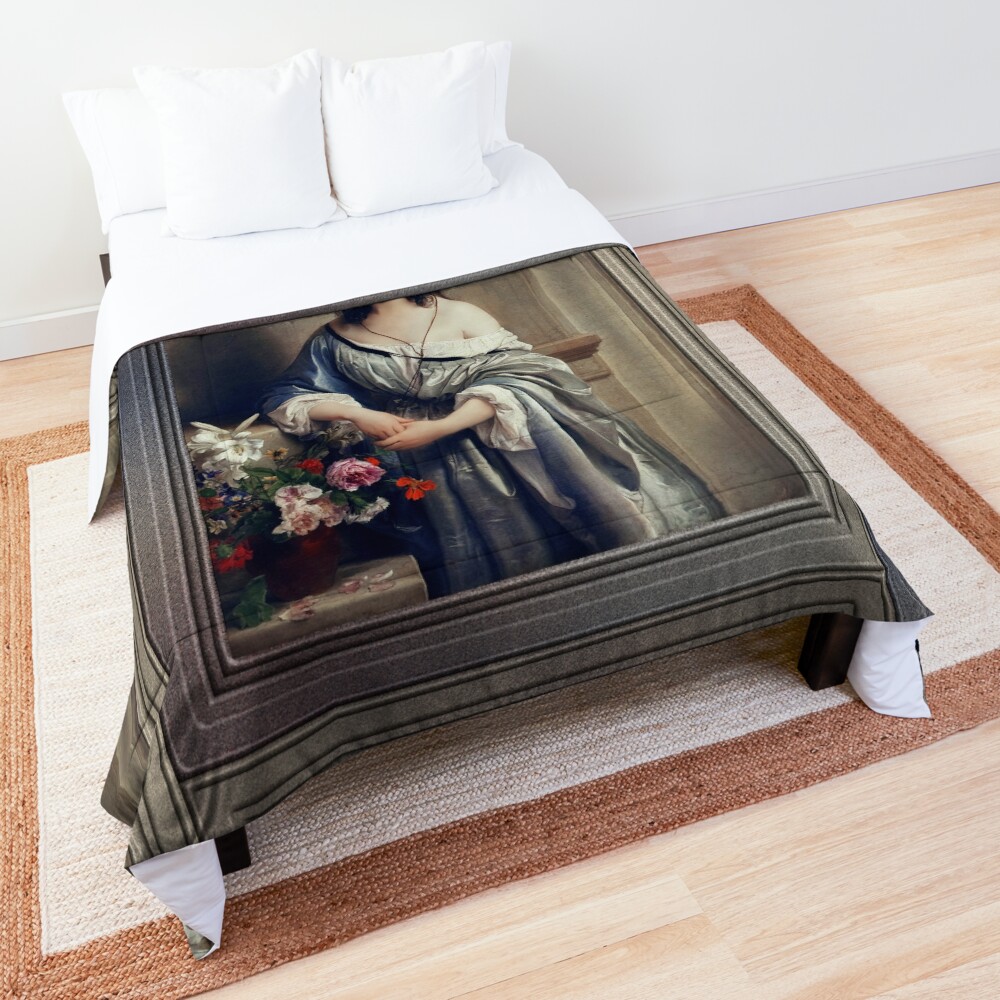
Francesco Hayez, a prominent Italian painter of the Romantic period, captured the emotive power of human expression and drama in his renowned work “Melancholy”. This poignant portrait, búið til í kring 1841-42, epitomizes the Romantic ideals of intense emotional depth, ríkt táknmál, and the exploration of human inner turmoil. The painting features a young woman in a reflective pose, her body angled slightly away from the viewer, yet her gaze directly engages with the observer. Her expression is one of deep contemplation and melancholy, a theme that resonates throughout much of Hayez’s oeuvre.

The primary subject of the artwork is a woman dressed in a luxurious yet simple gown of muted silvery-blue fabric. Her attire is both modest and elegant, indicative of her high social standing but also suggesting a restrained, subdued personality.
The material of her gown is rendered with Hayez’s signature meticulous brushwork, which gives the fabric a soft, almost translucent quality. It reflects light in such a way that one can almost feel its weight and texture. The delicacy of the gown contrasts with the weight of her expression, reinforcing the thematic tension of the painting.
The subject’s hair, dökk og gljáandi, falls in loose waves around her shoulders, framing her face. Her posture is demure yet sorrowful, her hand gently resting on a vase of flowers placed on a table to her side. The inclusion of flowers—likely meant to symbolize transience and the fragility of life—adds a layer of complexity to the emotional narrative.
The flowers themselves are rendered with meticulous detail, a hallmark of Hayez’s technical prowess. They appear lifelike, as if they could be plucked from the canvas at any moment. This detailed rendering contrasts sharply with the somber tone of the subject, creating a sense of fragility in both the floral elements and the human form.
Behind the subject, the setting is an interior space, subtly lit to evoke a sense of isolation and introspection. The light seems to enter from an unseen source, casting soft shadows that envelop the subject, further intensifying the feeling of seclusion. The muted colors of the background, which include soft earth tones and shades of gray, highlight the figure of the woman, making her the focal point of the composition.
The architectural features of the room, particularly the classical columns that frame the space, suggest a timeless quality. This classical influence also evokes a sense of the past and the passage of time, which ties in with the theme of melancholy.
Stemningin á “Melancholy” is one of introspective sadness. The woman’s expression is not one of overt grief or despair but rather a quiet, contemplative sorrow. Augnaráð hennar, though distant, suggests a mind lost in thought—perhaps reflecting on personal loss, unfulfilled desires, or an existential longing. Hayez was deeply interested in the psychological states of his subjects, and this painting showcases his ability to capture the complexity of emotion through subtle facial expressions and body language.
While the subject’s melancholy could be interpreted in various ways, it is important to consider the broader cultural and historical context of the painting. Created during the early 1840s, the work was produced at a time of political and social unrest in Italy.
The Romantic movement, with its emphasis on emotion, einstaklingshyggju, and rebellion against societal norms, had a profound impact on the intellectual climate of the time. Hayez’s “Melancholy” could be seen as a reflection of the inner turmoil experienced by many individuals living through the tensions of political upheaval, as well as the personal, emotional struggles that often accompanied such periods of uncertainty.
The symbolism within the painting also speaks to broader themes of romanticism. The wistful nature of the subject, combined with the classical elements of the room and the natural motifs of the flowers, suggests an idealization of the past and an awareness of life’s fleeting nature. The woman’s contemplative pose and the stillness of the surrounding environment suggest an acceptance of these fleeting moments, evoking a sense of resignation that is characteristic of many Romantic works.
Hayez’s use of light and shadow in this painting further enhances the emotional tone. The light that falls gently across the woman’s face and gown creates a sense of intimacy, almost as if we are intruding on a private moment. Samt, the shadows that play across her figure suggest something darker—perhaps an unspoken sadness or the weight of an unvoiced emotion. This interplay of light and shadow is a powerful tool in conveying the internal conflict of the subject, highlighting the emotional depth and complexity that Hayez was able to achieve in this piece.
Hvað varðar stíl, “Melancholy” is quintessentially Romantic in its focus on emotion and individual experience. Hayez’s technical mastery is evident in his handling of texture and light, and his ability to convey psychological depth through subtle details is what makes this painting a standout example of Romantic portraiture. The realism with which he renders his subject, coupled with the idealization of the woman’s form, reflects the Romantic ideal of the artist as a master of both technique and emotional expression.
Að lokum, “Melancholy” is a masterpiece of emotional and psychological depth. Through the figure of the young woman, Hayez explores themes of introspection, loss, and the complexity of human emotion. His masterful use of light, lit, and composition creates a timeless portrait that continues to resonate with viewers, evoking feelings of empathy and contemplation. The painting remains one of the most iconic representations of Romantic portraiture and exemplifies Francesco Hayez’s ability to capture the profound emotional states of his subjects.
Upplýsingar að neðan Frá Wikipedia.org
Francesco Hayez var af tiltölulega fátækri fjölskyldu frá Feneyjum. Faðir hans, Giovanni, var franskur að uppruna meðan móðir hans, Chiara Torcella, var frá Murano. Francesco var yngstur fimm sona.
Hann var alinn upp af móðursystur sinni, sem hafði gifst Giovanni Binasco, vel stæður útgerðarmaður og listasafnari. Hayez sýndi tilhneigingu til að teikna frá barnæsku. Frændi hans, eftir að hafa tekið eftir bráðþroska hæfileika hans, lærði hann hjá listaverkamanni í Feneyjum. Hayez varð síðar nemandi listmálarans Francesco Maggiotto sem hann hélt áfram námi hjá í þrjú ár..
Hann var tekinn inn á málaranámskeið Nýju listaakademíunnar í Feneyjum í 1806, þar sem hann lærði undir Teodoro Matteini. Í 1809 hann vann samkeppni frá Feneyjaakademíunni um eins árs dvöl við Accademia di San Luca í Róm.
Hann var í Róm til kl 1814, flutti síðan til Napólí þar sem hann var skipaður af Joachim Murat að mála stórt verk sem sýnir Ulysses við hirð Alcinous.. Um miðjan 1830 sótti hann Maffei Salon í Mílanó, gestgjafi Clara Maffei. Eiginmaður Maffei myndi síðar panta Hayez mynd af konu sinni. Í 1850 Hayez var ráðinn forstöðumaður Brera Academy.
Á löngum ferli, Hayez reyndist sérstaklega afkastamikill. Framleiðsla hans innihélt söguleg málverk hönnuð til að höfða til þjóðrækinnar næmni fastagestur hans, auk verk sem endurspegla löngunina til að fylgja nýklassískum stíl við stórt þemu., ýmist úr biblíulegum eða klassískum bókmenntum.
Hann málaði einnig atriði úr leikhúskynningum. Áberandi fjarverandi í verkum hans, þó, eru altaristöflur – hugsanlega vegna Napóleonsinnrásanna sem afvígðu margar kirkjur og klaustur á Norður-Ítalíu. Listfræðingurinn Corrado Ricci lýsti Hayez sem klassíkista sem þróaðist síðan yfir í tilfinningalegt uppnám.. Francesco Hayez, Kossinn (1859)
Andlitsmyndir hans hafa styrkleika Ingres og Nasarethreyfingarinnar. Oft sitjandi, Viðfangsefni Hayez eru oft klædd í ströngu, svörtum og hvítum fötum, með litlum sem engum útbúnaði. Á meðan Hayez gerði portrett fyrir aðalsmenn, hann kannaði einnig önnur viðfangsefni eins og aðra listamenn og tónlistarmenn. Seint á ferlinum, Vitað er að hann hefur unnið með ljósmyndum.
Eitt af uppáhalds þemum Hayez var hálfklæddur Odalisque sem kallar á austurlensk þemu - uppáhalds efni rómantískra málara.[3] Myndirnar af haremum og konum þeirra leyfðu listamönnum að mála atriði sem annars væru ekki viðunandi innan samfélagsins. Jafnvel Mary Magdalene eftir Hayez hefur meiri næmni en trúarhita.
Málverk Hayez, The Kiss, var talið meðal bestu verk hans af samtímamönnum sínum, og er mögulega hans þekktasta viðleitni. Hin nafnlausu, óbreytt látbragði hjónanna þarf ekki þekkingu á goðsögnum eða bókmenntum til að túlka, og höfðar til nútíma augnaráðs.
Vísindalegt mat á ferli Hayez hefur verið flókið vegna tilhneigingar hans til að skrifa ekki undir eða deita verk hans.. Oft gefa dagsetningar í málverkum hans til kynna hvenær verkið var keypt eða selt, ekki tími sköpunar þess. Þar að auki, hann málaði oft sömu tónverkin nokkrum sinnum með lágmarks tilbrigðum ef nokkur.
Meðal nemenda hans frá Brera akademíunni voru Carlo Belgioioso, Amanzio Cattaneo, Alessandro Focosi, Giovanni Battista Lamperti, Livo Pecora, Angelo Pietrasanta, Antonio Silo, Carlo Antonio Tavella, Ismaele Teglio Milla og Francesco Valaperta.
Hayez lést í Mílanó, aldur 91. Vinnustofa hans í Brera Academy er merkt með plötu.
Þessi stafræna listsköpun, eins og með öll listaverkin sem finna má á Xzendor7 vefsíðunni er hægt að kaupa á netinu í ýmsum efnissniðum þar á meðal strigaprentun, akrýl prentun, málmprentun, viðarprentanir, innrömmuð prentun, veggspjöld, og sem upprúlluð strigaprentun í ýmsum stærðum frá 12 tommur til 72 tommur eftir stærð raunverulegu listaverksins og prentunarversluninni sem þú velur að kaupa listina frá.