

Melancholisch
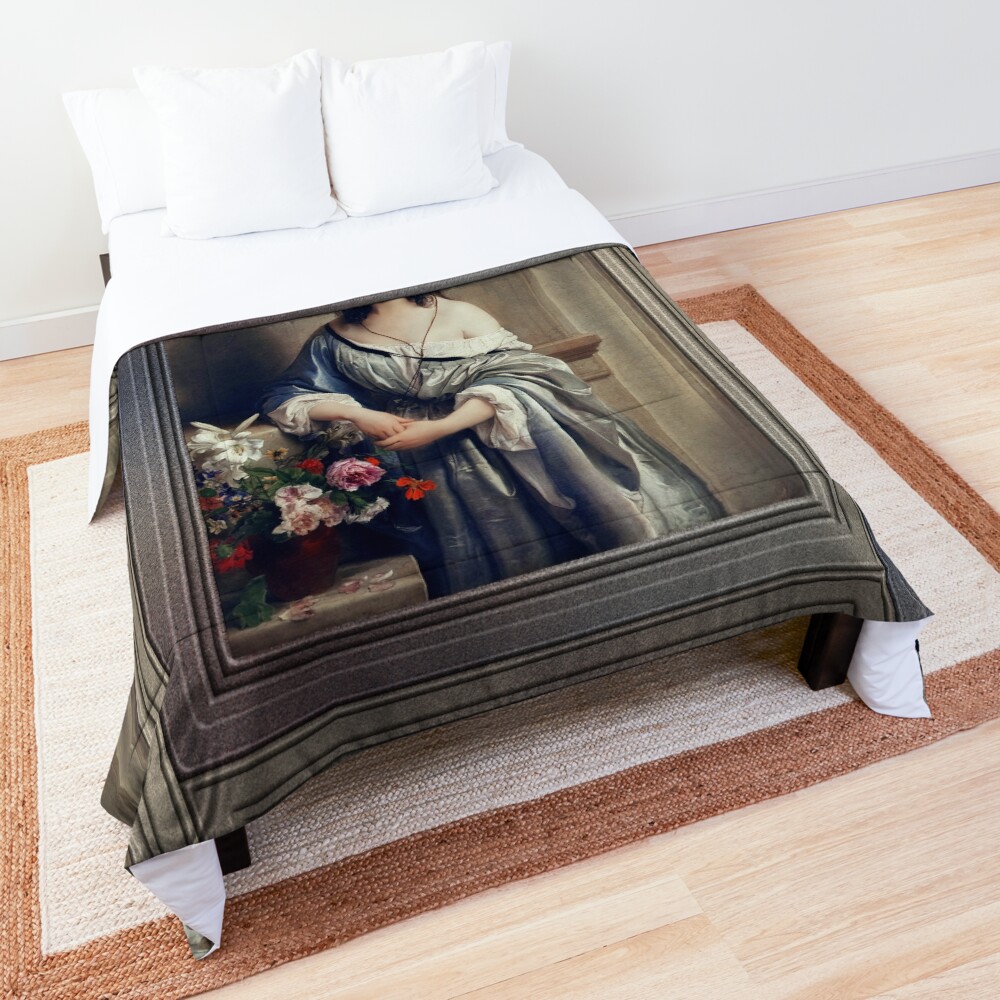
Melancholie c1841-42 door de Italiaanse schilder Francesco Hayez (1791 – 1882); die werd gezien als de belangrijkste schilder van de Romantiek in het midden van de 19e eeuw in Milaan, Italië. Hij stond bekend om zijn grote historische schilderijen, politieke allegorieën en uitzonderlijke mooie portretten.
Francesco Hayez, a prominent Italian painter of the Romantic period, captured the emotive power of human expression and drama in his renowned work “Melancholisch”. This poignant portrait, rondom gemaakt 1841-42, epitomizes the Romantic ideals of intense emotional depth, rich symbolism, and the exploration of human inner turmoil. The painting features a young woman in a reflective pose, her body angled slightly away from the viewer, yet her gaze directly engages with the observer. Her expression is one of deep contemplation and melancholy, a theme that resonates throughout much of Hayez’s oeuvre.

The primary subject of the artwork is a woman dressed in a luxurious yet simple gown of muted silvery-blue fabric. Her attire is both modest and elegant, indicative of her high social standing but also suggesting a restrained, subdued personality.
The material of her gown is rendered with Hayez’s signature meticulous brushwork, which gives the fabric a soft, almost translucent quality. It reflects light in such a way that one can almost feel its weight and texture. The delicacy of the gown contrasts with the weight of her expression, reinforcing the thematic tension of the painting.
The subject’s hair, dark and glossy, falls in loose waves around her shoulders, haar gezicht omlijsten. Her posture is demure yet sorrowful, her hand gently resting on a vase of flowers placed on a table to her side. The inclusion of flowers—likely meant to symbolize transience and the fragility of life—adds a layer of complexity to the emotional narrative.
The flowers themselves are rendered with meticulous detail, a hallmark of Hayez’s technical prowess. They appear lifelike, as if they could be plucked from the canvas at any moment. This detailed rendering contrasts sharply with the somber tone of the subject, creating a sense of fragility in both the floral elements and the human form.
Achter het onderwerp, the setting is an interior space, subtly lit to evoke a sense of isolation and introspection. The light seems to enter from an unseen source, casting soft shadows that envelop the subject, further intensifying the feeling of seclusion. The muted colors of the background, which include soft earth tones and shades of gray, highlight the figure of the woman, making her the focal point of the composition.
The architectural features of the room, particularly the classical columns that frame the space, suggest a timeless quality. This classical influence also evokes a sense of the past and the passage of time, which ties in with the theme of melancholy.
De stemming van “Melancholisch” is one of introspective sadness. The woman’s expression is not one of overt grief or despair but rather a quiet, contemplative sorrow. Haar blik, though distant, suggests a mind lost in thought—perhaps reflecting on personal loss, unfulfilled desires, or an existential longing. Hayez was deeply interested in the psychological states of his subjects, and this painting showcases his ability to capture the complexity of emotion through subtle facial expressions and body language.
While the subject’s melancholy could be interpreted in various ways, it is important to consider the broader cultural and historical context of the painting. Created during the early 1840s, the work was produced at a time of political and social unrest in Italy.
The Romantic movement, with its emphasis on emotion, individualism, and rebellion against societal norms, had a profound impact on the intellectual climate of the time. Hayez's “Melancholisch” could be seen as a reflection of the inner turmoil experienced by many individuals living through the tensions of political upheaval, as well as the personal, emotional struggles that often accompanied such periods of uncertainty.
The symbolism within the painting also speaks to broader themes of romanticism. The wistful nature of the subject, combined with the classical elements of the room and the natural motifs of the flowers, suggests an idealization of the past and an awareness of life’s fleeting nature. The woman’s contemplative pose and the stillness of the surrounding environment suggest an acceptance of these fleeting moments, evoking a sense of resignation that is characteristic of many Romantic works.
Hayez’s use of light and shadow in this painting further enhances the emotional tone. The light that falls gently across the woman’s face and gown creates a sense of intimacy, almost as if we are intruding on a private moment. Nog, the shadows that play across her figure suggest something darker—perhaps an unspoken sadness or the weight of an unvoiced emotion. This interplay of light and shadow is a powerful tool in conveying the internal conflict of the subject, highlighting the emotional depth and complexity that Hayez was able to achieve in this piece.
Qua stijl, “Melancholisch” is quintessentially Romantic in its focus on emotion and individual experience. Hayez’s technical mastery is evident in his handling of texture and light, and his ability to convey psychological depth through subtle details is what makes this painting a standout example of Romantic portraiture. The realism with which he renders his subject, coupled with the idealization of the woman’s form, reflects the Romantic ideal of the artist as a master of both technique and emotional expression.
Uiteindelijk, “Melancholisch” is a masterpiece of emotional and psychological depth. Through the figure of the young woman, Hayez explores themes of introspection, loss, and the complexity of human emotion. His masterful use of light, kleur, and composition creates a timeless portrait that continues to resonate with viewers, evoking feelings of empathy and contemplation. The painting remains one of the most iconic representations of Romantic portraiture and exemplifies Francesco Hayez’s ability to capture the profound emotional states of his subjects.
Info hieronder van Wikipedia.org
Francesco Hayez kwam uit een relatief arm gezin uit Venetië. Zijn vader, Giovanni, was van Franse afkomst terwijl zijn moeder, Chiara Torcella, kwam uit Murano. Francesco was de jongste van vijf zonen.
Hij werd opgevoed door de zus van zijn moeder, die was getrouwd met Giovanni Binasco, een welgestelde reder en kunstverzamelaar. Hayez vertoonde van kinds af aan aanleg voor tekenen. Zijn oom, zijn vroegrijp talent hebben opgemerkt, hem in de leer bij een kunstrestaurator in Venetië. Hayez zou later een leerling worden van de schilder Francesco Maggiotto bij wie hij zijn studie drie jaar voortzette.
Hij werd toegelaten tot de schildercursus van de Nieuwe Academie voor Schone Kunsten in Venetië in 1806, waar hij studeerde onder Teodoro Matteini. In 1809 hij won een wedstrijd van de Academie van Venetië voor een verblijf van een jaar aan de Accademia di San Luca in Rome.
Hij bleef in Rome tot... 1814, verhuisde vervolgens naar Napels, waar hij van Joachim Murat de opdracht kreeg om een groot werk te schilderen met de afbeelding van Ulysses aan het hof van Alcinous. In het midden van de jaren 1830 bezocht hij de Maffei Salon in Milaan, gehost door Clara Maffei. Maffei's man zou Hayez later een portret van zijn vrouw laten maken. In 1850 Hayez werd benoemd tot directeur van de Brera Academy.
In de loop van een lange carrière, Hayez bleek bijzonder productief te zijn. Zijn output omvatte historische schilderijen die waren ontworpen om een beroep te doen op de patriottische gevoeligheid van zijn opdrachtgevers, evenals werken die de wens weerspiegelen om een neoklassieke stijl te begeleiden bij grote thema's, hetzij uit bijbelse of klassieke literatuur.
Hij schilderde ook scènes uit theatervoorstellingen. Opvallend afwezig in zijn oeuvre, echter, zijn altaarstukken – mogelijk als gevolg van de Napoleontische invasies die veel kerken en kloosters in Noord-Italië hebben ontwijd. Kunsthistoricus Corrado Ricci beschreef Hayez als een classicus die vervolgens evolueerde naar een stijl van emotioneel tumult. Francesco Hayez, De kus (1859)
Zijn portretten hebben de intensiteit van Ingres en de Nazarener-beweging. Vaak zittend, De onderwerpen van Hayez zijn vaak sober gekleed, zwarte en witte kleding, met weinig tot geen uitrusting. Terwijl Hayez portretten maakte voor de adel, hij verkende ook andere onderwerpen zoals collega-artiesten en muzikanten. Laat in zijn carrière, het is bekend dat hij met foto's heeft gewerkt.
Een van de favoriete thema's van Hayez was de halfgeklede Odalisque, die doet denken aan oosterse thema's - een favoriet onderwerp van romantische schilders.[3] De afbeeldingen van harems en hun vrouwen gaven kunstenaars de mogelijkheid om scènes te schilderen die anders niet acceptabel waren in de samenleving. Zelfs Mary Magdalene van Hayez heeft meer sensualiteit dan religieuze ijver.
Het schilderij van Hayez De kus werd door zijn tijdgenoten als een van zijn beste werken beschouwd, en is misschien wel zijn meest bekende poging. de anonieme, onaangetast gebaar van het paar vereist geen kennis van mythe of literatuur om te interpreteren, en appelleert aan een moderne blik.
Een wetenschappelijke beoordeling van de carrière van Hayez is bemoeilijkt door zijn neiging om zijn werken niet te signeren of te dateren. Vaak geven data in zijn schilderijen aan wanneer het werk is aangekocht of verkocht, niet de tijd van zijn schepping. Bovendien, hij schilderde vaak dezelfde composities meerdere keren met minimale variaties of helemaal niet.
Onder zijn leerlingen van de Brera Academy waren Carlo Belgioioso, Amanzio Cattaneo, Alessandro Focosi, Giovanni Battista Lamperti, Livo Schaap, Angelo Pietrasanta, Antonio Silo, Carlo Antonio Tavella, Ismaele Teglio Milla en Francesco Valaperta.
Hayez stierf in Milaan, leeftijd 91. Zijn atelier aan de Brera Academy is gemarkeerd met een bord.
Deze digitale kunstcreatie, zoals bij alle kunstwerken die op de Xzendor7-website te vinden zijn, is deze online te koop in verschillende materiaalformaten, waaronder canvasafdrukken, acryl afdrukken, metalen prints, hout prints, ingelijste afdrukken, affiches, en als opgerolde canvasafdrukken in diverse maten vanaf 12 inch tot 72 inch, afhankelijk van de grootte van het daadwerkelijke kunstwerk en de print on demand-winkel waar je de kunst wilt kopen.