

Melancholy
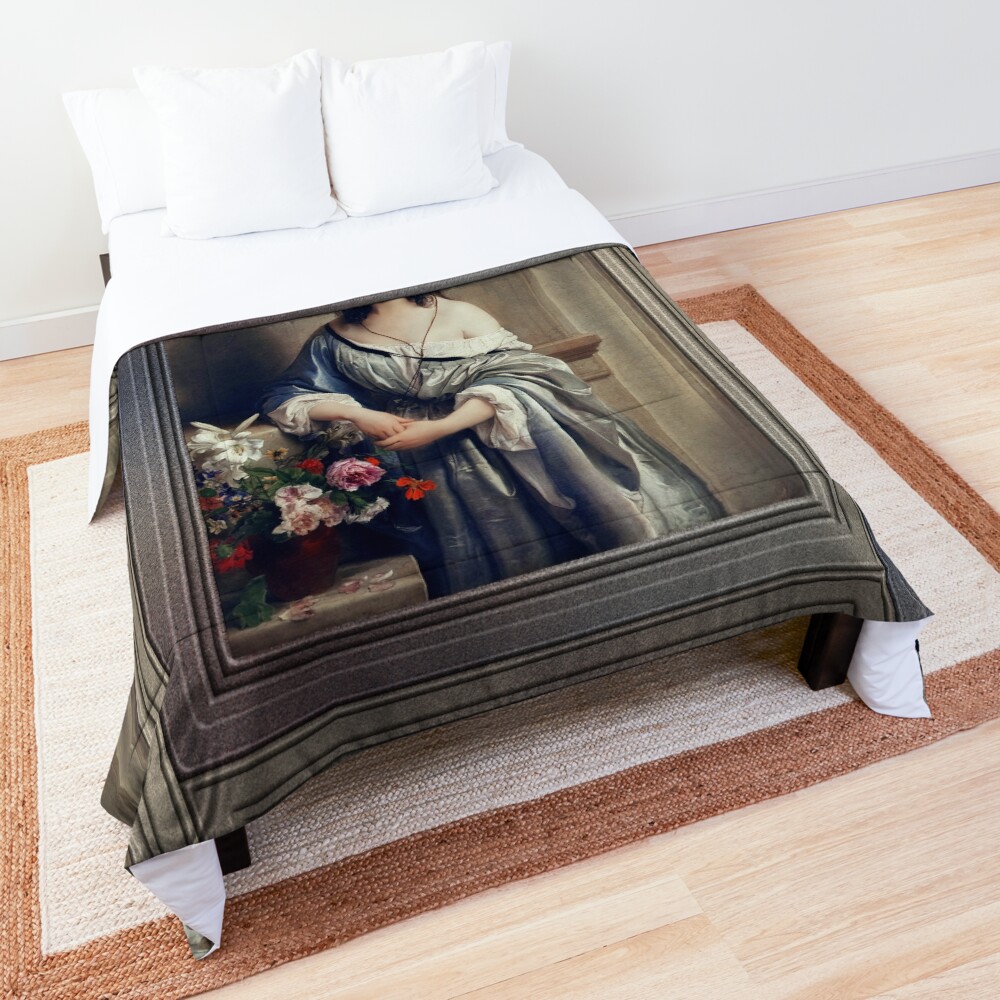
Melancholy c1841-42 by Italian Painter Francesco Hayez (1791 – 1882); who was viewed as the leading painter of the Romanticism Period in the mid 19th Century in Milan Italy. Han var kjent for sine store historiske malerier, politiske allegorier og eksepsjonelle fine portretter.
Francesco Hayez, a prominent Italian painter of the Romantic period, captured the emotive power of human expression and drama in his renowned work “Melancholy”. This poignant portrait, skapt rundt 1841-42, epitomizes the Romantic ideals of intense emotional depth, rich symbolism, and the exploration of human inner turmoil. The painting features a young woman in a reflective pose, her body angled slightly away from the viewer, yet her gaze directly engages with the observer. Her expression is one of deep contemplation and melancholy, a theme that resonates throughout much of Hayez’s oeuvre.

The primary subject of the artwork is a woman dressed in a luxurious yet simple gown of muted silvery-blue fabric. Her attire is both modest and elegant, indicative of her high social standing but also suggesting a restrained, subdued personality.
The material of her gown is rendered with Hayez’s signature meticulous brushwork, which gives the fabric a soft, nesten gjennomsiktig kvalitet. It reflects light in such a way that one can almost feel its weight and texture. The delicacy of the gown contrasts with the weight of her expression, reinforcing the thematic tension of the painting.
The subject’s hair, dark and glossy, falls in loose waves around her shoulders, framing her face. Her posture is demure yet sorrowful, her hand gently resting on a vase of flowers placed on a table to her side. The inclusion of flowers—likely meant to symbolize transience and the fragility of life—adds a layer of complexity to the emotional narrative.
The flowers themselves are rendered with meticulous detail, a hallmark of Hayez’s technical prowess. They appear lifelike, as if they could be plucked from the canvas at any moment. This detailed rendering contrasts sharply with the somber tone of the subject, creating a sense of fragility in both the floral elements and the human form.
Behind the subject, the setting is an interior space, subtly lit to evoke a sense of isolation and introspection. The light seems to enter from an unseen source, casting soft shadows that envelop the subject, further intensifying the feeling of seclusion. The muted colors of the background, which include soft earth tones and shades of gray, highlight the figure of the woman, making her the focal point of the composition.
The architectural features of the room, particularly the classical columns that frame the space, suggest a timeless quality. This classical influence also evokes a sense of the past and the passage of time, which ties in with the theme of melancholy.
Stemningen av “Melancholy” is one of introspective sadness. The woman’s expression is not one of overt grief or despair but rather a quiet, contemplative sorrow. Blikket hennes, though distant, suggests a mind lost in thought—perhaps reflecting on personal loss, unfulfilled desires, or an existential longing. Hayez was deeply interested in the psychological states of his subjects, and this painting showcases his ability to capture the complexity of emotion through subtle facial expressions and body language.
While the subject’s melancholy could be interpreted in various ways, it is important to consider the broader cultural and historical context of the painting. Created during the early 1840s, the work was produced at a time of political and social unrest in Italy.
The Romantic movement, with its emphasis on emotion, individualisme, and rebellion against societal norms, had a profound impact on the intellectual climate of the time. Hayez’s “Melancholy” could be seen as a reflection of the inner turmoil experienced by many individuals living through the tensions of political upheaval, as well as the personal, emotional struggles that often accompanied such periods of uncertainty.
The symbolism within the painting also speaks to broader themes of romanticism. The wistful nature of the subject, combined with the classical elements of the room and the natural motifs of the flowers, suggests an idealization of the past and an awareness of life’s fleeting nature. The woman’s contemplative pose and the stillness of the surrounding environment suggest an acceptance of these fleeting moments, evoking a sense of resignation that is characteristic of many Romantic works.
Hayez’s use of light and shadow in this painting further enhances the emotional tone. The light that falls gently across the woman’s face and gown creates a sense of intimacy, almost as if we are intruding on a private moment. Ennå, the shadows that play across her figure suggest something darker—perhaps an unspoken sadness or the weight of an unvoiced emotion. This interplay of light and shadow is a powerful tool in conveying the internal conflict of the subject, highlighting the emotional depth and complexity that Hayez was able to achieve in this piece.
Når det gjelder stil, “Melancholy” is quintessentially Romantic in its focus on emotion and individual experience. Hayez’s technical mastery is evident in his handling of texture and light, and his ability to convey psychological depth through subtle details is what makes this painting a standout example of Romantic portraiture. The realism with which he renders his subject, coupled with the idealization of the woman’s form, reflects the Romantic ideal of the artist as a master of both technique and emotional expression.
Til slutt, “Melancholy” is a masterpiece of emotional and psychological depth. Through the figure of the young woman, Hayez explores themes of introspection, loss, and the complexity of human emotion. His masterful use of light, farge, and composition creates a timeless portrait that continues to resonate with viewers, evoking feelings of empathy and contemplation. The painting remains one of the most iconic representations of Romantic portraiture and exemplifies Francesco Hayez’s ability to capture the profound emotional states of his subjects.
Info nedenfor fra Wikipedia.org
Francesco Hayez var fra en relativt fattig familie fra Venezia. Hans far, Giovanni, var av fransk opprinnelse mens moren hans, Chiara Torcella, var fra Murano. Francesco var den yngste av fem sønner.
Han ble oppdratt av sin mors søster, som hadde giftet seg med Giovanni Binasco, en velstående reder og kunstsamler. Hayez viste en disposisjon for å tegne siden barndommen. Onkelen hans, etter å ha lagt merke til hans forgjengelige talent, lærte ham til en kunstgjenoppretter i Venezia. Hayez skulle senere bli elev av maleren Francesco Maggiotto som han fortsatte studiene med i tre år.
Han ble tatt opp på malerkurset ved New Academy of Fine Arts i Venezia i 1806, hvor han studerte under Teodoro Matteini. I 1809 han vant en konkurranse fra Academy of Venice for et års opphold på Accademia di San Luca i Roma.
Han ble i Roma til 1814, flyttet deretter til Napoli hvor han fikk i oppdrag av Joachim Murat å male et større verk som skildrer Ulysses ved hoffet i Alcinous. På midten av 1830-tallet deltok han på Maffei-salongen i Milano, arrangert av Clara Maffei. Maffeis ektemann skulle senere gi Hayez et portrett av kona. I 1850 Hayez ble utnevnt til direktør for Brera Academy.
I løpet av en lang karriere, Hayez viste seg å være spesielt produktiv. Hans produksjon inkluderte historiske malerier designet for å appellere til patriotiske følsomheten til hans lånetakere, så vel som verk som gjenspeiler ønsket om å følge en nyklassisk stil til store temaer, enten fra bibelsk eller klassisk litteratur.
Han malte også scener fra teaterpresentasjoner. Påfallende fraværende fra hans verk, derimot, er altertavler – muligens på grunn av Napoleons invasjoner som dekonerte mange kirker og klostre i Nord -Italia. Kunsthistoriker Corrado Ricci beskrev Hayez som en klassiker som deretter utviklet seg til en stil med følelsesmessig tumult. Francesco Hayez, Kysset (1859)
Portrettene hans har intensiteten til Ingres og Nazarene -bevegelsen. Sitter ofte, Hayezs emner er ofte kledd i strenge, svart -hvite klær, med lite eller ingen utstyr. Mens Hayez laget portretter for adelen, han utforsket også andre emner som andre artister og musikere. Sent i karrieren, han er kjent for å ha jobbet med fotografier.
Et av Hayezs favoritttemaer var halvkledd Odalisque som stemte for orientalske temaer-et favorittemne for romantiske malere.[3] Skildringene av haremer og deres kvinner tillot kunstnere muligheten til å male scener som ellers ikke var akseptable i samfunnet. Selv Hayezs Mary Magdalene har mer sensualitet enn religiøs inderlighet.
Hayezs maleri The Kiss ble ansett blant hans beste arbeider av hans samtidige, og er muligens hans mest kjente innsats. Den anonyme, upåvirket gest fra paret krever ikke kunnskap om myte eller litteratur for å tolke, og appellerer til et moderne blikk.
En vitenskapelig vurdering av Hayez karriere er blitt komplisert av hans tilbøyelighet til ikke å signere eller date verkene hans. Ofte indikerer datoer i maleriene hans når verket ble anskaffet eller solgt, ikke tidspunktet for opprettelsen. Dessuten, han malte ofte de samme komposisjonene flere ganger med minimale variasjoner hvis noen i det hele tatt.
Blant elevene hans fra Brera Academy var Carlo Belgioioso, Amanzio Cattaneo, Alessandro Focosi, Giovanni Battista Lamperti, Livo Sau, Angelo Pietrasanta, Antonio Silo, Carlo Antonio Tavella, Ismaele Teglio Milla og Francesco Valaperta.
Hayez døde i Milano, alder 91. Atelieret hans ved Brera Academy er merket med en tallerken.
Denne digitale kunstkreasjonen, som med alle kunstverkene som finnes på Xzendor7-nettstedet, er det tilgjengelig for kjøp online i en rekke materialformater, inkludert lerretstrykk, akryltrykk, metalltrykk, treutskrifter, innrammede trykk, plakater, og som rullede lerretstrykk i en rekke størrelser fra 12 tommer til 72 tommer avhengig av størrelsen på det faktiske kunstverket og print on demand-butikken du velger å kjøpe kunsten fra.