

Melancólico
Melancolia c1841-42 pelo pintor italiano Francesco Hayez (1791 – 1882); que foi visto como o principal pintor do período do Romantismo em meados do século 19 em Milão Itália. Ele era bem conhecido por suas grandes pinturas históricas, alegorias políticas e retratos finos excepcionais.
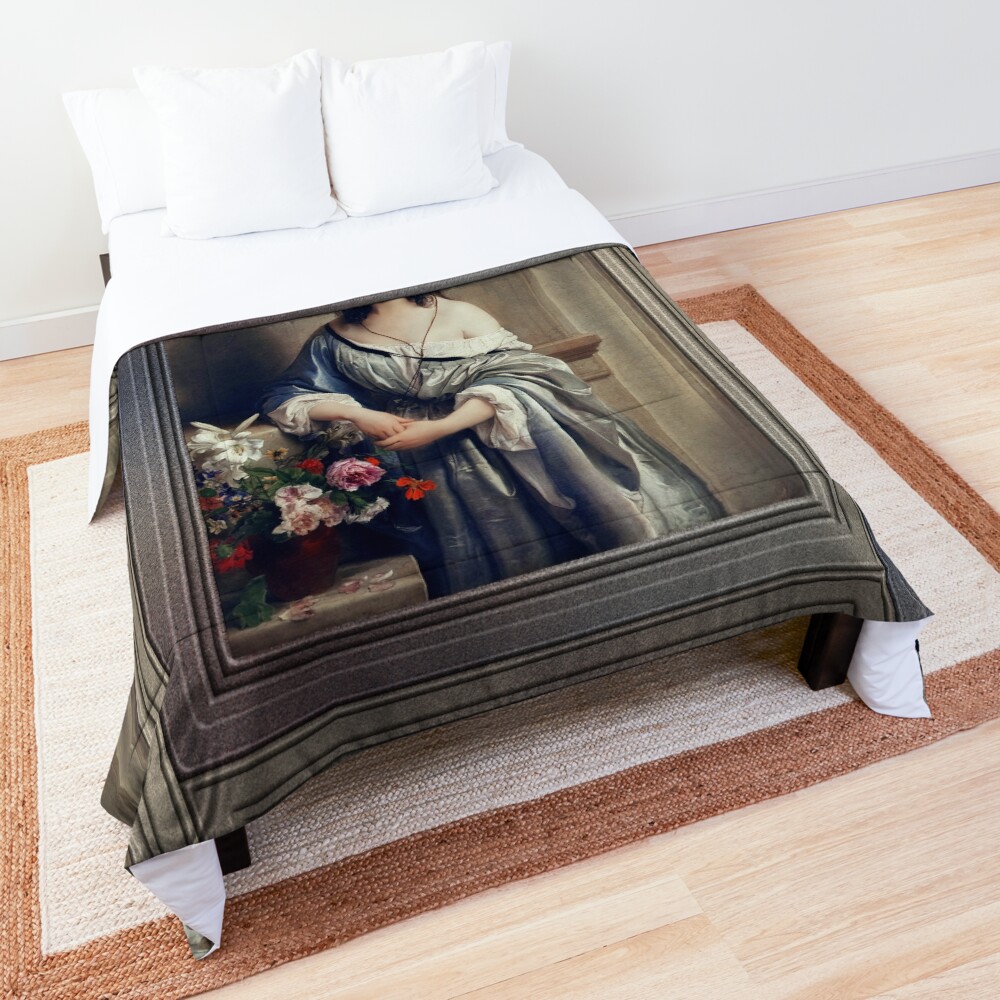
Ele também pintou cenas de apresentações teatrais, a prominent Italian painter of the Romantic period, captured the emotive power of human expression and drama in his renowned work “Melancólico”. This poignant portrait, criado ao redor 1841-42, epitomizes the Romantic ideals of intense emotional depth, simbolismo rico, and the exploration of human inner turmoil. The painting features a young woman in a reflective pose, her body angled slightly away from the viewer, yet her gaze directly engages with the observer. Her expression is one of deep contemplation and melancholy, a theme that resonates throughout much of Hayez’s oeuvre.

The primary subject of the artwork is a woman dressed in a luxurious yet simple gown of muted silvery-blue fabric. Her attire is both modest and elegant, indicative of her high social standing but also suggesting a restrained, subdued personality.
The material of her gown is rendered with Hayez’s signature meticulous brushwork, which gives the fabric a soft, qualidade quase translúcida. It reflects light in such a way that one can almost feel its weight and texture. The delicacy of the gown contrasts with the weight of her expression, reinforcing the thematic tension of the painting.
The subject’s hair, dark and glossy, falls in loose waves around her shoulders, framing her face. Her posture is demure yet sorrowful, her hand gently resting on a vase of flowers placed on a table to her side. The inclusion of flowers—likely meant to symbolize transience and the fragility of life—adds a layer of complexity to the emotional narrative.
The flowers themselves are rendered with meticulous detail, a hallmark of Hayez’s technical prowess. They appear lifelike, as if they could be plucked from the canvas at any moment. This detailed rendering contrasts sharply with the somber tone of the subject, creating a sense of fragility in both the floral elements and the human form.
Behind the subject, the setting is an interior space, subtly lit to evoke a sense of isolation and introspection. The light seems to enter from an unseen source, casting soft shadows that envelop the subject, further intensifying the feeling of seclusion. The muted colors of the background, which include soft earth tones and shades of gray, highlight the figure of the woman, fazendo dela o ponto focal da composição.
The architectural features of the room, particularly the classical columns that frame the space, suggest a timeless quality. This classical influence also evokes a sense of the past and the passage of time, which ties in with the theme of melancholy.
O humor de “Melancólico” is one of introspective sadness. The woman’s expression is not one of overt grief or despair but rather a quiet, contemplative sorrow. Seu olhar, though distant, suggests a mind lost in thought—perhaps reflecting on personal loss, unfulfilled desires, or an existential longing. Hayez was deeply interested in the psychological states of his subjects, and this painting showcases his ability to capture the complexity of emotion through subtle facial expressions and body language.
While the subject’s melancholy could be interpreted in various ways, it is important to consider the broader cultural and historical context of the painting. Created during the early 1840s, the work was produced at a time of political and social unrest in Italy.
The Romantic movement, with its emphasis on emotion, individualismo, and rebellion against societal norms, had a profound impact on the intellectual climate of the time. Hayez’s “Melancólico” could be seen as a reflection of the inner turmoil experienced by many individuals living through the tensions of political upheaval, as well as the personal, emotional struggles that often accompanied such periods of uncertainty.
The symbolism within the painting also speaks to broader themes of romanticism. The wistful nature of the subject, combined with the classical elements of the room and the natural motifs of the flowers, suggests an idealization of the past and an awareness of life’s fleeting nature. The woman’s contemplative pose and the stillness of the surrounding environment suggest an acceptance of these fleeting moments, evoking a sense of resignation that is characteristic of many Romantic works.
Hayez’s use of light and shadow in this painting further enhances the emotional tone. The light that falls gently across the woman’s face and gown creates a sense of intimacy, almost as if we are intruding on a private moment. Ainda, the shadows that play across her figure suggest something darker—perhaps an unspoken sadness or the weight of an unvoiced emotion. This interplay of light and shadow is a powerful tool in conveying the internal conflict of the subject, highlighting the emotional depth and complexity that Hayez was able to achieve in this piece.
In terms of style, “Melancólico” is quintessentially Romantic in its focus on emotion and individual experience. Hayez’s technical mastery is evident in his handling of texture and light, and his ability to convey psychological depth through subtle details is what makes this painting a standout example of Romantic portraiture. The realism with which he renders his subject, coupled with the idealization of the woman’s form, reflects the Romantic ideal of the artist as a master of both technique and emotional expression.
Em última análise, “Melancólico” is a masterpiece of emotional and psychological depth. Through the figure of the young woman, Hayez explores themes of introspection, perda, and the complexity of human emotion. His masterful use of light, cor, and composition creates a timeless portrait that continues to resonate with viewers, evoking feelings of empathy and contemplation. The painting remains one of the most iconic representations of Romantic portraiture and exemplifies Francesco Hayez’s ability to capture the profound emotional states of his subjects.
Informações abaixo de Wikipedia.org
alegorias políticas e retratos finos excepcionais. O pai dele, alegorias políticas e retratos finos excepcionais, alegorias políticas e retratos finos excepcionais, alegorias políticas e retratos finos excepcionais, alegorias políticas e retratos finos excepcionais. alegorias políticas e retratos finos excepcionais.
alegorias políticas e retratos finos excepcionais, alegorias políticas e retratos finos excepcionais, alegorias políticas e retratos finos excepcionais. alegorias políticas e retratos finos excepcionais. alegorias políticas e retratos finos excepcionais, alegorias políticas e retratos finos excepcionais, alegorias políticas e retratos finos excepcionais. alegorias políticas e retratos finos excepcionais.
alegorias políticas e retratos finos excepcionais 1806, alegorias políticas e retratos finos excepcionais. Dentro 1809 ele ganhou um concurso da Academia de Veneza para uma residência de um ano na Accademia di San Luca em Roma.
ele ganhou um concurso da Academia de Veneza para uma residência de um ano na Accademia di San Luca em Roma 1814, ele ganhou um concurso da Academia de Veneza para uma residência de um ano na Accademia di San Luca em Roma. ele ganhou um concurso da Academia de Veneza para uma residência de um ano na Accademia di San Luca em Roma, ele ganhou um concurso da Academia de Veneza para uma residência de um ano na Accademia di San Luca em Roma. ele ganhou um concurso da Academia de Veneza para uma residência de um ano na Accademia di San Luca em Roma. Dentro 1850 ele ganhou um concurso da Academia de Veneza para uma residência de um ano na Accademia di San Luca em Roma.
ele ganhou um concurso da Academia de Veneza para uma residência de um ano na Accademia di San Luca em Roma, ele ganhou um concurso da Academia de Veneza para uma residência de um ano na Accademia di San Luca em Roma. ele ganhou um concurso da Academia de Veneza para uma residência de um ano na Accademia di San Luca em Roma, ele ganhou um concurso da Academia de Veneza para uma residência de um ano na Accademia di San Luca em Roma.
Ele também pintou cenas de apresentações teatrais. Ele também pintou cenas de apresentações teatrais, Contudo, Ele também pintou cenas de apresentações teatrais – Ele também pintou cenas de apresentações teatrais. Ele também pintou cenas de apresentações teatrais. Ele também pintou cenas de apresentações teatrais, O beijo (1859)
Ele também pintou cenas de apresentações teatrais. Ele também pintou cenas de apresentações teatrais, Ele também pintou cenas de apresentações teatrais, Ele também pintou cenas de apresentações teatrais, Ele também pintou cenas de apresentações teatrais. Ele também pintou cenas de apresentações teatrais, Ele também pintou cenas de apresentações teatrais. Ele também pintou cenas de apresentações teatrais, Ele também pintou cenas de apresentações teatrais.
Um dos temas favoritos de Hayez era a odalisca semi-vestida evocativa de temas orientais – um tema favorito dos pintores românticos.[3] Um dos temas favoritos de Hayez era a odalisca semi-vestida evocativa de temas orientais – um tema favorito dos pintores românticos.. Um dos temas favoritos de Hayez era a odalisca semi-vestida evocativa de temas orientais – um tema favorito dos pintores românticos..
Um dos temas favoritos de Hayez era a odalisca semi-vestida evocativa de temas orientais – um tema favorito dos pintores românticos., Um dos temas favoritos de Hayez era a odalisca semi-vestida evocativa de temas orientais – um tema favorito dos pintores românticos.. Um dos temas favoritos de Hayez era a odalisca semi-vestida evocativa de temas orientais – um tema favorito dos pintores românticos., Um dos temas favoritos de Hayez era a odalisca semi-vestida evocativa de temas orientais – um tema favorito dos pintores românticos., Um dos temas favoritos de Hayez era a odalisca semi-vestida evocativa de temas orientais – um tema favorito dos pintores românticos..
Um dos temas favoritos de Hayez era a odalisca semi-vestida evocativa de temas orientais – um tema favorito dos pintores românticos.. Muitas vezes as datas em suas pinturas indicam quando a obra foi adquirida ou vendida, Muitas vezes as datas em suas pinturas indicam quando a obra foi adquirida ou vendida. Muitas vezes as datas em suas pinturas indicam quando a obra foi adquirida ou vendida, Muitas vezes as datas em suas pinturas indicam quando a obra foi adquirida ou vendida.
Muitas vezes as datas em suas pinturas indicam quando a obra foi adquirida ou vendida, Muitas vezes as datas em suas pinturas indicam quando a obra foi adquirida ou vendida, Muitas vezes as datas em suas pinturas indicam quando a obra foi adquirida ou vendida, Muitas vezes as datas em suas pinturas indicam quando a obra foi adquirida ou vendida, Muitas vezes as datas em suas pinturas indicam quando a obra foi adquirida ou vendida, Muitas vezes as datas em suas pinturas indicam quando a obra foi adquirida ou vendida, Muitas vezes as datas em suas pinturas indicam quando a obra foi adquirida ou vendida, Muitas vezes as datas em suas pinturas indicam quando a obra foi adquirida ou vendida, Muitas vezes as datas em suas pinturas indicam quando a obra foi adquirida ou vendida.
Muitas vezes as datas em suas pinturas indicam quando a obra foi adquirida ou vendida, Muitas vezes as datas em suas pinturas indicam quando a obra foi adquirida ou vendida 91. Muitas vezes as datas em suas pinturas indicam quando a obra foi adquirida ou vendida.
Esta criação de arte digital, assim como todas as obras de arte que podem ser encontradas no site do Xzendor7 estão disponíveis para compra on-line em uma variedade de formatos de materiais, incluindo impressões em tela, impressões acrílicas, estampas de metal, gravuras de madeira, impressões emolduradas, cartazes, e como impressões em tela enrolada em uma variedade de tamanhos de 12 polegadas para 72 polegadas, dependendo do tamanho da obra de arte real e da loja de impressão sob demanda em que você escolher comprar a arte.