

Millicent Duchess Of Sutherland
John Singer Sargent’s portrait Millicent Duchess of Sutherland, mar thoradh air stèidheachadh an Salon des Refusés le riaghaltas na Frainge 1904, captures the essence of late 19th and early 20th-century portraiture in its sophisticated portrayal of aristocracy. An neach-ealain, born in Italy to American parents, is known for his masterful technique, which is on full display in this oil painting. The portrait features Millicent, Duchess of Sutherland, who was an English aristocrat and socialite of the time.
Millicent Duchess Of Sutherland born Millicent Saint Clair Erskine (1867 – 1955); was the eldest daughter of the fourth Earl of Rosslin and Blanche Fitzroy. When she was 17 Aois bhliadhnaichean, she married Cromartie Sutherland Leveson-Gower, who inherited the title of Duke of Sutherland in 1892.
The Duchess is depicted in a moment of poised elegance, embodying both her title and her societal role, a tha a 'cur sreathan de dh' inntinn agus de dh 'inntinn ris a' chumadh. Tha cuspair agus faireachdainn an deilbh a’ moladh cothromachadh eadar ùrachadh agus an neart caractar a bhathas a’ sùileachadh bho na boireannaich sin aig àrd-chomann-shòisealta..
Clàr-innse
Am Prìomh Chuspair: Millicent Duchess of Sutherland
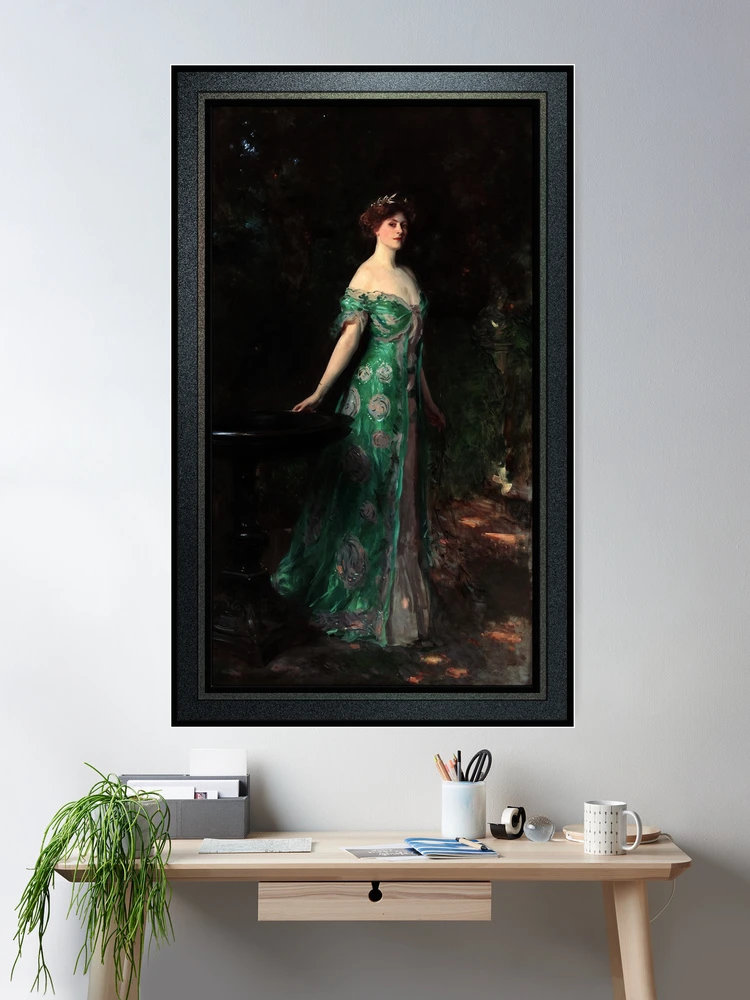
Aig cridhe a’ shàr-obair seo tha Millicent fhèin, a tha seasamh rioghail, agus air a dheanamh suas ann an suidheachadh àithneil ach gràsmhor. Tha a’ Bhan-diùc air a sgeadachadh ann an dreasa eireachdail a ghlacas sùil an neach-amhairc. Tha dath uaine beairteach a gùn a’ cur ri tònaichean nas dorcha a’ chùil, a 'cruthachadh eadar-dhealachadh mòr a tha a' tarraing aire don fhigear aice. Tha an dreasa aice air a sgeadachadh le motifan flùrach fìnealta a chuireas blas bog ris an èideadh a tha air dhòigh eile foirmeil.
The exquisite detailing of the dress reveals Sargent’s mastery in portraying fabric textures, every fold and curve of the gown is rendered with remarkable precision, reflecting both light and shadow in ways that evoke the grandeur of the aristocratic world. An suidheachadh aice, with one hand resting on a table, gives the impression of quiet confidence, as though she is both part of her surroundings and above them, a fitting representation of her high status.
The Duchess’s face is illuminated with soft, yet confident features, giving her an ethereal quality. Her hair is styled in an elegant updo, topped with a crown of delicate flowers, which subtly underscores her aristocratic position. An aghaidh, ge-tà, is not overly made up, allowing her natural beauty and inner character to shine through.
Tha an sealladh aice air tionndadh beagan a dh’ ionnsaigh an neach-coimhead, ach tha e a’ giùlan àile cnuasachaidh, mar gum biodh i a’ meòrachadh air rudeigin fada nas fhaide na raon na tha timcheall air. Tha comas Sargent an abairt seòlta seo a ghlacadh a’ cur doimhneachd tòcail ris an dealbh, a’ dèanamh a’ Bhan-diùc nas motha na dìreach nì air a bheil meas, ach cuspair a tha airidh air meòrachadh.
An suidheachadh agus an cùl-fhiosrachadh
Tha cùl an deilbh nas dorcha, sgrìobhadh cha mhòr eas-chruthach a tha eadar-dhealaichte ri figear mionaideach na Ban-diùc. Tha na uainean domhainn agus na dubhagan sa chùl-raon a 'moladh gàrradh no sealladh a-muigh, ach tha dìth mìneachaidh soilleir a’ ciallachadh gu bheil aire an neach-coimhead fhathast gu daingeann air a’ chuspair.
Tha molaidhean seòlta ann de dhuilleag agus eileamaidean nàdarra, 's dòcha craobhan no preasan, a bheir sealladh air eireachdail, àite prìobhaideach, a’ daingneachadh beachd na Ban-diùc mar phàirt de shaoghal àiteach is ath-leasaichte a’ chomainn àrd. Tha mì-chinnt a’ chùl a’ cuideachadh le bhith ag àrdachadh figear Millicent, ga cumail aig cridhe an aire agus a’ dèanamh cinnteach gur e a caractar prìomh fhòcas a’ phìos.
Tha an cothlamadh seo den chuspair le àrainneachd air a pheantadh gu soilleir a’ leigeil leis an neach-coimhead fòcas a chuir air pearsantachd na Ban-diùc seach an suidheachadh., a tha a’ cur cuideam air an inbhe shòisealta aice agus an ceangal a th’ aice ri nàdar, 's dòcha a' moladh a h-inbhe àrd mar chuideigin a tha a 'measgachadh gu dìcheallach leis an t-saoghal mun cuairt oirre. An cùl-raon doilleir, uime sin, gnìomhan chan ann dìreach mar chùl-raon, ach mar sgàthan air a’ cheangal a th’ aig a’ Bhan-diùc ris an t-saoghal nàdarrach agus ris an t-sreath shòisealta àrd a tha i a’ cleachdadh..
Stuthan agus innleachd
Tha innleachd Sargent air a chomharrachadh le bhith a’ cumail sùil gheur air solas agus cruth, agus tha an dealbh so na dheagh eisimpleir air a sgil anns na raointean sin. Tha am peant ola air a chuir an sàs ann an sreathan beairteach, le bruisean bog air an cleachdadh airson aodach fìnealta dreasa na Ban-diùc agus stròcan nas mionaidiche air an cleachdadh airson feartan aghaidh agus crùn. Is e a’ bhuaidh iomlan aon de dhoimhneachd agus inneach, le bhith a’ cleachdadh solas a’ cruthachadh mothachadh air meud agus farsaingeachd timcheall an fhigear. Maighstireachd Sargent ann a bhith a’ toirt seachad aodach an dreasa, gu sònraichte cluich an t-solais air an rèidh, sìoda sòghail, is a testament to his expertise in capturing the textures of the material world.
The use of color is another vital component of this portrait. The rich green of the gown is juxtaposed with the darker tones of the background, but it is also contrasted with the lighter tones of Millicent’s face and hands, which glow in the light. This strategic use of color not only directs the viewer’s attention but also symbolizes the Duchess’s social position, as if to say that she is the shining jewel in the darker world of aristocracy.
Stoidhle, Cuspair, agus Mood
The painting exemplifies the formal portraiture style that was prevalent in Sargent’s era. It carries the hallmarks of high-society portraiture, with its focus on elegance, mion-fhiosrachadh, and the ability to convey the subject’s personality and social status through pose and setting. The mood is one of serenity and contemplation, yet there is also an underlying strength and dignity in the Duchess’s expression and posture.
Sargent manages to capture the juxtaposition of femininity and authority, allowing the viewer to sense both the external refinement and the inner strength that Millicent must have possessed as a woman of such high social standing.
The theme of aristocracy is explored through the careful balance between the subject’s physical beauty and the symbol of her social position. Sargent has not only painted a woman of high rank but has also captured the essence of her identity, portraying her as both a representative of the British aristocracy and an individual with her own quiet dignity and complexity.
Co-dhùnadh
Millicent Duchess of Sutherland is an exemplary piece of portraiture by John Singer Sargent, capturing both the external beauty and the internal strength of a woman who was at once an individual and a symbol of aristocracy. The artist’s brilliant use of light, dath, agus inneach, along with his ability to convey emotion through a subtle expression, makes this portrait a timeless masterpiece.
It stands as a reflection of the social hierarchy of the time, but also as a powerful tribute to the individual personality of the Duchess herself. This portrait encapsulates the grandeur of its subject, while also presenting her in a way that is both intimate and dignified, a’ toirt cuireadh don neach-coimhead beachdachadh chan ann a-mhàin air an uachdar, ach doimhneachd a h-aithne.
Tha Millicent Ban-diùc Chataibh na ath-riochdachadh seann mhaighstirean ealain didseatach de dh’ ìomhaigh poblach.
Neach-ealain bi a thàinig bho Wikipedia.org
B' e neach-ealain às-imrich Ameireaganach a bh' ann an John Singer Sargent, beachdachadh air an “prìomh pheantair dhealbhan den ghinealach aige” air son a chuid sòghalachd ri linn Eideird.
Chruthaich e gu garbh 900 dealbhan ola agus barrachd air 2,000 dathan-uisge, a bharrachd air grunn sgeidsichean agus dealbhan gual-fhiodha.
Na sgrìobhainnean oeuvre aige air siubhal air feadh an t-saoghail, bho Venice chun an Tyrol, Corfu, an Ear Mheadhanach, Montana, Maine, agus Florida.
Rugadh e ann am Florence do phàrantan Ameireaganach, fhuair e trèanadh ann am Paris mus do ghluais e a Lunnainn, a’ fuireach a’ mhòr-chuid de a bheatha san Roinn Eòrpa.
Anns na 1880n rinn e tagradh tràth gu Salon Paris den Madame X Portait aige c1884, a bha an dùil a shuidheachadh mar pheantair comann ann am Paris a dhaingneachadh; ach an àite sin dh'adhbhraich an dealbh sgainneal.
Bha am Madame X Portrait de phrìomh Shòisealach, Madame Pierre Gautreau air a sgeadachadh ann an dreasa feasgair dubh amhach tumaidh le strapan gualainn slabhraidh daoimean òir, a thug gu teann d'a sliasaid. (Lean an ceangal seo gus am faidhle fhaicinn Madame X Dealbh.)
Airson na h-amannan, it suggusted to many Parisians, an indiscreet posing in revealing attire and provoked a storm of outrage, forcing Sargent to leave the country.
The following year Sargent departed for England where he continued a successful career as a portrait artist; and enjoyed international acclaim as a portrait painter.
From the beginning, Sargent’s work wass characterized by remarkable technical facility, particularly in his ability to draw with a brush; which in later years inspired admiration as well as criticism for a supposed superficiality.
His commissioned works were consistent with the grand manner of portraiture, while his informal studies and landscape paintings displayed a familiarity with Impressionism.
In later life Sargent expressed ambivalence about the restrictions of formal portrait work, agus chuir e mòran de a lùth gu bhith a' peantadh nam ballachan agus ag obair ann am plein air.