

Millicent Duchess Of Sutherland
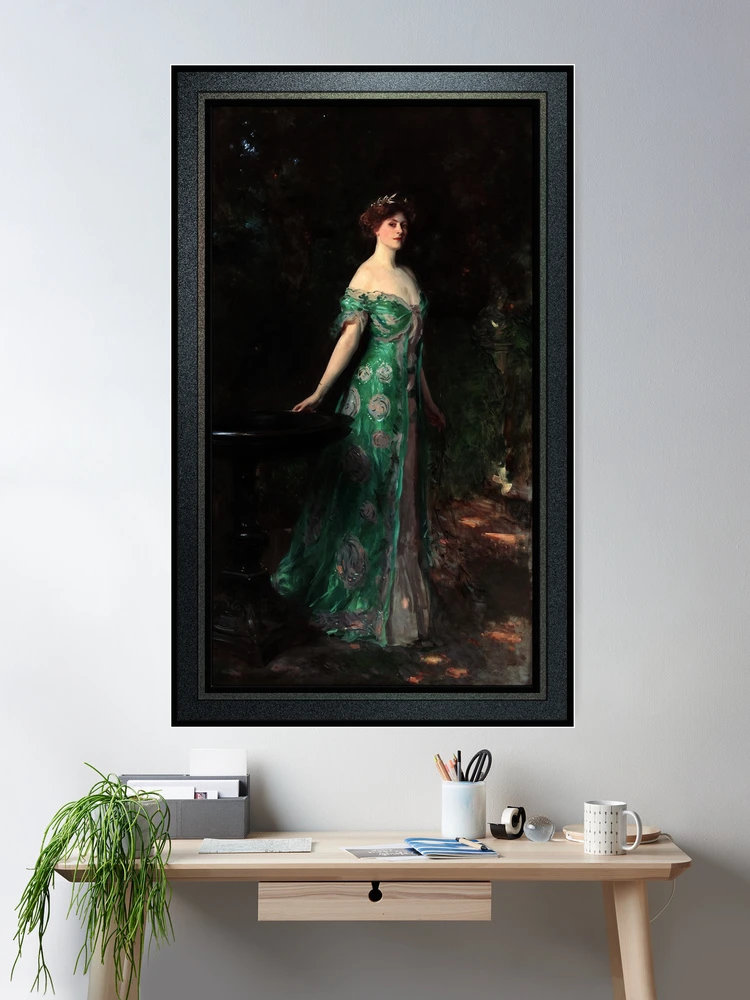
John Singer Sargent’s portrait Millicent Duchess of Sutherland, erin geschilderd 1904, captures the essence of late 19th and early 20th-century portraiture in its sophisticated portrayal of aristocracy. De kunstenaar, born in Italy to American parents, is known for his masterful technique, which is on full display in this oil painting. The portrait features Millicent, Duchess of Sutherland, who was an English aristocrat and socialite of the time.
millicent Hertogin Of Sutherland geboren Millicent Saint Clair Erskine (1867 – 1955); was de oudste dochter van de vierde graaf van Rosslin en Blanche Fitzroy. Toen ze was 17 jaar oud, ze trouwde met Cromartie Sutherland Leveson-Gower, die de titel van hertog van Sutherland erfde in 1892.
The Duchess is depicted in a moment of poised elegance, embodying both her title and her societal role, which adds layers of intrigue and gravitas to the composition. The painting’s theme and mood suggest a balance between refinement and the underlying strength of character that was expected of such women of high society.
Inhoudsopgave
Het belangrijkste onderwerp: Millicent Duchess of Sutherland
At the heart of this masterpiece is Millicent herself, who stands regal and composed in a commanding yet graceful pose. The Duchess is dressed in a lavish gown that catches the viewer’s eye. The rich green color of her gown complements the darker tones of the background, creating a stark contrast that draws attention to her figure. Her gown is adorned with delicate floral motifs that add a touch of softness to the otherwise formal attire.
The exquisite detailing of the dress reveals Sargent’s mastery in portraying fabric textures, every fold and curve of the gown is rendered with remarkable precision, reflecting both light and shadow in ways that evoke the grandeur of the aristocratic world. Haar houding, with one hand resting on a table, gives the impression of quiet confidence, as though she is both part of her surroundings and above them, a fitting representation of her high status.
The Duchess’s face is illuminated with soft, yet confident features, giving her an ethereal quality. Her hair is styled in an elegant updo, topped with a crown of delicate flowers, which subtly underscores her aristocratic position. The face, echter, is not overly made up, allowing her natural beauty and inner character to shine through.
Her gaze is slightly turned towards the viewer, but it carries an air of contemplation, as though she is reflecting on something far beyond the scope of the immediate surroundings. Sargent’s ability to capture this subtle expression adds an emotional depth to the portrait, making the Duchess more than just an object of admiration but rather a subject worthy of reflection.
The Setting and Background
The background of the portrait is a darker, almost abstract composition that contrasts with the finely detailed figure of the Duchess. The deep greens and blacks in the backdrop suggest a garden or outdoor scene, yet the lack of clear definition means the viewer’s attention remains firmly on the subject.
There are subtle hints of foliage and natural elements, perhaps trees or shrubs, that give the impression of an elegant, private space, reinforcing the idea of the Duchess as part of the high society’s cultivated and refined world. The ambiguity of the background helps elevate the figure of Millicent, keeping her at the center of attention and ensuring that her character is the primary focus of the piece.
This blending of the subject with a loosely painted environment allows the viewer to focus on the Duchess’s personality rather than the setting, which serves to emphasize her social status and her connection to nature, perhaps suggesting her high-standing as someone who effortlessly blends with the world around her. The blurred background, daarom, functions not as a mere backdrop, but as a reflection of the Duchess’s connection to both the natural world and the elevated social stratum she occupies.
Materialen en techniek
Sargent’s technique is characterized by his keen observation of light and form, and this portrait is a perfect example of his skill in these areas. The oil paint is applied in rich layers, with soft brushstrokes used for the delicate fabrics of the Duchess’s gown and more defined strokes used for the facial features and crown. The overall effect is one of depth and texture, with the use of light creating a sense of volume and space around the figure. Sargent’s mastery in rendering the fabrics of the dress, particularly the play of light on the smooth, luxurious silk, is a testament to his expertise in capturing the textures of the material world.
The use of color is another vital component of this portrait. The rich green of the gown is juxtaposed with the darker tones of the background, but it is also contrasted with the lighter tones of Millicent’s face and hands, which glow in the light. This strategic use of color not only directs the viewer’s attention but also symbolizes the Duchess’s social position, as if to say that she is the shining jewel in the darker world of aristocracy.
Stijl, Thema, en stemming
The painting exemplifies the formal portraiture style that was prevalent in Sargent’s era. It carries the hallmarks of high-society portraiture, with its focus on elegance, detail, and the ability to convey the subject’s personality and social status through pose and setting. The mood is one of serenity and contemplation, yet there is also an underlying strength and dignity in the Duchess’s expression and posture.
Sargent manages to capture the juxtaposition of femininity and authority, allowing the viewer to sense both the external refinement and the inner strength that Millicent must have possessed as a woman of such high social standing.
The theme of aristocracy is explored through the careful balance between the subject’s physical beauty and the symbol of her social position. Sargent has not only painted a woman of high rank but has also captured the essence of her identity, portraying her as both a representative of the British aristocracy and an individual with her own quiet dignity and complexity.
Conclusie
Millicent Duchess of Sutherland is an exemplary piece of portraiture by John Singer Sargent, capturing both the external beauty and the internal strength of a woman who was at once an individual and a symbol of aristocracy. The artist’s brilliant use of light, kleur, en textuur, along with his ability to convey emotion through a subtle expression, makes this portrait a timeless masterpiece.
It stands as a reflection of the social hierarchy of the time, but also as a powerful tribute to the individual personality of the Duchess herself. This portrait encapsulates the grandeur of its subject, while also presenting her in a way that is both intimate and dignified, inviting the viewer to consider not just the surface, but the depths of her identity.
Millicent Duchess Of Sutherland is een geretoucheerde digitale kunst oude meesters reproductie van een afbeelding uit het publieke domein.
Bio van kunstenaar afgeleid van Wikipedia.org
John Singer Sargent was een Amerikaanse expatriate kunstenaar, beschouwd als de “toonaangevende portretschilder van zijn generatie” voor zijn evocaties van luxe uit het Edwardiaanse tijdperk.
Hij creëerde ongeveer 900 olieverfschilderijen en meer dan 2,000 aquarellen, evenals talloze schetsen en houtskooltekeningen.
Zijn oeuvre documenteert wereldwijde reizen, van Venetië naar Tirol, Korfoe, het Midden-Oosten, Montana, Maine, en Florida.
Geboren in Florence uit Amerikaanse ouders, hij werd opgeleid in Parijs voordat hij naar Londen verhuisde, woont het grootste deel van zijn leven in Europa.
In de jaren 1880 maakte hij een vroege onderwerping aan de Parijse Salon van zijn Madame X Portait c1884, met de bedoeling om zijn positie als societyschilder in Parijs te consolideren; maar in plaats daarvan resulteerde het schilderij in een schandaal.
Het portret van Madame X was van een vooraanstaande socialite, Madame Pierre Gautreau gekleed in een zwarte avondjurk met diepe nek en gouden schouderbanden met diamanten ketting, die haar middel strak streelde. (Volg deze link om de . te bekijken Mevrouw X Portret.)
Voor de tijd, het suggereerde veel Parijzenaars, een indiscreet poseren in onthullende kleding en veroorzaakte een storm van verontwaardiging, Sargent dwingen het land te verlaten.
Het jaar daarop vertrok Sargent naar Engeland, waar hij een succesvolle carrière als portretkunstenaar voortzette; en genoot internationale bekendheid als portretschilder.
Vanaf het begin, Het werk van Sargent werd gekenmerkt door een opmerkelijke technische faciliteit, vooral in zijn vermogen om te tekenen met een penseel; die in latere jaren zowel bewondering als kritiek opriep voor een veronderstelde oppervlakkigheid.
Zijn werken in opdracht waren consistent met de grootse manier van portretteren, terwijl zijn informele studies en landschapsschilderijen vertrouwd waren met het impressionisme.
Op latere leeftijd uitte Sargent ambivalentie over de beperkingen van formeel portretwerk, en wijdde veel van zijn energie aan muurschilderingen en werken en plein air.