

Mischief and Repose c1895
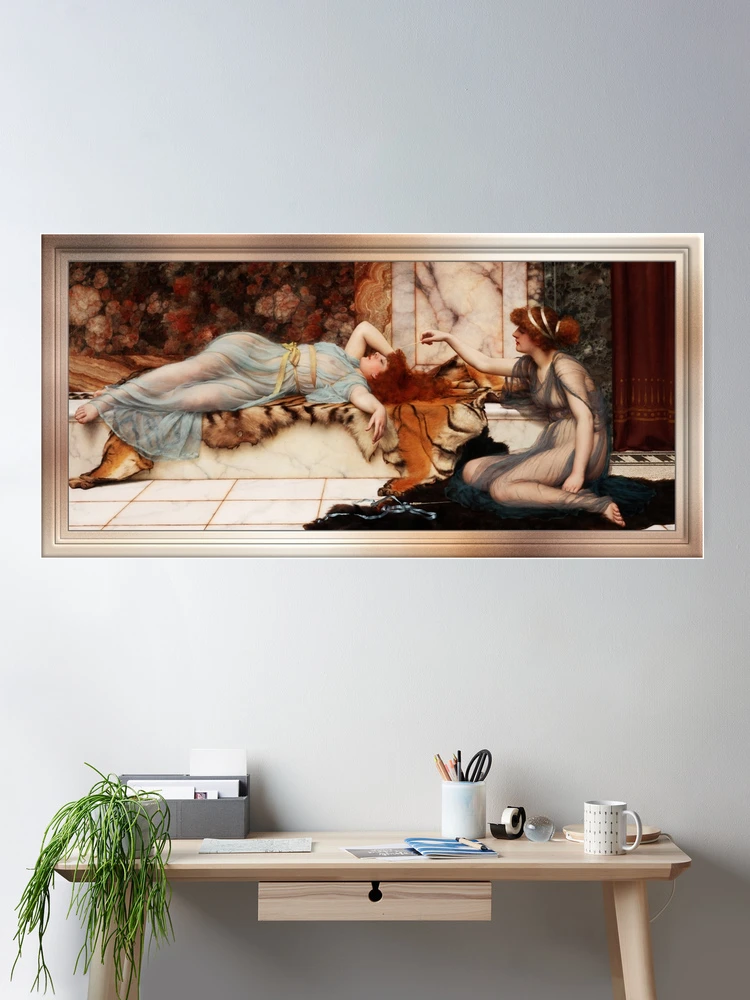
John William Godward’s painting, Míchief and Repose c1895, captures the essence of his signature classical style, offering a glimpse into a world of serene beauty and luxurious indulgence. Diabhalta (1861 – 1922), is known for his exquisite depictions of classical figures and tranquil settings, influenced heavily by the neoclassical traditions. Sa saothar ealaíne seo, Godward combines two starkly contrasting elements: mischief and repose, embodied in the characters of two young women. Through his delicate portrayal of these figures and their environment, Godward delivers a narrative rich with emotional depth and historical reverence.
Clár na nÁbhar
Na Príomhábhair
At the center of the composition are two women, seemingly caught in a delicate moment of interaction. The reclining figure, dressed in a pale gown, lies languidly across a fur-covered divan. A posture, suggestive of repose, hints at an atmosphere of idle relaxation, with her head turned toward the other figure. The relaxed, almost languid pose of the first figure evokes a sense of indifference to the world around her, a luxury afforded only to those of wealth and status in the classical world.
In stark contrast, the second woman leans over her companion with a playful expression, gently touching her hair. This act of mischief is subtle, as she delicately twirls a strand of the reclining woman’s auburn hair around her finger. Her posture—sitting, yet leaning forward with a sense of intent—imbues the scene with a sense of energy and flirtation. The subtle smile that plays on her lips suggests a sense of playful dominance over the other figure, creating a dynamic between the two women.
The Objects and Terrain
The luxurious environment surrounding the figures further amplifies the aristocratic nature of the scene. The figures are placed within a richly adorned room that is designed to exude opulence. The floor is made of polished marble, with intricate geometric patterns that enhance the sense of depth and grandeur. A mór, fur rug rests across the marble floor, providing a luxurious space for the reclining figure. The fur, along with the soft pastel tones of the mná‘s clothing, adds an additional layer of richness to the overall aesthetic.
The background of the painting is equally impressive, with a backdrop of lush, red marble walls that are swirled with white and gold veins. This intricate texture not only suggests wealth but also brings a sense of timelessness to the piece, reinforcing the classical theme that Godward often employed in his works. The use of marble, both on the floor and the walls, enhances the feeling of permanence and the eternal, as if these figures are timeless beings captured in a fleeting moment of mischief and repose.
Ábhair agus Teicníc
John William Godward’s technique in Míchief and Repose is meticulous and refined, demonstrating his exceptional skill in rendering textures and light. His use of oil paints allows for the rich depth of color that enhances the luxurious textures of the fur, marmair, and flowing garments. The women’s skin is rendered with a smoothness that suggests softness, almost ethereal in quality, while the texture of their gowns is meticulously depicted, flowing in soft, natural folds.
The background and foreground are equally well-executed, with Godward’s careful application of light and shadow creating a depth that allows the figures to stand out against the rich marble and fabric. The interplay between the light falling across the women’s faces and bodies highlights their delicate features, adding a sense of realism to the dreamlike setting. The smooth transitions of light between the figures and the environment further demonstrate Godward’s mastery of the medium.
Stíl agus Meon na Saothar Ealaíne
Stíl na Míchief and Repose firmly places it within the neoclassical tradition, with its reverence for classical forms, idealized figures, and an emphasis on harmony and beauty. Godward’s attention to detail and the serene atmosphere he creates exemplify the neoclassical ideals of beauty and perfection. The carefully constructed composition, with its emphasis on geometric patterns in the architecture and the smoothness of the figures’ forms, invites the viewer into a world where the classical past meets the present moment of indulgence and luxury.
The mood of the painting is serene yet charged with a subtle undercurrent of playful tension. The reclining figure exudes tranquility, perhaps representing a moment of inner peace or introspection. I gcodarsnacht, the figure leaning forward to twirl her companion’s hair introduces a moment of flirtatious mischief, breaking the stillness of the scene with a slight gesture. This contrast between repose and mischief lends the painting an air of intrigue, where the viewer is left to wonder about the relationship between the two women and the story unfolding in the quiet space they inhabit.
Godward’s ability to capture the nuances of human interaction, paired with his impeccable technique, makes Míchief and Repose a prime example of the artist’s skill and the allure of the classical tradition. Through his portrayal of these two women, Godward brings to life a moment of contrast, where relaxation and playfulness coexist, offering a snapshot of a world filled with both tranquility and the promise of adventure.
Is é atá i gceist leis seo ná sean-mháistrí ealaíne digití atáirgeadh ar íomhá fearainn phoiblí.
Cruthú ealaíne digiteach seo, mar atá an saothar ealaíne go léir atá le fáil ar shuíomh Gréasáin Xzendor7 ar fáil le ceannach ar líne i bhformáidí éagsúla ábhar lena n-áirítear priontaí canbháis, priontaí aicrileach, priontaí miotail, priontaí adhmaid, priontaí frámaithe, póstaeir, agus mar phriontaí chanbhás rollta i méideanna éagsúla ó 12 orlach go 72 orlach ag brath ar mhéid an tsaothair ealaíne iarbhír agus ar an siopa priontála ar éileamh a roghnaíonn tú an ealaín a cheannach uaidh.
Tá an saothar ealaíne ar fáil freisin ar raon leathan éadaí fear agus ban, mugaí, totes, scaifeanna, leabhair nótaí agus irisleabhair agus go leor táirgí maisiúcháin tí.
Beathaisnéis Ealaíontóir
Eolas Thíos Ó Wikipedia.org
Ba é an duine ba shine de chúigear leanaí é, agus ainmníodh é i ndiaidh a athar John agus a sheanathair William. Baisteadh é ag St.. Eaglais Mhuire i Battersea ar 17 Deireadh Fómhair 1861.
Neo-Chlasaiceach Victeoiriach ab ea Godward, agus dá bhrí sin, go teoiriciúil, leantóir Frederic Leighton. ach, tá baint níos dlúithe aige le Sir Lawrence Alma-Tadema ó thaobh stíle de, lena roinn sé penchant maidir le hailtireacht Chlasaiceach a thabhairt - go háirithe, gnéithe tírdhreacha statacha tógtha as marmair.