

Sra. Abington como Thalia c1783
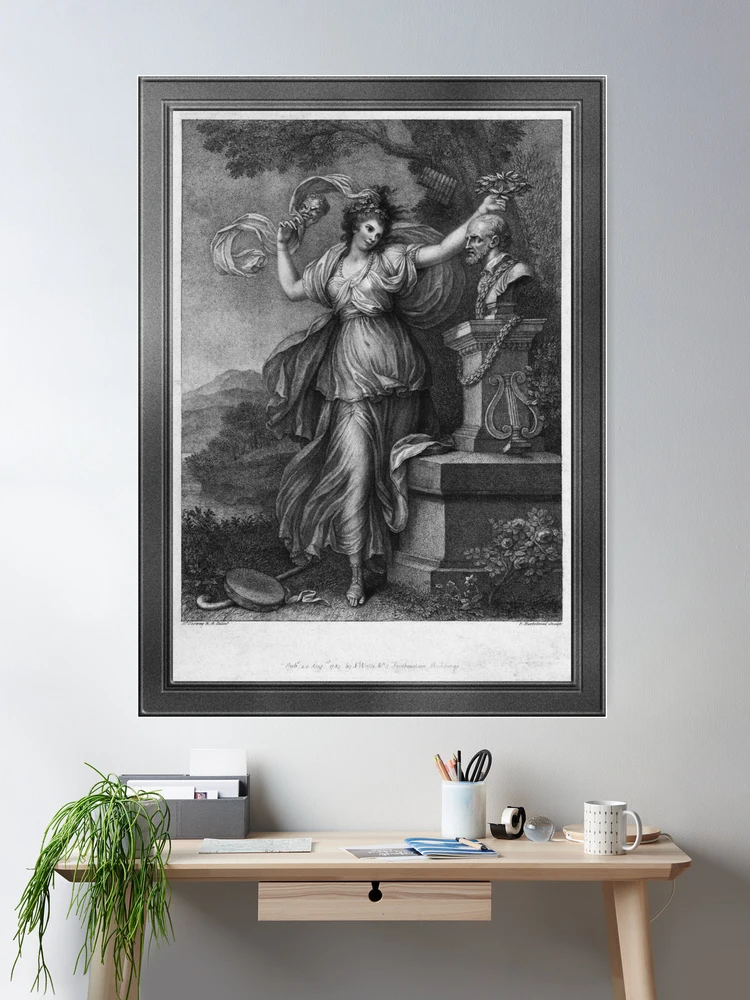
“Sra. Abington como Thalia,” criado em 1783 do gravador italiano Francesco Bartolozzi (1727 – 1815), apresenta a lendária atriz e comediante, Sra.. Abington, em uma cena que evoca a figura mitológica clássica de Thalia, a musa da comédia. A gravura de Bartolozzi é um exemplo requintado da arte neoclássica do século XVIII, capturando a graça e a elegância associadas ao período e, ao mesmo tempo, honrando a tradição teatral da época.
A obra é altamente detalhada e demonstra a expertise de Bartolozzi em gravura, um meio que ele dominou durante sua carreira. Sua habilidade em capturar textura e o fluxo natural da cortina, cabelo, e a pele é evidente, tornando esta obra de arte uma bela representação de seu artesanato. A representação da Sra.. Abington as Thalia radiates an air of playful elegance, blending mythological themes with the real-world personality of the actress. This fusion reflects the period’s tendency to reimagine classical figures through contemporary lenses, a hallmark of the Neoclassical style.
Índice
Assunto principal: Sra.. Abington as Thalia
In this engraving, the central figure is Mrs. Abington herself, dressed as Thalia (one of the nine Greek Muses), she is the Muse of music, dance, comedy and idyllic poetry, standing with her body slightly turned to the left. Her facial expression exudes a sense of joy and vitality, reflecting the Muse’s role in inspiring comedy. Thalia is often depicted in the arts as a lively and playful character, and Mrs. Abington, with her renowned comedic talent, is an ideal representation of this figure.
Sra.. Abington’s attire is in line with the classical tradition, a flowing draped gown, reminiscent of Greco-Roman fashions. The texture of the fabric is captured in great detail, giving it a sense of movement, as though it is gently flowing with an unseen breeze. The rich folds of her dress add to the depth of the engraving, creating a dynamic contrast with the delicate features of her face.
Her right hand holds a ribbon that spirals through the air, a gesture that both directs the viewer’s attention and connects her to the surrounding objects. Her left hand is extended toward the bust of Shakespeare, which is likely a symbolic reference to the intellectual and artistic influence that Thalia, and by extension Mrs. Abington, embodies. The bust is rendered in soft lines, enhancing the contrast with the vibrant movement of the figure of Mrs. Abington.
Objetos e Simbolismo
The ribbon held by Mrs. Abington is not just a decorative element but serves a symbolic purpose. It can be interpreted as representing the flow of creativity and the connection between the Muse of Comedy and the world of the living, signifying the movement of the theatrical arts into the broader cultural sphere. The ribbon swirls delicately in the air, drawing the viewer’s eye in a circular motion around the composition.
On the right side of the artwork stands a bust, likely representing a classical figure, possibly the Greek playwright Menander or another important figure in the history of theater. This symbolic gesture ties the engraving to the intellectual traditions of ancient Greece and Rome, reinforcing the theme of artistic inspiration.
Adicionalmente, the objects scattered at the foot of the figure, including a lyre, hint at the importance of music and song in both comedy and theatrical performance. The lyre, an ancient instrument associated with the Muses, further connects the artwork to its classical roots, offering a visual connection to the arts of antiquity.
Terreno e plano de fundo
The background of the engraving is lush and soft, featuring an ethereal landscape. The soft contours of the trees and the distant mountains add a sense of tranquility, allowing the viewer to focus on the primary subject. A paisagem serve para enquadrar ainda mais a figura central, oferecendo um cenário que enfatiza a pureza e a atemporalidade da cena. Bartolozzi usa hachuras finas e linhas suaves para criar uma sensação de profundidade, com as árvores aparentemente recuando na distância.
O ambiente natural é pacífico, ainda assim complementa o tema da criatividade e desempenho, onde a própria natureza pode ser vista como uma musa. As curvas suaves das colinas e as plantas floridas oferecem um cenário harmonioso para a figura lúdica e vibrante da Sra.. Abington, destacando o contraste entre a figura humana e o mundo natural, e reforçando a ligação entre arte e natureza.
Materiais e Técnicas
A obra de arte é uma gravura, uma técnica pela qual Francesco Bartolozzi era conhecido. A gravação envolve esculpir uma placa de metal para criar uma imagem, que é então pintado e pressionado no papel. O domínio de Bartolozzi neste meio é evidente nos detalhes finos das texturas e nas sutis variações de tons alcançadas através de linhas delicadas e hachuras.. Seu uso de luz e sombra é particularmente notável; a suave gradação de tom da Sra.. A pele e o vestido de Abington criam uma qualidade realista, enquanto o fundo mantém uma aparência mais suave, mais presença atmosférica.
A composição geral é meticulosamente organizada, com cada elemento contribuindo para o equilíbrio da cena. Bartolozzi emprega leve toque nas ferramentas de gravação, permitindo que os detalhes intrincados do tecido e do cabelo brilhem sem sobrecarregar a figura central. The fluidity of the lines in the ribbon and the soft textures of the background enhance the sense of movement and grace, adding to the playful and celebratory mood of the scene.
Tema e humor
The theme of the engraving is firmly rooted in the celebration of the arts and the role of comedy within cultural and intellectual life. Sra.. Abington as Thalia embodies not only the figure of the Muse but also the lively spirit of the 18th-century theatrical world. The use of Thalia, a musa da comédia, aligns with the rising importance of entertainment and performance in the cultural life of the period. The mood is one of lightness, joy, e inspiração, as the figure of Mrs. Abington, with her radiant expression, seems to encourage the viewer to embrace the pleasures of the stage and the arts.
The juxtaposition of classical symbolism with contemporary subjects reflects the Neoclassical movement’s emphasis on reason, ordem, and the revival of classical ideals, as well as the ongoing dialogue between past and present. The engraving not only celebrates the figure of Thalia but also elevates the role of the artist, particularly the actress, in contributing to the cultural fabric of society.
Conclusão
“Sra.. Abington as Thalia” by Francesco Bartolozzi is a masterpiece of 18th-century engraving that seamlessly blends classical mythology with contemporary cultural figures. Through its delicate yet powerful portrayal of Mrs. Abington as the Muse of Comedy, the artwork encapsulates the spirit of the time, celebrating the arts, creativity, and the intellectual legacy of the past. The detailed craftsmanship and the skillful use of light, sombra, and texture elevate this piece as a quintessential example of Neoclassical art, making it a timeless reflection of the era’s aesthetic ideals and cultural values.
Sra.. Abington as Thalia c1783 by Italian Engraver Francesco Bartolozzi (1727 – 1815); as well as a painter, a founding member of the Royal Academy and known for popularizing the crayon method of engraving.
Sra.. Abington as Thalia is a retouched digital art old masters reproduction of a public domain image.
Informações abaixo derivadas de Wikipédia.org
Francesco Bartolozzi
Francesco Bartolozzi was born in Florence, and as was the custom of the time, it was thought that he would follow in his father’s footsteps and become a gold and silver smith.
This though would change since the young Bartolozzi showed a great deal of skill and taste in designing; as a result he was thus placed under the supervision of two Florentine artists, including Italian Painter Ignazio Hugford (1703 – 1778) and Italian Rococo Style Painter Giovanni Domenico Ferretti (1692 – 1768) who instructed him in painting.
After three years of art training, he went to Venice to study engraving; and spent six years working for German Engraver and Draughtsman Joseph Wagner (1706 – 1780), an engraver and printseller, before setting up his own workshop.
The first engraving Francesco Bartolozzi produced in Venice were plates in the style of Italian Baroque Period Painter Marco Ricci (1676 – 1730) and Giacomo Francesco Zuccarelli (1702 – 1788) a Late Baroque or Rococo Period Landscape Painter.
Então em 1762 Bartolozzi moved to Rome for a short period of time, where he completed a set of engravings representing frescoes at Grottaferrata by Italian Baroque Painter Domenichino (Domenico Zampieri 1581 – 1641) depicting the life of St Nilus.
That set of engravings and his etchings of old master’s works, began to draw public attention throughout Europe; e em 1763 he met Richard Dalton (1715 – 1791), draughtsman, engraver and the English Royal Librarian who was traveling in Italy looking for acquisitions for King George III art collection.
Dalton offered him an appointment as Engraver to the King; which Bartolozzi accepted and left for London in 1764; where he lived for 42 anos.
During his time in London he produced a large number of engravings, which included Clytie after Italian Painter Annibale Carracci (1560 – 1609), and of the Virgin and Child, after Italian Baroque Painter Carlo Dolci (1616/7 – 1686).
A large proportion of them are from the works of Italian Painter Giovanni Battista Cipriani (1727 – 1785) and British Painter Angelica Kauffman (1741 – 1807). Bartolozzi also contributed a number of plates to Boydell’s Shakespeare Gallery.