

Mrs Richard Paul Jodrell (Vertue Jodrell) c1774-76
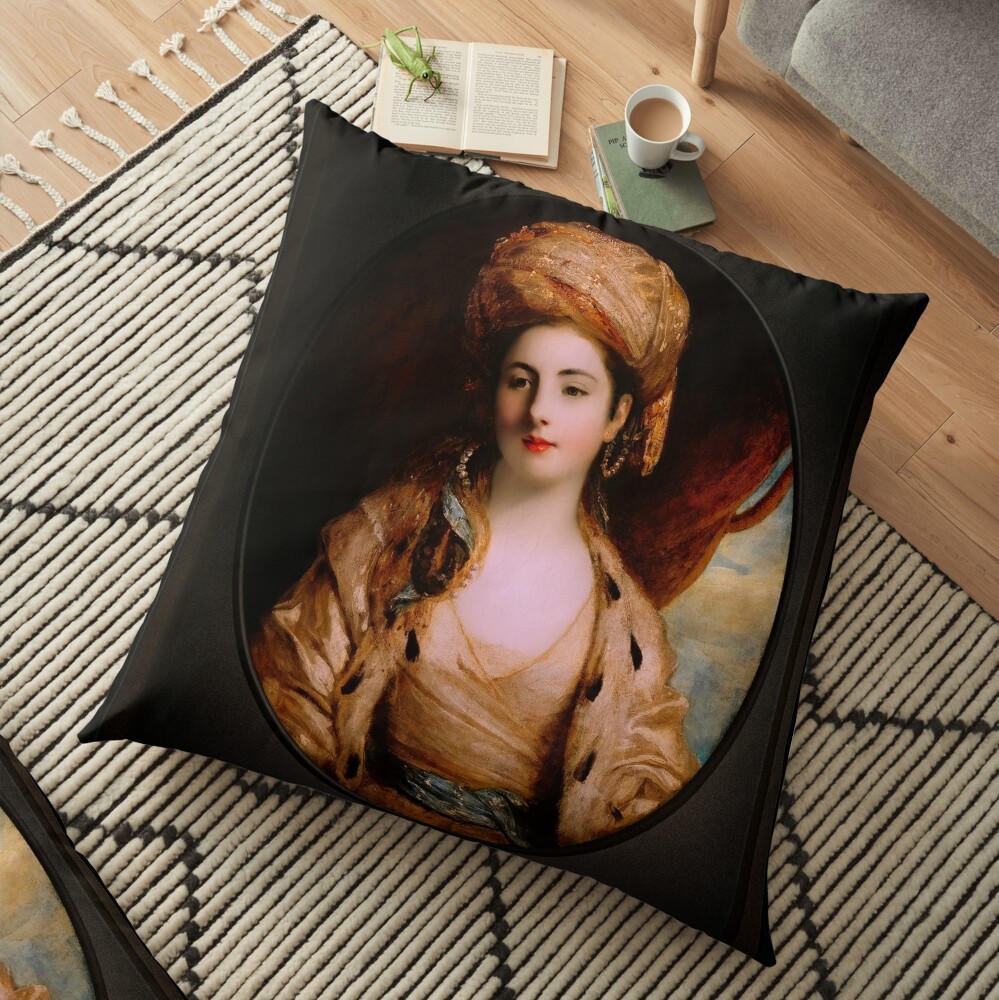
The painting titled Mrs Richard Paul Jodrell (Vertue Jodrell), created between 1774 en 1776 by renowned British artist Sir Joshua Reynolds (1723 – 1792), is a fine example of portraiture from the Georgian era. The work beautifully captures the elegance and opulence of the period, offering a glimpse into the sophistication and style of late 18th-century British society. As was characteristic of Reynolds’ portraits, the depiction combines technical mastery with an emphasis on the sitter’s personality, schoonheid, and social status. The subject of the painting, Mvr. Richard Paul Jodrell, is portrayed in the classical style of the time, dressed in a luxurious gown, with her posture and demeanor radiating an air of refinement.
The composition of the painting places Mrs. Jodrell at the forefront, with a simple yet rich background that serves to enhance her presence. The artist’s use of a muted yet warm color palette reflects the soft lighting and creates an aura of elegance. The figure is delicately framed in a rounded oval shape, an artistic device commonly used in portraiture to emphasize the individual and remove the distraction of a busy background. The fine details of Mrs. Jodrell’s attire and accessories showcase the wealth and status of the sitter, while her poised posture and calm expression speak to her refinement and the grace that Reynolds was known to capture in his subjects.
Inhoudsopgave
Stijl en techniek
Sir Joshua Reynolds was a leading figure in British portraiture during the 18th century, and his work is often associated with the Rococo and early Neoclassical styles. His technical expertise is evident in this portrait, where the careful attention to detail and the rich textures of fabric, huid, and hair are remarkable. Reynolds was known for his use of broad, yet controlled brushstrokes, which can be seen in the way the fabric of Mrs. Jodrell’s gown flows across her body. The smoothness of the skin is masterfully rendered, with subtle highlights and shadows that give her face a lifelike glow.
The soft modeling of light on her face and gown enhances her beauty and grace, a hallmark of Reynolds’ technique. The rendering of her delicate features, her slightly turned head, her serene expression, and the gentle contours of her neck and shoulders, further exemplifies Reynolds’ ability to blend realism with idealization. De achtergrond, rendered with soft, painterly strokes, emphasizes the subject without detracting from her importance. It is not an overtly detailed scene but rather a calming, harmonious backdrop that contrasts with Mrs. Jodrell’s rich attire and radiant skin.
Reynolds employed a method of creating texture that was very advanced for his time. The folds in the fabric of Mrs. Jodrell’s gown appear soft and luxurious, while the sheen on her silk shawl suggests its weight and tactile quality. The use of light and shadow gives volume to the materials, making them almost tangible. Haar haar, styled in the fashionable high coiffure of the time, is both finely rendered and stylish, further demonstrating Reynolds’ mastery over different textures.
Thema en stemming
The mood of this portrait is one of poised elegance and serene composure. Mvr. Jodrell is depicted as a woman of dignity and grace, her face reflecting a calm and confident demeanor. This was typical of the period’s portraiture, where subjects were often shown in a light that conveyed their higher social standing and respectable character. The calmness in her expression suggests a certain inner strength, as well as the social expectations placed on women of the time, especially those of the upper classes.
The theme of the portrait is one of refinement and status, not only in Mrs. Jodrell’s appearance but also in her surroundings. The rich materials of her gown, her fine jewelry, and the overall elegance of her attire suggest that she was a woman of means, likely from a prominent family in Georgian Britain. The softness of the lighting and the minimalistic background emphasize her figure, making her the undeniable focus of the painting. There is a sense of formality in the composition, suggesting that the portrait was commissioned to showcase her elegance and social prominence, as well as her connection to the artistic and intellectual circles of the time.
The oval framing of the portrait adds to this sense of timelessness, making it seem as though Mrs. Jodrell’s grace and poise are eternal qualities. The use of an oval frame was a common device in Reynolds’ portraits, serving to give the subject an almost saintly, immortal quality. The lack of a highly detailed background further isolates her from the surrounding world, directing the viewer’s attention entirely on her.
The Significance of the Portrait
The portrait of Mrs. Richard Paul Jodrell (Vertue Jodrell) is significant not only as a work of art but also as a representation of the role and image of women in 18th-century British society. It offers a glimpse into the fashion, schoonheid, and social mores of the Georgian period, providing a historical record of the attire, posture, and composure expected of women in the upper echelons of society.
For Reynolds, this portrait reflects his ability to transcend the simple act of depicting a person and instead craft an image of lasting elegance. He was able to capture the essence of his subjects, making each portrait an exploration of their character, personality, and social position. In this particular portrait, Mvr. Jodrell’s beauty and wealth are undeniable, but there is also a deeper sense of humanity and grace that resonates through Reynolds’ masterful rendering.
As one of Reynolds’ key contributions to British portraiture, this work remains an iconic example of 18th-century portrait art, a testament to his skill and his understanding of both his subjects and the world around him. It continues to captivate audiences with its timeless elegance and the sophistication of the period it represents.
Dit is een retoucheerde reproductie van digitale kunst oude meesters van een openbaar domeinafbeelding die voor aankoop online beschikbaar is als a canvas print.
Bio van kunstenaar afgeleid Wikipedia.org
Sir Joshua Reynolds PRA FRS FRSA (16 juli- 1723 – 23 Februari 1792) was een Engelse schilder, gespecialiseerd in portretten. John Russell zei dat hij een van de belangrijkste Europese schilders van de 18e eeuw was.[1] Hij promootte de “Goede stijl” in de schilderkunst die afhing van de idealisering van het onvolmaakte. Hij was een van de oprichters en eerste president van de Royal Academy of Arts, en werd geridderd door George III in 1769.
Reynolds werd geboren in Plympton, Devon, Aan 16 juli- 1723[2] de derde zoon van de Rev. Samuel Reynolds, meester van de Plympton Free Grammar School in de stad. Zijn vader was een fellow van Balliol College geweest, Oxford, maar stuurde geen van zijn zonen naar de universiteit.[3] Een van zijn zussen was Mary Palmer (1716–1794), zeven jaar ouder dan hij, auteur van Devonshire Dialogue, wiens voorliefde voor tekenen veel invloed op hem zou hebben gehad toen hij een jongen was?.
In 1740 ze gaf £ 60, de helft van de premie betaald aan Thomas Hudson de portretschilder, voor de leerling van Joshua, en negen jaar later schoot hij geld voor voor zijn uitgaven in Italië. Zijn andere broers en zussen waren onder meer Frances Reynolds en Elizabeth Johnson.
Als jongen, hij kwam onder de invloed van Zachariah Mudge, wiens platonistische filosofie hem zijn hele leven bijbleef?. Reynolds maakte uittreksels in zijn alledaagse boek van Theophrastus, Plutarchus, Seneca, Mark Anthony, Ovidius, William Shakespeare, John Milton, Alexander Pope, John Dryden, Joseph Addison, Richard Steele, Aphra Behn, en passages over kunsttheorie van Leonardo da Vinci, Charles Alphonse Du Fresnoy, en André Félibien.
Het werk dat de meeste invloed op Reynolds kreeg, was An Essay on the Theory of Painting van Jonathan Richardson. (1715). Reynolds’ geannoteerde kopie ging bijna tweehonderd jaar verloren totdat het in een boekwinkel in Cambridge verscheen, gegraveerd met de handtekening 'J. Reynolds Pictor', en is nu in de collectie van de Royal Academy of Arts, Londen.