

Netty But Nice
“Netty But Nice!” is an iconic illustration by the American artist Boliau Enoch, wedi'i greu yn 1930. Bolles, eni yn 1883 a marw i mewn 1976, was known for his depictions of glamorous women, and this artwork exemplifies his mastery of the pin-up genre. The piece features a seductive and playful portrayal of a fashionable woman, exuding confidence, charm, a allure. Through her demeanor and attire, Bolles captures the spirit of the Jazz Age, a time when both art and culture were evolving rapidly. The use of bold, stylized forms and rich colors contributes to a sense of luxury and refinement, perfectly suited for the era’s fascination with fashionable women.
Tabl Cynnwys
Prif Bwnc a Chyfansoddiad
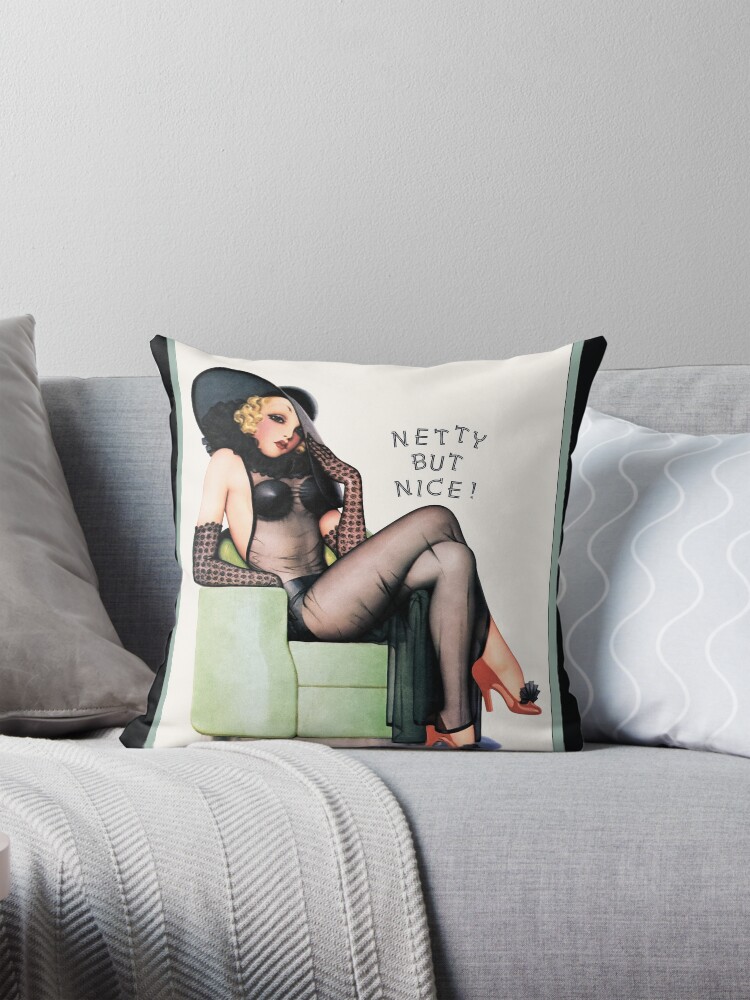
At the center of “Netty But Nice!” sits a woman in a relaxed pose. Her figure is elongated and elegantly framed, dressed in a form-fitting, sheer outfit that suggests both sensuality and sophistication. She lounges on a green upholstered chair, her body turned slightly to the side as if she is engaged in a casual yet seductive conversation.
The model’s attire is distinctive, consisting of sheer black stockings, a black dress with a fitted bodice, and a wide-brimmed black hat that covers much of her curly hair. Ei hosgo, though relaxed, maintains an air of composure, with one arm resting nonchalantly on the arm of the chair and the other draped over her knee. Her right foot is perched atop a bright red high heel, an accessory that adds a sense of dynamism to her otherwise composed demeanor.
The woman’s face is framed with soft, voluminous curls that cascade over her shoulder, while her expression is playful, tinged with a sense of mystery. Ei dywyll, arched eyebrows and inviting eyes draw the viewer’s gaze directly to her face, enhancing the flirtatious tone of the piece. The words “NETTY BUT NICE!” are printed in bold, art-deco style letters beside her, contributing to the overall cheeky nature of the artwork. The caption serves not only as a playful commentary on the woman’s character but also as a nod to the witty, flirtatious culture of the time.
Gwrthrychau a Manylion
The setting in “Netty But Nice!” is minimalist, with the woman seated in a simple but elegant green armchair. The chair’s design, with its smooth, rounded back and metallic base, embodies the streamlined, modern aesthetics of the early 20th century, known for its Art Deco influence.
The green upholstery of the chair contrasts sharply with the woman’s sheer black attire, further drawing attention to her as the focal point. Beneath the chair, the gleaming metallic base hints at the luxurious materials favored during the 1930s, blending comfort with high style. The absence of intricate background detail, focusing all attention on the woman, highlights the visual simplicity that was characteristic of pin-up art at the time.
The woman’s high heels are bright red, an intentional color choice to further emphasize her elegance and assert her femininity. These shoes, with their prominent red hue and flower embellishments, make a striking statement that aligns with the bold, attention-grabbing nature of pin-up culture.
The stockinged legs are another focal point, with delicate lace details visible along the tops of the stockings. These subtle details enhance the sense of allure and sensuality that Bolles frequently portrayed in his work. Her choice of accessories—a black wide-brimmed hat and fishnet gloves—are reflective of the fashionable trends of the 1920s and 1930s. Gyda'n gilydd, they serve as visual markers of the woman’s high social standing, soffistigeiddrwydd, and desirability.
Arddull, Thema, a hwyliau
Enoch Bolles’ work is often associated with the pin-up style, a genre that emerged in the early 20th century and became synonymous with American pop culture during the 1920s and 1930s. Pin-up art was known for its stylized, glamorous depictions of women, often with an air of cheeky playfulness and flirtation. “Netty But Nice!” is a quintessential example of this style, with Bolles’ masterful use of clean lines, minimal background, and attention to the details of fashion and posture. The figure of the woman is portrayed with smooth, flowing lines that emphasize the elegance of her shape, while the soft color palette of pastels and neutrals accentuates the visual harmony of the piece.
The overall theme of the painting reflects the social and cultural ideals of the time, which often celebrated youthful beauty, synhwyraidd, and feminine allure. The exaggerated proportions of the woman’s figure, such as her long, elegant legs and hourglass shape, exemplify the idealized vision of the female form that was common in pin-up art. The playful tone of the caption “NETTY BUT NICE!” further underscores the lighthearted nature of the work, reflecting the confident and independent woman of the 1930s who embodied both sophistication and fun.
The mood of the artwork is one of relaxed confidence. The woman appears self-assured, sitting comfortably in her chair, yet her gaze and posture suggest an invitation, drawing the viewer into her world of charm and flirtation. Her carefree attitude and the subtle sensuality of her pose create a timeless sense of allure that continues to captivate audiences today. The combination of bold color choices, streamlined composition, and elegant fashion elements produces a sense of timeless beauty that remains quintessentially American in its cultural appeal.
Nghasgliad
“Netty But Nice!” by Enoch Bolles captures the essence of 1930s glamour, exemplifying the fashion, hyder, and playful spirit of the time. With its elegant yet playful portrayal of the female form, the painting serves as a reflection of an era fascinated by beauty and style, while also embodying the carefree and confident attitude of the modern woman. Through Bolles’ use of color, llinell, a chyfansoddiad, the artwork continues to resonate as a classic example of American pin-up art.
Mae hwn yn atgynhyrchiad hen feistri celf ddigidol wedi'i atgynhyrchu o ddelwedd parth cyhoeddus.
Y greadigaeth gelfyddyd ddigidol hon, fel gyda'r holl waith celf sydd i'w gael ar wefan Xzendor7 ar gael i'w brynu ar-lein mewn amrywiaeth o fformatau deunydd gan gynnwys printiau cynfas, printiau acrylig, printiau metel, printiau pren, printiau wedi'u fframio, posteri, ac fel printiau cynfas wedi'u rholio mewn amrywiaeth o feintiau o 12 modfedd i 72 modfeddi yn dibynnu ar faint y gwaith celf gwirioneddol a'r siop argraffu ar alw y byddwch yn dewis prynu'r celf ohoni.
Mae’r gwaith celf hefyd ar gael ar ystod eang o ddillad dynion a merched, mygiau, totes, sgarffiau, llyfrau nodiadau a chyfnodolion a llawer o gynhyrchion addurno cartref.
Bio artist
Gwybodaeth Islaw sy'n Deillio o Wikipedia.org
Ganwyd Enoch i'r fferyllydd persawr Enoch Bolles, Jr a Catherine Keep yn Sir Marion, Florida ar Fawrth 3, 1883.
Astudiodd yn Academi Dylunio Genedlaethol Efrog Newydd (yn. 1825), a chyhoeddodd ei ddarlun cyntaf ar gloriau cylchgronau hiwmor; Barnwr a Puck i mewn 1914; dod yn fwyaf adnabyddus am ddarlunio'r cylchgrawn mwydion Film Fun.
Yna i mewn 1923 daeth yn artist clawr unigryw i Film Magazine a byddai'n parhau yn y swydd honno tan 1943, pan ddaeth y cylchgrawn yn ddioddefwr ymgyrch y Postfeistr Cyffredinol ar y pryd yn erbyn deunydd salaf.
Yn ystod cyfnod Enoch gyda Film Fun Magazine fe greodd 200 darnau yn cwmpasu celf, ac o leiaf 300 cloriau ychwanegol ar gyfer cylchgronau mwydion sbeislyd eraill, gan gynnwys Storïau Awel, Nosweithiau Pep ac Efrog Newydd.
Mae rhaglen fisol Enoch o'r Harddwch All-Americanaidd wedi'i gosod yn fanwl gywir mewn gwisg ddychmygus yn gyfrifol am ddiffinio celfyddyd American Pin Up Illustration. Roedd hefyd yn ddarlunydd amryddawn a greodd gelfyddyd hysbysebu ar gyfer llawer o gynhyrchion y cyfnod megis Sun-Maid Raisins a Zippo Lighters.
Yn oed 60, yn 1943 Roedd yn rhaid i Enoch ddod â gyrfa broffesiynol i ben oherwydd problemau seicolegol, a chyfyngwyd ef i Ysbyty Seiciatrig Greystone Park yn New Jersey am y rhan fwyaf o'i oes; ond parhaodd i beintio portreadau comisiwn ac er mwynhad personol.
Yn y diwedd cafodd ei ryddhau o Ysbyty Seiciatrig Greystone Park yn 1969 a bu farw saith mlynedd yn ddiweddarach o fethiant y galon yn 93.