

Odalisque c1858
“Odalisque c1858” is a masterpiece by the French artist Henri Pierre Picou, who lived from 1824 a 1895. Pintat en 1858, this artwork represents a fine example of Romanticism, a movement that sought to convey deep emotion, sensualitat, and vivid imagery. The subject matter and composition reflect the opulence and sensuality typical of the 19th-century French salons. Picou’s work, filled with vivid color and graceful detail, encapsulates the atmosphere of the Orient and the allure of the harem, an artistic theme that gained popularity in European art during the 19th century.
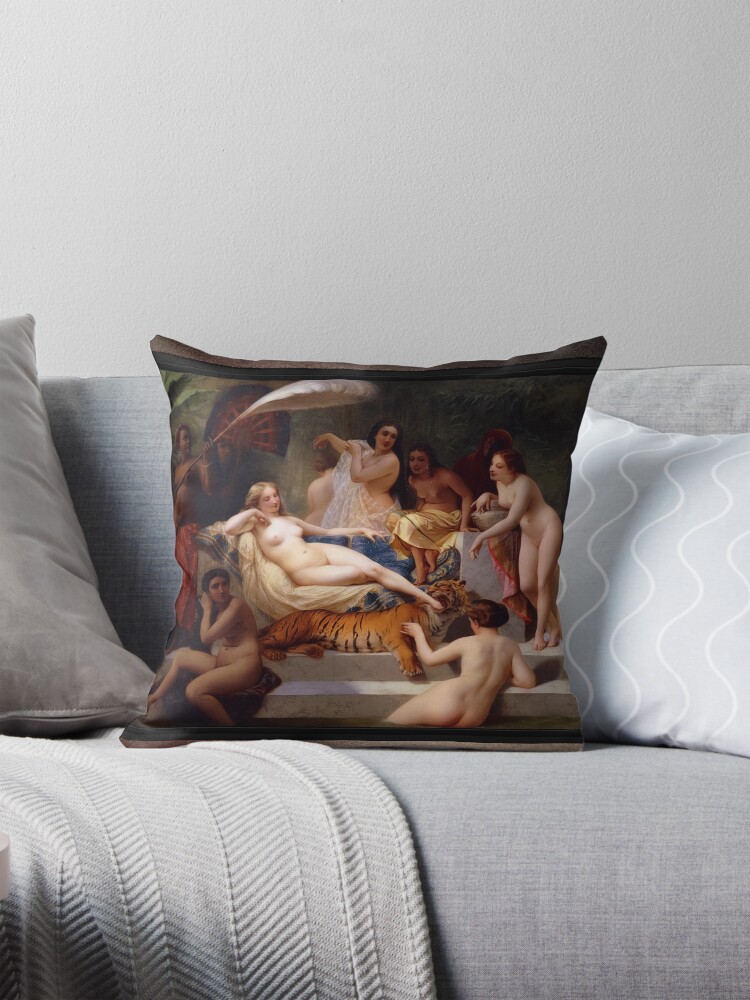
The painting depicts an exotic and opulent scene set within a lush, green garden. En primer pla, a reclining nude woman lies draped over a luxurious tiger skin rug, her body elegantly posed to convey both relaxation and sensuality.
El tema del quadre, often referred to as an “odalisque” in the art world, refers to a woman in a harem, typically a concubine or servant, though in this case, the figure embodies a sense of power and beauty rather than mere submission. The subject’s position, partially turned to the side, suggests a moment of repose, and her expression, while not overly emotive, evokes a serene yet slightly aloof mood. The figure is meticulously detailed, amb suau, porcelain-like skin that contrasts with the vivid richness of her surroundings.
Taula de continguts
The Setting and Composition
The background of the painting is a lush, natural setting, with the surrounding foliage creating a sense of depth and enclosure. The warm tones of the earth and the deep greens of the trees contrast against the vibrant golds and turquoises of the woman’s attire, which consists of flowing, sheer fabrics. These colors and textures evoke a sense of Eastern luxury, in line with the Romanticized view of the Orient that was prevalent in European art of the time.
The setting itself, comprising not just a garden but also figures of other women and servants—adds a sense of social hierarchy to the piece. En el fons, several other figures are partially visible. Some women are depicted in various stages of undress, attending to the main figure in a way that suggests both intimacy and exotic allure. The way they are positioned around the central figure highlights the harem setting and the role of women within it. The inclusion of a tiger further adds to the exoticism, as it symbolizes power and mystery, reflecting the theme of untamed nature and luxury.
The Figures and Their Role
In addition to the reclining odalisque, the painting features a number of secondary figures, including female attendants and an exotic servant. One such figure stands at the back, holding a fan and facing the central figure, adding to the dynamic of the scene. The presence of these figures serves to reinforce the sense of the harem environment, where women are not only objects of desire but also part of a larger, intricate social structure.
The figures in the painting are rendered with remarkable attention to detail, especially in terms of their anatomy and expressions. The artist pays great care to the human form, emphasizing the smoothness and softness of the flesh in stark contrast to the more tactile textures of the tiger skin rug and the surrounding environment. The female figures, each with their unique postures and roles, form a visual harmony that draws the viewer’s eye back to the central reclining figure.
Symbolism and Theme
The central theme of the painting is the depiction of female sensuality, and by extension, the romanticized concept of the Orient. In the 19th century, the harem became a popular subject in European art, often seen as a symbol of luxury, forbidden beauty, and exotic allure. malgrat això, Picou’s portrayal moves beyond a simple depiction of sensuality, suggesting a more complex narrative about power, desire, and the roles of women in different cultures.
The use of the tiger skin rug as a central motif is highly symbolic. Tigers, in European art, were often associated with untamed forces, força, and sometimes danger. La dona, by lying atop the tiger, suggests her control over the ferocity and wildness of the animal, a metaphor for both her own power and the heightened sense of mystery associated with the East. The female form, smooth and vulnerable, is in contrast with the wildness of the tiger, yet it is not subdued or submissive, it is regal, calma, and in control of her surroundings.
The harem, as depicted in this piece, is less a place of confinement than a space of empowerment and mystery, where women exist outside the usual rules of society and are able to express a more sensual and liberated existence. This is reflected in the calm demeanor of the central figure and the luxuriousness of the scene itself. By presenting the odalisque in a state of repose, Picou adds a layer of depth to the piece, suggesting that the woman’s power lies not in overt action, but in her allure, her mystery, and her presence.
The Mood and Emotional Tone
The mood of the painting is one of quiet luxury and latent power. The serene expression of the central figure contrasts with the more active, yet passive, roles of the other women and the exotic environment around her. The sensuality in the painting is not overtly provocative but is instead conveyed through the soft lines of the female form, the opulence of the setting, and the harmonious interaction between the figures and their surroundings. There is an almost dreamlike quality to the scene, enhanced by the naturalistic details and the rich color palette.
The interaction between the various figures in the painting, some passive, others active, creates a subtle tension within the composition. This interplay of emotions and roles adds a layer of narrative complexity to the piece, allowing the viewer to interpret the scene in a variety of ways, depending on their own perspective.
Conclusió
Henri-Pierre Picou’s “Odalisque c1858” is an exquisite representation of 19th-century French Romanticism. Through the lush, sensual portrayal of the reclining figure and the exotic environment, Picou creates a mood that combines luxury with mystery. The painting encapsulates the fascination with the Orient that was prevalent during the era, while also exploring themes of power, sensualitat, i feminitat. Its careful composition, attention to detail, and use of symbolism make it a work of enduring beauty, capturing a moment in time when the allure of the harem was woven into the fabric of European artistic imagination.
Odalisque c1858 by French Painter Henri Pierre Picou (1824 – 1895); known for his early portrait work and historical subject matter and in his later years for his Allegorical and Mythological themes
An Odalisque was a female attendant or chambermaid in a Turkish Seraglio (a sequestered living quarter used by wives and concubines in an Ottoman household.).
This Odalisque painting shows a nude central female figure who may be the main wife or Concubine, is resting on a marble couch that is padded with decorative pillows and sheets; that is part of a double stacked marble base that leads to a pool; and in the background there are green plants.
She is surrounded by eight other nude women; two that are partially in the pool of water. with one petting a young tiger that is putting the foot of the main female into its mouth.
There are also three more females (which are most like the Odalisque), that one can assume are slaves that are providing for the needs of the other women that are relaxing on the marble pedestal.
Odalisque is a retouched digital art old masters reproduction of a public domain image that you can purchase as home decor wall art prints.
Aquesta creació d'art digital, com amb totes les obres d'art que es poden trobar al lloc web de Xzendor7, es poden comprar en línia en una varietat de formats de material, incloses impressions de llenç, impressions acríliques, estampes de metall, estampes de fusta, impressions emmarcades, cartells, i com impressions de llenços enrotllats en una varietat de mides de 12 polzades a 72 polzades depenent de la mida de l'obra d'art real i de la botiga d'impressió sota demanda on trieu comprar l'art.
L'obra d'art també està disponible en una àmplia gamma de roba d'home i dona, tasses, bosses, mocadors, quaderns i revistes i molts productes de decoració de la llar.
Artista Bio
Informació a continuació derivada de Wikipedia.org
Henri-Pierre va ser un pintor acadèmic i un dels fundadors de l'escola Neo-Grec, juntament amb els seus amics íntims Gustave Boulanger, Jean-Léon Gérôme, i Jean-Louis Hamon, també pintors acadèmics.
Tots els homes van estudiar als tallers de Paul Delaroche i posteriorment de Charles Gleyre. L’estil de Picou es va veure influït notablement per Gleyre; mentre que la resta del grup pintava generalment temes clàssics i mitològics.
Picou va debutar per primera vegada amb estil artístic al Saló de Barcelona 1847; i l'any següent va rebre una medalla de segona classe per la seva pintura, Cleopatra i Anthony a Cydnus. També coneguda com Cleòpatra a Cydnus, es considera comunament com l’obra mestra de Picou.
La projecció al Saló de Barcelona 1848 de Cléopâtre et Antoine sur le Cydnus va ser escrit pel crític Théophile Gautier, que considerava que el tema era massa ambiciós, però també ho va dir “Com és, dóna la millor esperança per al futur del jove artista, i se situa entre les set o vuit pintures més importants del saló.”
En 1875, el quadre es va exposar a Nova York, i després va trobar un lloc a les parets d’una galeria d’art privada a San Francisco.
Picou mantenia un gran taller a París al bulevard de Magenta, cosa que li va proporcionar espai per treballar els seus frescos expansius. La seva popularitat va continuar augmentant i va guanyar el Segon Premi de Roma a 1853 per la seva pintura, Jesús expulsant els venedors del temple (Els prestamistes van perseguir el temple), i una altra medalla de segona classe per la seva pintura al saló 1857.
Des del moment del seu debut a Barcelona 1847, es va convertir en un habitual del Saló, mostrant-se gairebé cada any fins a la seva última exposició a 1893. Ha estat anomenat el pintor més de moda cap al final del Segon Imperi Francès; i va rebre molts encàrrecs, incloent encàrrecs de grans frescos religiosos de moltes esglésies, que incloïa l’Église Saint-Roch.