

Odalisque c1858
“Odalisque c1858” is a masterpiece by the French artist Henri-Pierre Picou, who lived from 1824 na 1895. Painted in 1858, this artwork represents a fine example of Romanticism, a movement that sought to convey deep emotion, smyslnost, and vivid imagery. The subject matter and composition reflect the opulence and sensuality typical of the 19th-century French salons. Picou’s work, filled with vivid color and graceful detail, encapsulates the atmosphere of the Orient and the allure of the harem, an artistic theme that gained popularity in European art during the 19th century.
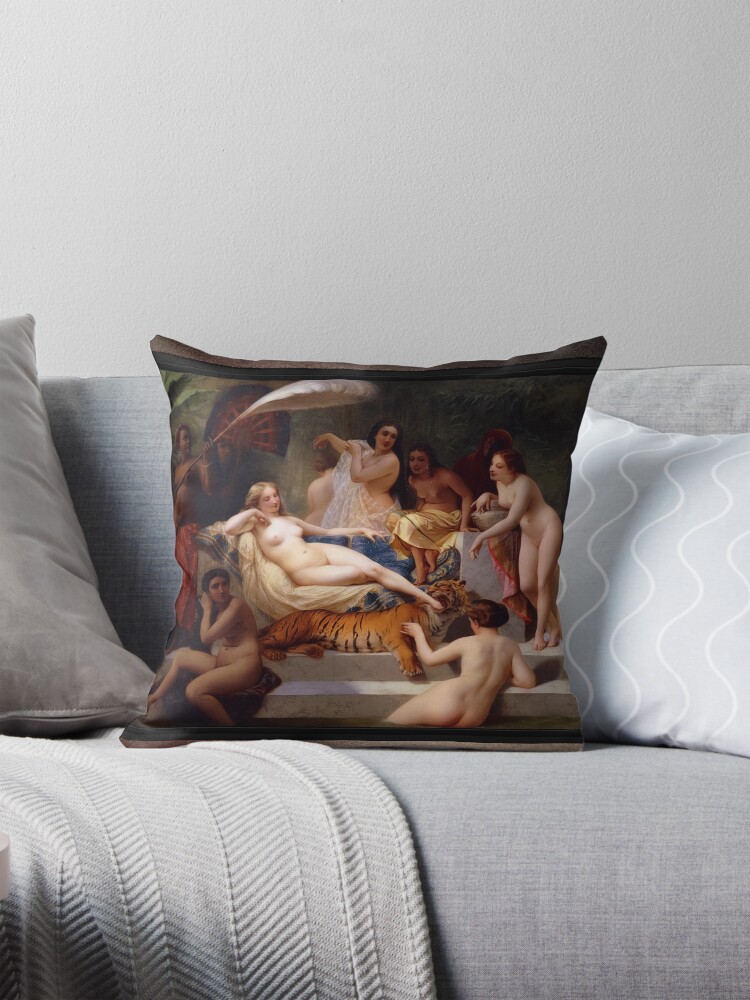
The painting depicts an exotic and opulent scene set within a lush, green garden. V popředí, a reclining nude woman lies draped over a luxurious tiger skin rug, her body elegantly posed to convey both relaxation and sensuality.
Předmět malby, often referred to as an “odalisque” in the art world, refers to a woman in a harem, typically a concubine or servant, though in this case, the figure embodies a sense of power and beauty rather than mere submission. The subject’s position, partially turned to the side, suggests a moment of repose, a její výraz, while not overly emotive, evokes a serene yet slightly aloof mood. The figure is meticulously detailed, with soft, porcelain-like skin that contrasts with the vivid richness of her surroundings.
Obsah
The Setting and Composition
The background of the painting is a lush, přírodní nastavení, with the surrounding foliage creating a sense of depth and enclosure. The warm tones of the earth and the deep greens of the trees contrast against the vibrant golds and turquoises of the woman’s attire, which consists of flowing, sheer fabrics. These colors and textures evoke a sense of Eastern luxury, in line with the Romanticized view of the Orient that was prevalent in European art of the time.
The setting itself, comprising not just a garden but also figures of other women and servants—adds a sense of social hierarchy to the piece. V pozadí, several other figures are partially visible. Some women are depicted in various stages of undress, attending to the main figure in a way that suggests both intimacy and exotic allure. The way they are positioned around the central figure highlights the harem setting and the role of women within it. The inclusion of a tiger further adds to the exoticism, as it symbolizes power and mystery, reflecting the theme of untamed nature and luxury.
The Figures and Their Role
In addition to the reclining odalisque, the painting features a number of secondary figures, including female attendants and an exotic servant. One such figure stands at the back, holding a fan and facing the central figure, adding to the dynamic of the scene. The presence of these figures serves to reinforce the sense of the harem environment, where women are not only objects of desire but also part of a larger, intricate social structure.
The figures in the painting are rendered with remarkable attention to detail, especially in terms of their anatomy and expressions. The artist pays great care to the human form, emphasizing the smoothness and softness of the flesh in stark contrast to the more tactile textures of the tiger skin rug and the surrounding environment. The female figures, each with their unique postures and roles, form a visual harmony that draws the viewer’s eye back to the central reclining figure.
Symbolism and Theme
The central theme of the painting is the depiction of female sensuality, and by extension, the romanticized concept of the Orient. V 19. stol, the harem became a popular subject in European art, often seen as a symbol of luxury, forbidden beauty, and exotic allure. nicméně, Picou’s portrayal moves beyond a simple depiction of sensuality, suggesting a more complex narrative about power, desire, and the roles of women in different cultures.
The use of the tiger skin rug as a central motif is highly symbolic. Tigers, in European art, were often associated with untamed forces, pevnost, and sometimes danger. Žena, by lying atop the tiger, suggests her control over the ferocity and wildness of the animal, a metaphor for both her own power and the heightened sense of mystery associated with the East. The female form, smooth and vulnerable, is in contrast with the wildness of the tiger, yet it is not subdued or submissive, it is regal, uklidnit, and in control of her surroundings.
The harem, as depicted in this piece, is less a place of confinement than a space of empowerment and mystery, where women exist outside the usual rules of society and are able to express a more sensual and liberated existence. This is reflected in the calm demeanor of the central figure and the luxuriousness of the scene itself. By presenting the odalisque in a state of repose, Picou adds a layer of depth to the piece, suggesting that the woman’s power lies not in overt action, but in her allure, her mystery, and her presence.
The Mood and Emotional Tone
The mood of the painting is one of quiet luxury and latent power. The serene expression of the central figure contrasts with the more active, yet passive, roles of the other women and the exotic environment around her. The sensuality in the painting is not overtly provocative but is instead conveyed through the soft lines of the female form, the opulence of the setting, and the harmonious interaction between the figures and their surroundings. There is an almost dreamlike quality to the scene, enhanced by the naturalistic details and the rich color palette.
The interaction between the various figures in the painting, some passive, others active, creates a subtle tension within the composition. This interplay of emotions and roles adds a layer of narrative complexity to the piece, allowing the viewer to interpret the scene in a variety of ways, depending on their own perspective.
Závěr
Henri-Pierre Picou’s “Odalisque c1858” is an exquisite representation of 19th-century French Romanticism. Through the lush, sensual portrayal of the reclining figure and the exotic environment, Picou creates a mood that combines luxury with mystery. The painting encapsulates the fascination with the Orient that was prevalent during the era, while also exploring themes of power, smyslnost, and femininity. Its careful composition, pozornost k detailům, and use of symbolism make it a work of enduring beauty, capturing a moment in time when the allure of the harem was woven into the fabric of European artistic imagination.
Odalisque c1858 od francouzského malíře Henri-Pierre Picou (1824 – 1895); známý svou ranou portrétní tvorbou a historickými náměty a v pozdějších letech svými alegorickými a mytologickými náměty
Odalisque byla průvodčí nebo komorná v tureckém Seragliu (oddělená obytná čtvrť používaná manželkami a konkubínami v osmanské domácnosti.).
Tento odaliský obraz ukazuje nahou ústřední ženskou postavu, která může být hlavní manželkou nebo konkubínou, odpočívá na mramorovém gauči, který je polstrovaný dekorativními polštáři a prostěradly; která je součástí dvojité skládané mramorové základny, která vede k bazénu; a v pozadí jsou zelené rostliny.
Je obklopena dalšími osmi nahými ženami; two that are partially in the pool of water. with one petting a young tiger that is putting the foot of the main female into its mouth.
There are also three more females (which are most like the Odalisque), that one can assume are slaves that are providing for the needs of the other women that are relaxing on the marble pedestal.
Odalisque is a retouched digital art old masters reproduction of a public domain image that you can purchase as home decor wall art prints.
Tato digitální umělecká tvorba, stejně jako všechna umělecká díla, která lze nalézt na webu Xzendor7, je k dispozici ke koupi online v různých materiálových formátech včetně tisků na plátno, akrylové tisky, kovové potisky, otisky dřeva, zarámované tisky, plakáty, a jako rolované obrazy na plátně v různých velikostech od 12 palce až 72 palce v závislosti na velikosti skutečného uměleckého díla a obchodu s tiskem na vyžádání, ve kterém se rozhodnete umění koupit.
Umělecká díla jsou k dispozici také na široké škále pánského a dámského oblečení, hrnky, totes, šátky, sešity a deníky a mnoho produktů pro domácí dekoraci.
Životopis umělce
Níže uvedené informace jsou odvozeny z Wikipedia.org
Henri-Pierre byl akademický malíř a jeden ze zakladatelů novořecké školy, spolu se svými blízkými přáteli Gustavem Boulangerem, Jean-Léon Gérôme, a Jean-Louis Hamon, také akademičtí malíři.
Všichni muži studovali v dílnách Paula Delarocha a později Charlese Gleyreho. Picouův styl byl výrazně ovlivněn Gleyrem; zatímco zbytek skupiny obecně maloval klasická a mytologická témata.
Picou poprvé debutoval v uměleckém stylu na Salonu v 1847; a následující rok byl oceněn medailí druhé třídy za svůj obraz, Kleopatra a Anthony na Cydnu. Také známá jako Kleopatra na Cydnu, je běžně považován za Picouovo mistrovské dílo.
Představení v Salonu v 1848 o Cléopâtre et Antoine sur le Cydnus napsal kritik Théophile Gautier, kteří cítili, že předmět je příliš ambiciózní, ale také to řekl “Tak jak to je, dává nejlepší naději do budoucnosti mladého umělce, a řadí se mezi sedm nebo osm nejdůležitějších obrazů Salonu.”
v 1875, obraz byl vystaven v New Yorku, a poté našel místo na zdech soukromé umělecké galerie v San Francisku.
Picou udržoval v Paříži velkou dílnu na bulváru de Magenta, což mu poskytlo prostor pro práci na jeho rozsáhlých freskách. Jeho popularita stále stoupala a vyhrál druhou cenu v Římě 1853 za jeho malování, Ježíš vyhání prodejce z chrámu (Peníze lichváři vyhnali z chrámu), a další medaile druhé třídy za jeho malování v Salonu 1857.
Od svého debutu v 1847, stal se pravidelným v Salonu, vystavuje téměř každý rok až do své poslední výstavy v 1893. Na sklonku Druhého francouzského císařství byl nazýván nejmódnějším malířem; a získal mnoho provizí, včetně provizí za velké náboženské fresky z mnoha kostelů, který zahrnoval Église Saint-Roch.