

Odalisque c1858
“Odalisque c1858” is a masterpiece by the French artist Henri Pierre Picou, who lived from 1824 til 1895. Painted in 1858, this artwork represents a fine example of Romanticism, a movement that sought to convey deep emotion, sanselighed, and vivid imagery. The subject matter and composition reflect the opulence and sensuality typical of the 19th-century French salons. Picou’s work, filled with vivid color and graceful detail, encapsulates the atmosphere of the Orient and the allure of the harem, an artistic theme that gained popularity in European art during the 19th century.
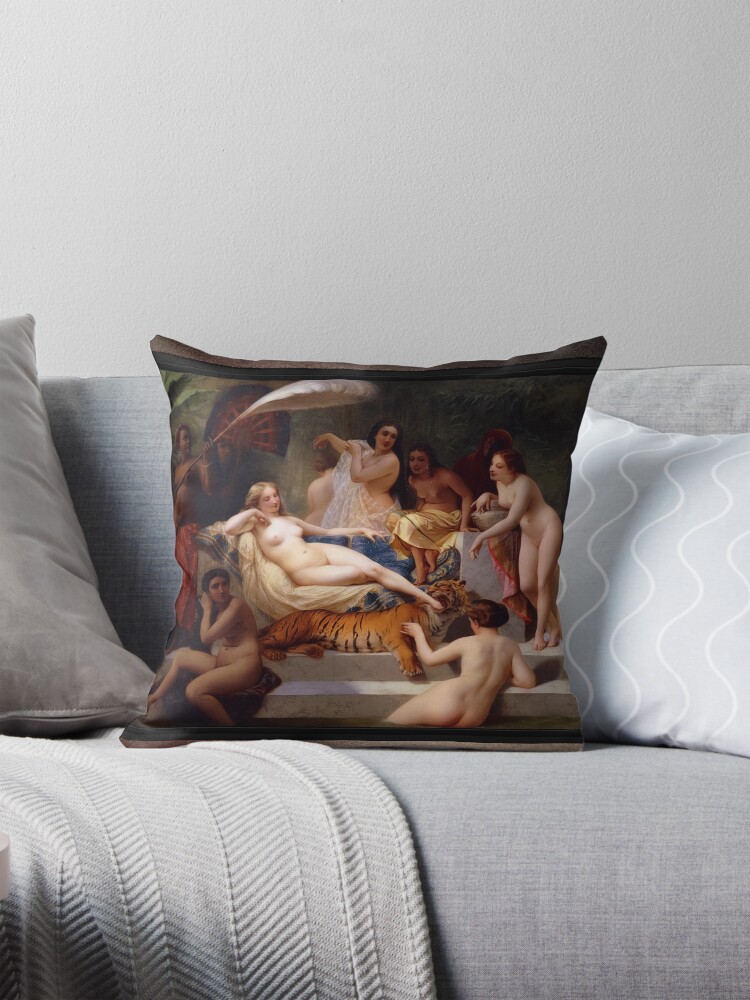
The painting depicts an exotic and opulent scene set within a lush, green garden. I forgrunden, a reclining nude woman lies draped over a luxurious tiger skin rug, her body elegantly posed to convey both relaxation and sensuality.
Emnet for maleriet, often referred to as an “odalisque” in the art world, refers to a woman in a harem, typically a concubine or servant, though in this case, the figure embodies a sense of power and beauty rather than mere submission. The subject’s position, partially turned to the side, suggests a moment of repose, and her expression, while not overly emotive, evokes a serene yet slightly aloof mood. The figure is meticulously detailed, med blød, porcelain-like skin that contrasts with the vivid richness of her surroundings.
Indholdsfortegnelse
The Setting and Composition
The background of the painting is a lush, natural setting, med det omgivende løv, der skaber en følelse af dybde og indeslutning. Jordens varme toner og træernes dybe grønne kontraster mod de levende guld og turkis i kvindens påklædning, som består af at flyde, rene stoffer. Disse farver og teksturer fremkalder en følelse af østlig luksus, i tråd med det romantiserede syn på Orienten, der var fremherskende i datidens europæiske kunst.
Selve indstillingen, omfatter ikke bare en have, men også figurer af andre kvinder og tjenere - tilføjer en følelse af socialt hierarki til stykket. I baggrunden, flere andre figurer er delvist synlige. Nogle kvinder er afbildet i forskellige faser af afklædning, at tage sig af hovedfiguren på en måde, der antyder både intimitet og eksotisk tiltrækning. The way they are positioned around the central figure highlights the harem setting and the role of women within it. The inclusion of a tiger further adds to the exoticism, as it symbolizes power and mystery, reflecting the theme of untamed nature and luxury.
The Figures and Their Role
In addition to the reclining odalisque, the painting features a number of secondary figures, including female attendants and an exotic servant. One such figure stands at the back, holding a fan and facing the central figure, adding to the dynamic of the scene. The presence of these figures serves to reinforce the sense of the harem environment, where women are not only objects of desire but also part of a larger, intricate social structure.
The figures in the painting are rendered with remarkable attention to detail, especially in terms of their anatomy and expressions. The artist pays great care to the human form, emphasizing the smoothness and softness of the flesh in stark contrast to the more tactile textures of the tiger skin rug and the surrounding environment. The female figures, each with their unique postures and roles, form a visual harmony that draws the viewer’s eye back to the central reclining figure.
Symbolism and Theme
The central theme of the painting is the depiction of female sensuality, and by extension, the romanticized concept of the Orient. In the 19th century, the harem became a popular subject in European art, often seen as a symbol of luxury, forbidden beauty, and exotic allure. Imidlertid, Picou’s portrayal moves beyond a simple depiction of sensuality, suggesting a more complex narrative about power, desire, and the roles of women in different cultures.
The use of the tiger skin rug as a central motif is highly symbolic. Tigers, in European art, were often associated with untamed forces, styrke, and sometimes danger. Kvinden, by lying atop the tiger, suggests her control over the ferocity and wildness of the animal, a metaphor for both her own power and the heightened sense of mystery associated with the East. The female form, smooth and vulnerable, is in contrast with the wildness of the tiger, yet it is not subdued or submissive, it is regal, calm, and in control of her surroundings.
The harem, as depicted in this piece, is less a place of confinement than a space of empowerment and mystery, where women exist outside the usual rules of society and are able to express a more sensual and liberated existence. This is reflected in the calm demeanor of the central figure and the luxuriousness of the scene itself. By presenting the odalisque in a state of repose, Picou adds a layer of depth to the piece, suggesting that the woman’s power lies not in overt action, but in her allure, her mystery, and her presence.
The Mood and Emotional Tone
The mood of the painting is one of quiet luxury and latent power. The serene expression of the central figure contrasts with the more active, yet passive, roles of the other women and the exotic environment around her. The sensuality in the painting is not overtly provocative but is instead conveyed through the soft lines of the female form, the opulence of the setting, and the harmonious interaction between the figures and their surroundings. There is an almost dreamlike quality to the scene, enhanced by the naturalistic details and the rich color palette.
The interaction between the various figures in the painting, some passive, others active, creates a subtle tension within the composition. This interplay of emotions and roles adds a layer of narrative complexity to the piece, allowing the viewer to interpret the scene in a variety of ways, depending on their own perspective.
Konklusion
Henri-Pierre Picou’s “Odalisque c1858” is an exquisite representation of 19th-century French Romanticism. Through the lush, sensual portrayal of the reclining figure and the exotic environment, Picou creates a mood that combines luxury with mystery. The painting encapsulates the fascination with the Orient that was prevalent during the era, while also exploring themes of power, sanselighed, og femininitet. Dens omhyggelige sammensætning, opmærksomhed på detaljer, og brugen af symbolik gør det til et værk af varig skønhed, indfange et øjeblik i tiden, hvor haremets tiltrækning blev vævet ind i vævet af europæisk kunstnerisk fantasi.
Odalisque c1858 af fransk maler Henri Pierre Picou (1824 – 1895); kendt for sit tidlige portrætværk og historiske emner og i sine senere år for sine allegoriske og mytologiske temaer
En Odalisque var en kvindelig tjener eller kammerpige i en tyrkisk Seraglio (et sekvestreret boligkvarter brugt af hustruer og konkubiner i en osmannisk husholdning.).
Dette Odalisque-maleri viser en nøgen central kvindeskikkelse, der kan være hovedhustruen eller konkubinen, hviler på en marmorsofa, der er polstret med pyntepuder og lagner; der er en del af en dobbelt stablet marmorbase, der fører til en pool; og i baggrunden er der grønne planter.
Hun er omgivet af otte andre nøgne kvinder; two that are partially in the pool of water. with one petting a young tiger that is putting the foot of the main female into its mouth.
There are also three more females (which are most like the Odalisque), som man kan antage er slaver, der dækker behovene hos de andre kvinder, der slapper af på marmorstokken.
Odalisque is a retouched digital art old masters reproduction of a public domain image that you can purchase as home decor wall art prints.
Denne digitale kunstskabelse, som med alt det kunstværk, der kan findes på Xzendor7-webstedet, er det tilgængeligt for køb online i en række materialeformater, herunder lærredstryk, akryltryk, metaltryk, trætryk, indrammede tryk, plakater, og som rullede lærred udskriver i forskellige størrelser fra 12 tommer til 72 tommer afhængigt af størrelsen på det faktiske kunstværk og den print-on-demand-butik, du vælger at købe kunsten fra.
Kunstværket er også tilgængeligt på en bred vifte af mænds og kvinders beklædning, krus, totes, tørklæder, notesbøger og journaler og mange boligindretningsprodukter.
Kunstner Bio
Info nedenfor stammer fra Wikipedia.org
Henri-Pierre var en akademisk maler og en af grundlæggerne af Neo-Grec-skolen, sammen med sine nære venner Gustave Boulanger, Jean-Léon Gérôme, og Jean-Louis Hamon, også akademiske malere.
Alle mændene studerede i værkstederne for både Paul Delaroche og senere Charles Gleyre. Picous stil var mærkbart påvirket af Gleyre; mens resten af gruppen generelt malede klassiske og mytologiske emner.
Picou første gang debuterede er kunstnerisk stil på salonen i 1847; og året efter fik han en anden klasses medalje for sit maleri, Cleopatra og Anthony på Cydnus. Også kendt som Cleopatra på Cydnus, det betragtes almindeligvis som Picous mesterværk.
Fremvisningen på salonen i 1848 af Cléopâtre et Antoine sur le Cydnus blev skrevet om af kritikeren Théophile Gautier, der følte, at emnet var for ambitiøst, men sagde også det “Som det er, det giver det bedste håb for den unge kunstners fremtid, og er blandt de syv eller otte vigtigste malerier af salonen.”
I 1875, maleriet blev udstillet i New York, og bagefter fundet et sted på væggene i et privat kunstgalleri i San Francisco.
Picou vedligeholdt et stort værksted i Paris på Boulevard de Magenta, hvilket gav ham plads til at arbejde med sine ekspansive kalkmalerier. Hans popularitet fortsatte med at stige, og han vandt videre det andet Prix de Rome i 1853 for sit maleri, Jesus driver sælgerne ud af templet (The Moneylenders Chased from the Temple), and another second-class medal for his Salon painting in 1857.
Fra tidspunktet for hans debut i 1847, han blev stamgæst på Salonen, vises næsten hvert år indtil hans sidste udstilling i 1893. Han er blevet kaldt den mest fashionable maler mod slutningen af det andet franske imperium; og fik mange opgaver, herunder provisioner til store religiøse kalkmalerier fra mange kirker, som omfattede Église Saint-Roch.