

Odalisca c1858
“Odalisca c1858” è un capolavoro dell'artista francese Henri Pierre Pico, da chi viveva 1824 per 1895. Dipinto dentro 1858, quest'opera d'arte rappresenta un bell'esempio di Romanticismo, un movimento che cercava di trasmettere emozioni profonde, sensualità, e immagini vivide. Il soggetto e la composizione riflettono l'opulenza e la sensualità tipiche dei salotti francesi del XIX secolo. Il lavoro di Picou, pieno di colori vivaci e dettagli aggraziati, racchiude l'atmosfera dell'Oriente e il fascino dell'harem, un tema artistico che ha guadagnato popolarità nell'arte europea durante il XIX secolo.
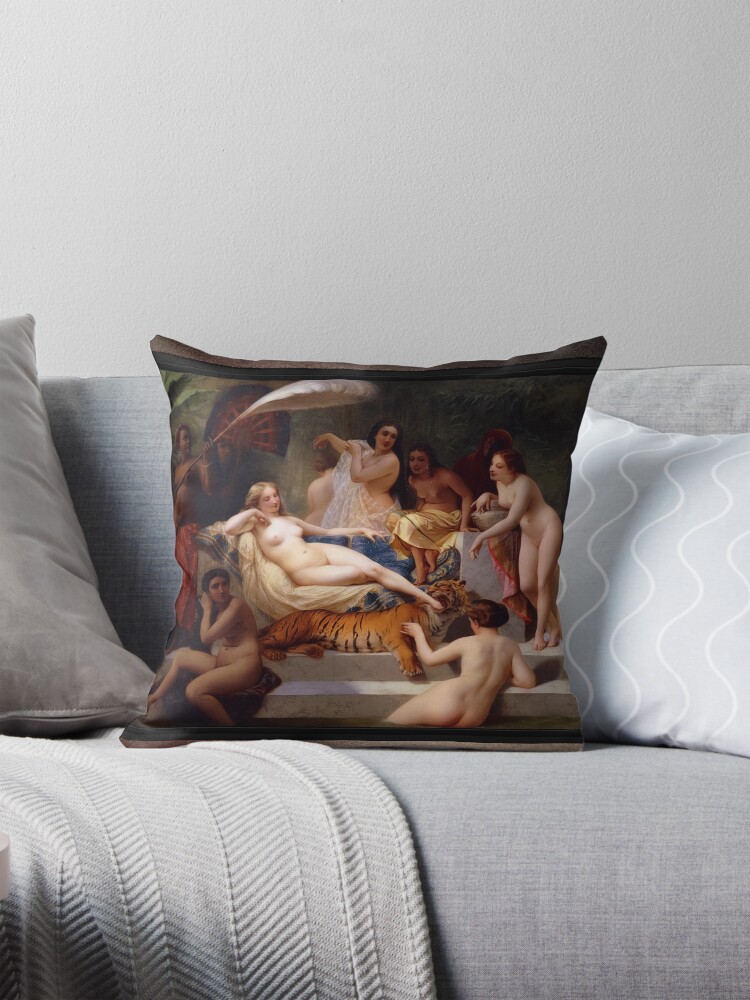
Il dipinto raffigura una scena esotica e opulenta ambientata in un contesto lussureggiante, giardino verde. In primo piano, una donna nuda sdraiata giace drappeggiata su un lussuoso tappeto di pelle di tigre, il suo corpo elegantemente posato per trasmettere relax e sensualità.
Il soggetto del dipinto, often referred to as an “odalisque” in the art world, refers to a woman in a harem, typically a concubine or servant, though in this case, the figure embodies a sense of power and beauty rather than mere submission. The subject’s position, partially turned to the side, suggests a moment of repose, and her expression, while not overly emotive, evokes a serene yet slightly aloof mood. The figure is meticulously detailed, con morbido, porcelain-like skin that contrasts with the vivid richness of her surroundings.
Sommario
The Setting and Composition
The background of the painting is a lush, impostazione naturale, with the surrounding foliage creating a sense of depth and enclosure. The warm tones of the earth and the deep greens of the trees contrast against the vibrant golds and turquoises of the woman’s attire, which consists of flowing, sheer fabrics. These colors and textures evoke a sense of Eastern luxury, in line with the Romanticized view of the Orient that was prevalent in European art of the time.
L'ambientazione stessa, comprising not just a garden but also figures of other women and servants—adds a sense of social hierarchy to the piece. Sullo sfondo, several other figures are partially visible. Some women are depicted in various stages of undress, attending to the main figure in a way that suggests both intimacy and exotic allure. The way they are positioned around the central figure highlights the harem setting and the role of women within it. The inclusion of a tiger further adds to the exoticism, as it symbolizes power and mystery, reflecting the theme of untamed nature and luxury.
The Figures and Their Role
In addition to the reclining odalisque, the painting features a number of secondary figures, including female attendants and an exotic servant. One such figure stands at the back, holding a fan and facing the central figure, adding to the dynamic of the scene. The presence of these figures serves to reinforce the sense of the harem environment, where women are not only objects of desire but also part of a larger, intricate social structure.
The figures in the painting are rendered with remarkable attention to detail, especially in terms of their anatomy and expressions. The artist pays great care to the human form, emphasizing the smoothness and softness of the flesh in stark contrast to the more tactile textures of the tiger skin rug and the surrounding environment. The female figures, each with their unique postures and roles, form a visual harmony that draws the viewer’s eye back to the central reclining figure.
Simbolismo e tema
The central theme of the painting is the depiction of female sensuality, and by extension, the romanticized concept of the Orient. In the 19th century, the harem became a popular subject in European art, often seen as a symbol of luxury, forbidden beauty, and exotic allure. tuttavia, Picou’s portrayal moves beyond a simple depiction of sensuality, suggesting a more complex narrative about power, desiderio, and the roles of women in different cultures.
The use of the tiger skin rug as a central motif is highly symbolic. Tigers, in European art, were often associated with untamed forces, forza, and sometimes danger. La donna, by lying atop the tiger, suggests her control over the ferocity and wildness of the animal, a metaphor for both her own power and the heightened sense of mystery associated with the East. The female form, smooth and vulnerable, is in contrast with the wildness of the tiger, yet it is not subdued or submissive, it is regal, calma, and in control of her surroundings.
The harem, as depicted in this piece, is less a place of confinement than a space of empowerment and mystery, where women exist outside the usual rules of society and are able to express a more sensual and liberated existence. Ciò si riflette nel comportamento calmo della figura centrale e nel lusso della scena stessa. Presentando l'odalisca in stato di riposo, Picou aggiunge uno strato di profondità al pezzo, suggerendo che il potere della donna non risiede nell’azione palese, ma nel suo fascino, il suo mistero, e la sua presenza.
The Mood and Emotional Tone
L'atmosfera del dipinto è quella del lusso tranquillo e del potere latente. L'espressione serena della figura centrale contrasta con quella più attiva, eppure passivo, ruoli delle altre donne e l'ambiente esotico che la circonda. La sensualità nel dipinto non è apertamente provocatoria ma è invece trasmessa attraverso le linee morbide della forma femminile, l'opulenza dell'ambiente, e l'interazione armoniosa tra le figure e l'ambiente circostante. There is an almost dreamlike quality to the scene, enhanced by the naturalistic details and the rich color palette.
The interaction between the various figures in the painting, some passive, others active, creates a subtle tension within the composition. This interplay of emotions and roles adds a layer of narrative complexity to the piece, allowing the viewer to interpret the scene in a variety of ways, depending on their own perspective.
Conclusione
Henri-Pierre Picou’s “Odalisca c1858” is an exquisite representation of 19th-century French Romanticism. Through the lush, sensual portrayal of the reclining figure and the exotic environment, Picou creates a mood that combines luxury with mystery. The painting encapsulates the fascination with the Orient that was prevalent during the era, while also exploring themes of power, sensualità, e femminilità. La sua attenta composizione, attenzione ai dettagli, e l'uso del simbolismo ne fanno un'opera di bellezza duratura, catturando un momento nel tempo in cui il fascino dell'harem era intessuto nel tessuto dell'immaginazione artistica europea.
Odalisca c1858 del pittore francese Henri Pierre Pico (1824 – 1895); noto per i suoi primi ritratti e soggetti storici e nei suoi ultimi anni per i suoi temi allegorici e mitologici
Un'odalisca era un'inserviente o una cameriera in un serraglio turco (un alloggio sequestrato usato da mogli e concubine in una famiglia ottomana.).
Questo dipinto dell'Odalisca mostra una figura femminile centrale nuda che potrebbe essere la moglie principale o la concubina, riposa su un divano di marmo imbottito con cuscini e lenzuola decorativi; che fa parte di una doppia base in marmo sovrapposta che conduce ad una piscina; e sullo sfondo ci sono piante verdi.
È circondata da altre otto donne nude; due che sono parzialmente nella pozza d'acqua. con uno che accarezza una giovane tigre che si sta mettendo in bocca il piede della femmina principale.
Ci sono anche altre tre femmine (che somigliano molto all'Odalisca), che si può supporre siano schiave che provvedono ai bisogni delle altre donne che si rilassano sul piedistallo di marmo.
Odalisque è una riproduzione ritoccata di arte digitale di vecchi maestri di un'immagine di pubblico dominio che puoi acquistare come stampe artistiche da parete per decorazioni per la casa.
Questa creazione di arte digitale, come tutte le opere d'arte che si possono trovare sul sito Web di Xzendor7 è disponibile per l'acquisto online in una varietà di formati di materiali, comprese le stampe su tela, stampe acriliche, stampe in metallo, stampe su legno, stampe incorniciate, manifesti, e come stampe su tela arrotolata in una varietà di formati da 12 pollici a 72 pollici a seconda delle dimensioni dell'opera d'arte effettiva e del negozio di stampa su richiesta da cui scegli di acquistare l'arte.
L'opera d'arte è disponibile anche su un'ampia gamma di abbigliamento da uomo e da donna, tazze, borse, sciarpe, quaderni e diari e tanti prodotti per l'arredamento della casa.
Biografia dell'artista
Informazioni di seguito derivate da Wikipedia.org
Henri-Pierre è stato un pittore accademico e uno dei fondatori della scuola neogreca, insieme ai suoi amici più cari Gustave Boulanger, Jean-Léon Gérôme, e Jean Louis Hamon, anche pittori accademici.
Tutti gli uomini hanno studiato nei laboratori di Paul Delaroche e successivamente di Charles Gleyre. Lo stile di Picou è stato notevolmente influenzato da Gleyre; mentre il resto del gruppo dipingeva generalmente soggetti classici e mitologici.
Picou ha debuttato per la prima volta nel suo stile artistico al Salon di 1847; e l'anno successivo gli fu assegnata una medaglia di seconda classe per la sua pittura, Cleopatra e Antonio sul Cidno. Conosciuta anche come Cleopatra sul Cydnus, è comunemente considerato il capolavoro di Picou.
La presentazione al Salon di 1848 di Cléopâtre et Antoine sur le Cydnus è stato scritto dal critico Théophile Gautier, che pensavano che l'argomento fosse troppo ambizioso, ma ha anche detto che “Così com'è, dà la migliore speranza per il futuro del giovane artista, e si colloca tra i sette o otto dipinti più importanti del Salon.”
Nel 1875, il dipinto è stato esposto a New York, e poi ha trovato posto sui muri di una galleria d'arte privata a San Francisco.
Picou ha mantenuto un grande laboratorio a Parigi sul Boulevard de Magenta, che gli ha fornito spazio per lavorare sui suoi ampi affreschi. La sua popolarità continuò a crescere e vinse il Secondo Prix de Rome 1853 per la sua pittura, Gesù scaccia i venditori dal Tempio (Gli usurai cacciati dal tempio), e un'altra medaglia di seconda classe per il suo dipinto al Salon 1857.
Dal momento del suo debutto in 1847, divenne un assiduo frequentatore del Salon, mostrando quasi ogni anno fino alla sua mostra finale in 1893. È stato definito il pittore più alla moda verso la fine del Secondo Impero francese; e ha ricevuto molte commissioni, comprese commissioni per grandi affreschi religiosi di molte chiese, che includeva l'Église Saint-Roch.