

Odalisque c1858
“Odalisque c1858” is a masterpiece by the French artist Henri Pierre Picou, who lived from 1824 til 1895. Painted in 1858, this artwork represents a fine example of Romanticism, a movement that sought to convey deep emotion, sensualitet, and vivid imagery. The subject matter and composition reflect the opulence and sensuality typical of the 19th-century French salons. Picou’s work, filled with vivid color and graceful detail, encapsulates the atmosphere of the Orient and the allure of the harem, an artistic theme that gained popularity in European art during the 19th century.
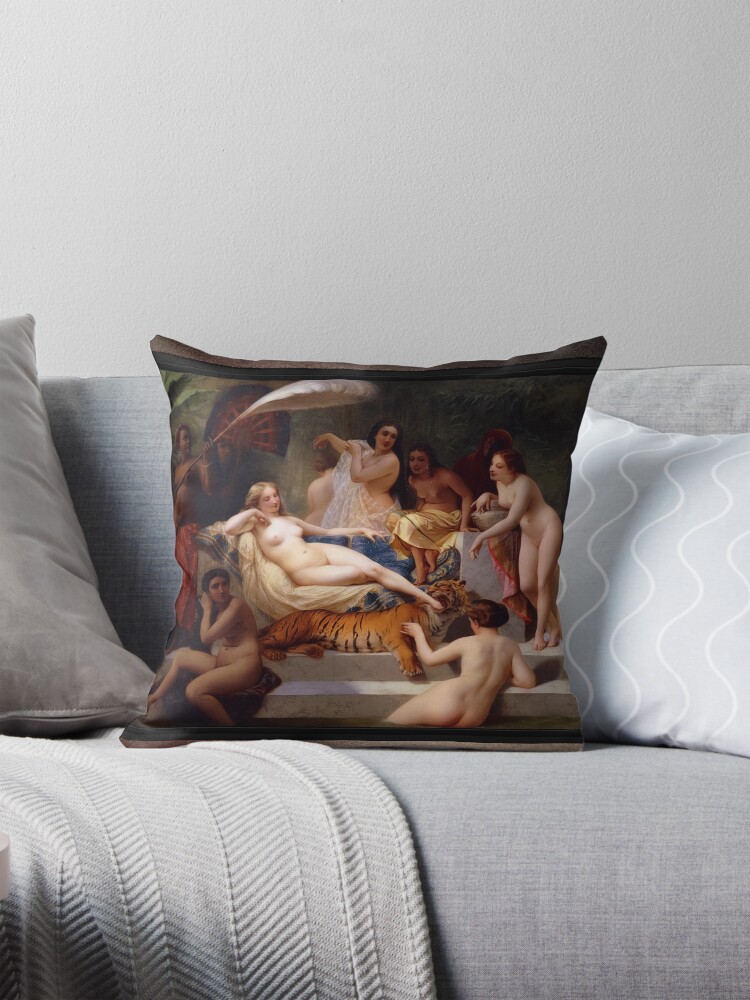
The painting depicts an exotic and opulent scene set within a lush, green garden. I forgrunnen, a reclining nude woman lies draped over a luxurious tiger skin rug, her body elegantly posed to convey both relaxation and sensuality.
The subject of the painting, often referred to as an “odalisque” in the art world, refers to a woman in a harem, typically a concubine or servant, though in this case, the figure embodies a sense of power and beauty rather than mere submission. The subject’s position, partially turned to the side, suggests a moment of repose, and her expression, while not overly emotive, evokes a serene yet slightly aloof mood. The figure is meticulously detailed, med myk, porcelain-like skin that contrasts with the vivid richness of her surroundings.
Innholdsfortegnelse
The Setting and Composition
The background of the painting is a lush, natural setting, with the surrounding foliage creating a sense of depth and enclosure. The warm tones of the earth and the deep greens of the trees contrast against the vibrant golds and turquoises of the woman’s attire, which consists of flowing, sheer fabrics. These colors and textures evoke a sense of Eastern luxury, in line with the Romanticized view of the Orient that was prevalent in European art of the time.
The setting itself, comprising not just a garden but also figures of other women and servants—adds a sense of social hierarchy to the piece. I bakgrunnen, several other figures are partially visible. Some women are depicted in various stages of undress, attending to the main figure in a way that suggests both intimacy and exotic allure. The way they are positioned around the central figure highlights the harem setting and the role of women within it. The inclusion of a tiger further adds to the exoticism, as it symbolizes power and mystery, reflecting the theme of untamed nature and luxury.
The Figures and Their Role
In addition to the reclining odalisque, the painting features a number of secondary figures, including female attendants and an exotic servant. One such figure stands at the back, holding a fan and facing the central figure, adding to the dynamic of the scene. The presence of these figures serves to reinforce the sense of the harem environment, where women are not only objects of desire but also part of a larger, intricate social structure.
The figures in the painting are rendered with remarkable attention to detail, especially in terms of their anatomy and expressions. The artist pays great care to the human form, emphasizing the smoothness and softness of the flesh in stark contrast to the more tactile textures of the tiger skin rug and the surrounding environment. The female figures, each with their unique postures and roles, form a visual harmony that draws the viewer’s eye back to the central reclining figure.
Symbolism and Theme
The central theme of the painting is the depiction of female sensuality, and by extension, the romanticized concept of the Orient. In the 19th century, the harem became a popular subject in European art, often seen as a symbol of luxury, forbidden beauty, and exotic allure. derimot, Picou’s portrayal moves beyond a simple depiction of sensuality, suggesting a more complex narrative about power, desire, and the roles of women in different cultures.
The use of the tiger skin rug as a central motif is highly symbolic. Tigers, in European art, were often associated with untamed forces, styrke, and sometimes danger. Kvinnen, by lying atop the tiger, suggests her control over the ferocity and wildness of the animal, a metaphor for both her own power and the heightened sense of mystery associated with the East. The female form, smooth and vulnerable, is in contrast with the wildness of the tiger, yet it is not subdued or submissive, it is regal, rolig, and in control of her surroundings.
The harem, as depicted in this piece, is less a place of confinement than a space of empowerment and mystery, where women exist outside the usual rules of society and are able to express a more sensual and liberated existence. This is reflected in the calm demeanor of the central figure and the luxuriousness of the scene itself. By presenting the odalisque in a state of repose, Picou adds a layer of depth to the piece, suggesting that the woman’s power lies not in overt action, but in her allure, her mystery, and her presence.
The Mood and Emotional Tone
The mood of the painting is one of quiet luxury and latent power. The serene expression of the central figure contrasts with the more active, yet passive, roles of the other women and the exotic environment around her. The sensuality in the painting is not overtly provocative but is instead conveyed through the soft lines of the female form, the opulence of the setting, and the harmonious interaction between the figures and their surroundings. There is an almost dreamlike quality to the scene, enhanced by the naturalistic details and the rich color palette.
The interaction between the various figures in the painting, some passive, others active, creates a subtle tension within the composition. This interplay of emotions and roles adds a layer of narrative complexity to the piece, allowing the viewer to interpret the scene in a variety of ways, depending on their own perspective.
Konklusjon
Henri-Pierre Picou’s “Odalisque c1858” is an exquisite representation of 19th-century French Romanticism. Through the lush, sensual portrayal of the reclining figure and the exotic environment, Picou creates a mood that combines luxury with mystery. The painting encapsulates the fascination with the Orient that was prevalent during the era, while also exploring themes of power, sensualitet, and femininity. Its careful composition, oppmerksomhet på detaljer, and use of symbolism make it a work of enduring beauty, capturing a moment in time when the allure of the harem was woven into the fabric of European artistic imagination.
Odalisque c1858 av fransk maler Henri Pierre Picou (1824 – 1895); kjent for sine tidlige portrettverk og historiske emner og i de senere årene for sine allegoriske og mytologiske temaer
En Odalisque var en kvinnelig ledsager eller kammerpike i en tyrkisk Seraglio (et sekvestrert boligkvarter brukt av koner og konkubiner i en osmansk husholdning.).
Dette Odalisque-maleriet viser en naken sentral kvinneskikkelse som kan være hovedkonen eller konkubinen, hviler på en marmorsofa som er polstret med pynteputer og laken; som er en del av en dobbel stablet marmorbase som fører til et basseng; og i bakgrunnen er det grønne planter.
Hun er omgitt av åtte andre nakne kvinner; to som er delvis i vannbassenget. med en som klapper en ung tiger som putter foten til hovedhunnen inn i munnen.
Det er også tre kvinner til (som ligner mest på Odalisque), som man kan anta er slaver som sørger for behovene til de andre kvinnene som slapper av på marmorsokkelen.
Odalisque er en retusjert digital kunst, gamle mesters reproduksjon av et offentlig domenebilde som du kan kjøpe som veggkunsttrykk for hjemmeinnredning.
Denne digitale kunstkreasjonen, som med alle kunstverkene som finnes på Xzendor7-nettstedet, er det tilgjengelig for kjøp online i en rekke materialformater, inkludert lerretstrykk, akryltrykk, metalltrykk, treutskrifter, innrammede trykk, plakater, og som rullede lerret utskrifter i en rekke størrelser fra 12 tommer til 72 tommer avhengig av størrelsen på det faktiske kunstverket og print on demand-butikken du velger å kjøpe kunsten fra.
Kunstverket er også tilgjengelig på et bredt utvalg av herre- og dameklær, krus, totes, skjerf, notatbøker og journaler og mange hjemmeinnredningsprodukter.
Kunstnerbiografi
Info nedenfor avledet fra Wikipedia.org
Henri-Pierre var en akademisk maler og en av grunnleggerne av den nygreske skolen, sammen med sine nære venner Gustave Boulanger, Jean-Leon Gerome, og Jean-Louis Hamon, også akademiske malere.
Alle mennene studerte i verkstedene til både Paul Delaroche og senere Charles Gleyre. Picous stil ble merkbart påvirket av Gleyre; mens resten av gruppen generelt malte klassiske og mytologiske emner.
Picou debuterte første gang er kunstnerisk stil på Salon in 1847; og året etter ble tildelt en annenklasses medalje for sitt maleri, Cleopatra og Antony på Cydnus. Også kjent som Cleopatra på Cydnus, det blir ofte sett på som Picous mesterverk.
Visningen på Salongen i 1848 av Cleopatra og Anthony på Cydnus ble skrevet om av kritikeren Théophile Gautier, som mente at temaet var for ambisiøst, men sa også det “Som det er, det gir det beste håp for fremtiden til den unge artisten, og rangerer blant de syv eller åtte viktigste maleriene i Salongen.”
I 1875, maleriet ble stilt ut i New York, og fant etterpå et sted på veggene til et privat kunstgalleri i San Francisco.
Picou opprettholdt et stort verksted i Paris på Boulevard de Magenta, som ga ham plass til å jobbe med sine ekspansive fresker. Hans popularitet fortsatte å stige, og han vant den andre Prix de Rome i 1853 for hans maleri, Jesus driver selgerne fra tempelet (Pengeutlånerne jaget fra tempelet), og nok en annenklasses medalje for hans Salong-maleri i 1857.
Fra debuten i 1847, han ble fast på Salongen, vises nesten hvert år frem til hans siste utstilling i 1893. Han har blitt kalt den mest fasjonable maleren mot slutten av det andre franske imperiet; og fikk mange oppdrag, inkludert oppdrag for store religiøse fresker fra mange kirker, som inkluderte Église Saint-Roch.