

Portrait oriental de femme c1890
“Oriental Portrait de femme,” créé autour 1890 du peintre et graveur espagnol Francisco Sans Castaño (1868–1937), présente une représentation exquise d'une femme drapée dans une tenue opulente, capturant l'attrait de la fascination de la fin du XIXe siècle pour l'Orient. Châtaigne, un artiste polyvalent réputé pour ses scènes historiques et de genre, a rendu cette peinture avec une attention portée aux détails luxueux qui évoque à la fois un sentiment de mystique et de raffinement. Le sujet du portrait est une belle femme dont le regard respire à la fois la confiance et la sérénité.. L’utilisation de la couleur par Castaño, lumière, et la texture rehausse l'élégance de la scène, créer une atmosphère riche en opulence culturelle et esthétique.
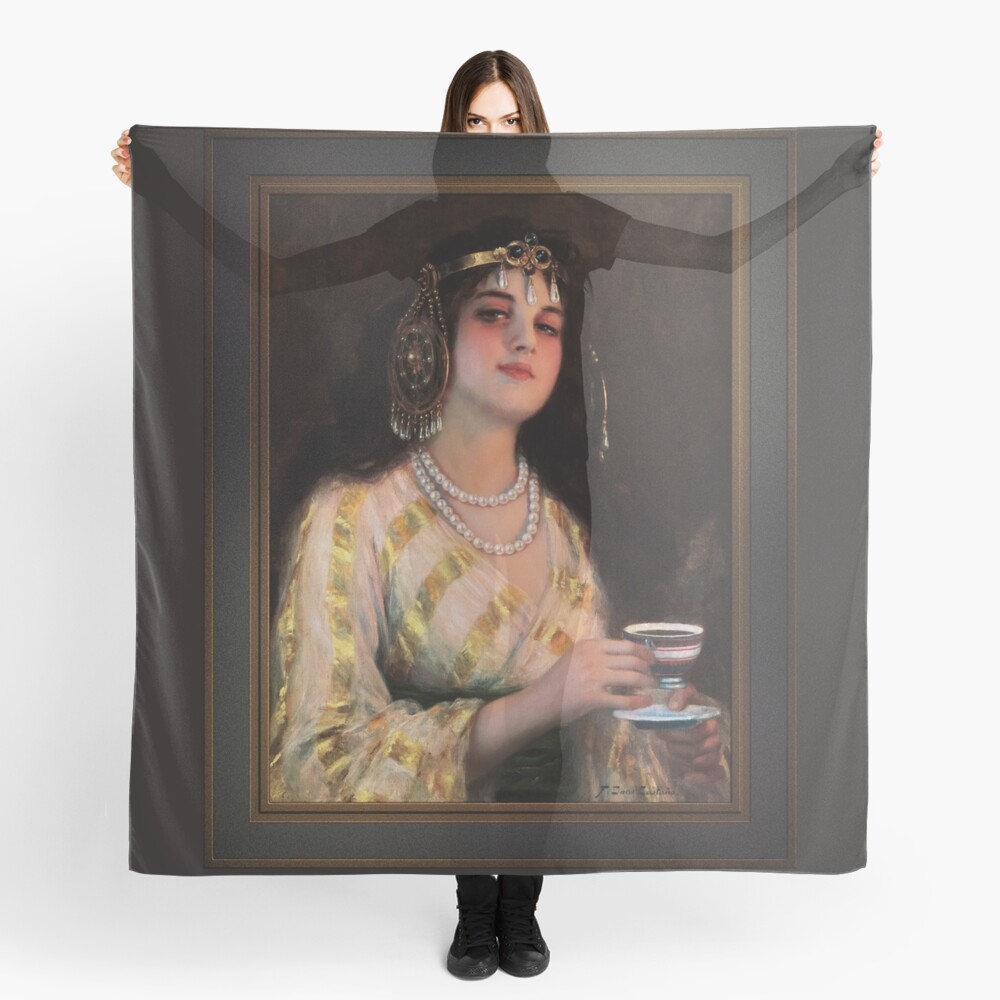
Table des matières
Sujet et composition
The primary subject of the painting is a young woman dressed in a lavishly ornate costume that seems to reflect the exotic tastes and influences of the time. Sa longue, dark hair is intricately styled and complemented by a headpiece adorned with jewels and hanging ornaments, which are highlighted by the soft glow of the light. The woman’s serene expression and slight, knowing smile suggest a persona of quiet strength, grâce, and dignity.
She holds a small vessel in one hand, delicately gripping the ornate cup as if lost in thought, perhaps contemplating the contents or simply holding it as part of her poised demeanor. The vessel, likely a traditional cup from a distant culture, is intricately decorated with fine patterns and colors. This object adds to the sense of cultural layering and adds a depth to the otherwise simple yet poignant composition.
Sa tenue, a luxurious gown with golden stripes, further emphasizes the centrality of the subject’s elegance. La robe, with its delicate fabric and shimmering golden details, suggère la richesse, and the subtle interplay of light on the material adds depth and texture to the piece. The painting’s background remains dark, with the focus on the woman herself, allowing her figure to stand out against the shadowy backdrop. This contrast between the subject and her surroundings heightens the subject’s significance, directing all attention to her poised presence.
Style et technique
Castaño’s style in this portrait is rooted in realism, with a particular emphasis on texture and light. The artist uses soft brushwork to create a smooth, almost ethereal effect in the subject’s skin, especially on her face, where every detail—her soft lips, the gleam in her eyes, and the subtle shading on her cheekbones—adds a sense of life and vitality. The artist’s attention to detail is evident in the rendering of the woman’s jewels and the soft fabric of her gown, with the golden stripes on her dress shimmering with a realism that almost invites the viewer to touch them.
L'utilisation de la lumière dans le portrait est magistrale, with highlights accentuating the jewelry and the textures of the clothing. This illumination contrasts with the deep shadows surrounding the subject, which suggests a quiet introspection or a moment of contemplation. L'obscurité, almost indistinct background serves to isolate the woman, making her the unequivocal focal point of the composition.
Castaño’s technique in this piece also reflects the late 19th-century romanticism and the fascination with “exotique” thèmes. This focus on the Orient or Eastern cultures was a prevalent trend in European art at the time, with many artists exploring subjects and themes from far-flung regions of the world. Dans “Oriental Portrait of Woman,” Castaño subtly incorporates this exoticism without sacrificing the richness and emotional depth of his subject.
Ambiance et thème
The mood of the painting can be described as one of calm confidence and enigmatic elegance. The woman in the portrait radiates a sense of mystery, heightened by her aloof gaze and the dark background. There is a quiet power to her presence, as though she belongs to a world of splendor and privilege, yet she remains detached from it, lost in a moment of introspection.
The theme of the painting reflects the late 19th-century fascination with the “Orient,” which was often romanticized and viewed through the lens of European exoticism. Castaño’s portrayal, pourtant, does not depict the woman in a purely stereotypical or fantastical way; plutôt, it celebrates her individuality and refinement. This nuanced approach invites the viewer to contemplate the woman’s life and identity, beyond the simple notion of her as an exotic figure. The choice of attire, the jewels, et la tasse qu'elle tient semble raconter une histoire, suggérant que la femme peut faire partie d'un récit culturel plus large, celui dont le spectateur n’a qu’un bref aperçu.
Matériaux et techniques
Les matériaux utilisés par Castaño dans ce portrait incluent probablement des peintures à l'huile, comme c'était typique pour les artistes de cette période. Le milieu huileux permet un riche, des couleurs vibrantes et des dégradés de lumière doux, donner au portrait un sentiment de réalisme. L’application méticuleuse de la peinture par l’artiste, notamment dans le rendu des bijoux femme, robe, et le subtil jeu de lumière sur sa peau, démontre un haut niveau de savoir-faire.
La texture du tableau est particulièrement visible dans la robe de la femme., où les éléments dorés scintillent avec une délicatesse qui contraste avec les tons plus sombres du fond. Les reflets et les ombres tout au long de la pièce sont soigneusement orchestrés pour créer de la profondeur et concentrer l’attention du spectateur sur le visage et les mains du sujet..
Conclusion
Celui de Francisco Sans Castaño “Oriental Portrait of Woman” est une œuvre magistrale qui mêle réalisme, profondeur émotionnelle, et d'exotisme qui captive et intrigue à la fois. Grâce à une attention méticuleuse aux détails et à une utilisation réfléchie de la lumière et de l'ombre, Castaño donne vie au sujet, lui permettant de transcender son contexte historique et culturel et de devenir un symbole intemporel de grâce et d'élégance. Ce portrait reflète non seulement les prouesses techniques de l’artiste, mais capture également l’ambiance d’une époque obsédée par le charme de l’Orient., offrant un aperçu d'un monde à la fois lointain et séduisant, mais intimement humain.
Il s'agit d'une reproduction de maîtres anciens d'art numérique remasterisée d'une image du domaine public qui est disponible en tant que impression sur toile en ligne.