

Pater Noster
Pater Noster (Our Father) c1900 by Czech Painter Alfonso Mucha (1860 – 1939); same kiel plenumebla Ilustristo kaj Grafika Artisto kiu estis grava forto de la Secesio-Epoko; konata pro sia stiligita, ornamitaj kaj ornamaj teatraj afiŝoj.
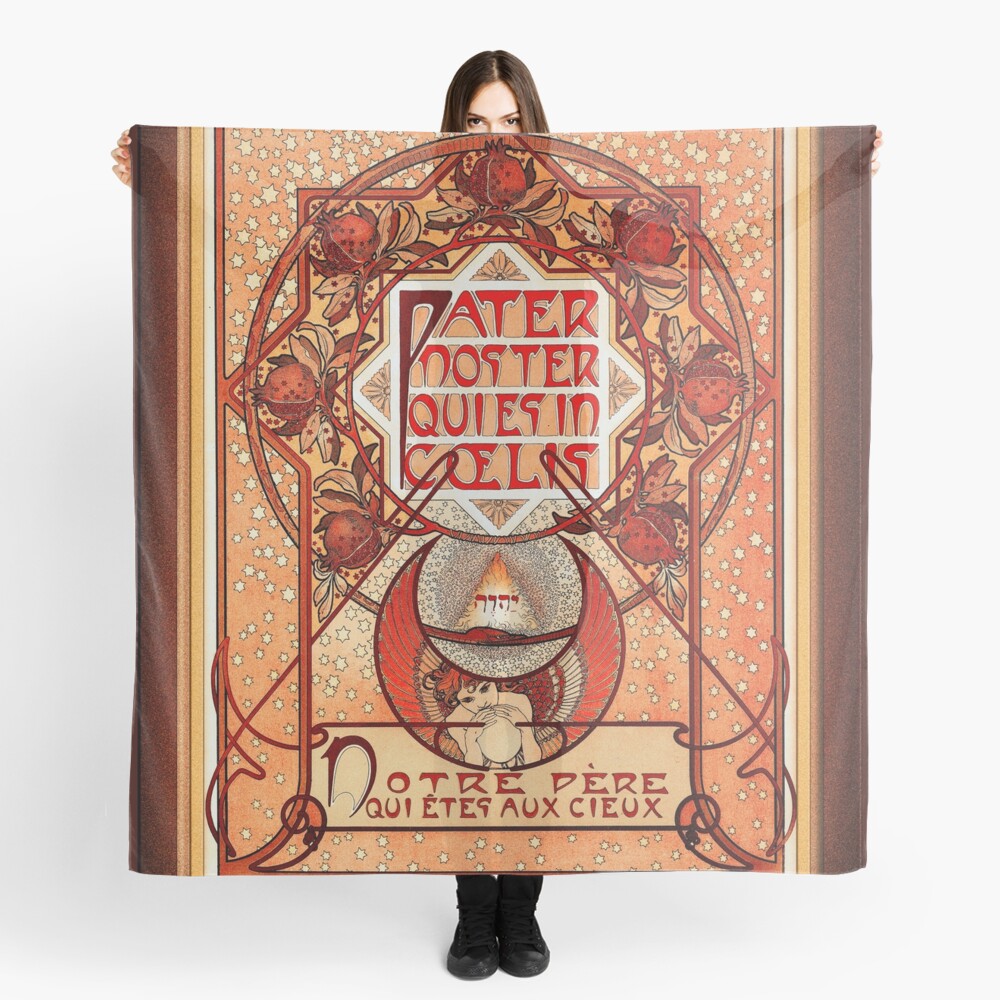
A beautiful illustrated poster that is a tribute to a beloved father that has passed away, with the words Pater Noster Quiesin Coelis (May Our Father Rest In Heaven) at the top and at the bottom the words Notre Pere Qui Etes Aux Cieux (Our Father Who Art In Heaven) that cite the beginning of he Lords prayer.
The top words are surrounded by a representation of the Star of David in the inner layer with a ring around it and a large like representation that also has open pomegranates at each point.
Below the words is another word in Hebrew that is placed in triangle with a fiery appearance, below that a woman grasping a sphere of sorts that has radiant orange, red and white wings; that may represent and angel.
Finally the rest of the illustration has flowing curves that also connect to the Star of David structure giving it a metal frame look with a multitude of starts filling every background space.
Ĉi tio estas readaptita cifereca arto malnova majstra reproduktaĵo de publika domajna bildo aĉetebla interrete kiel a ruliĝinta tolo presaĵo.
Informoj Malsupre De Vikipedio.org
Alfons Maria Mucha Julio 24, 1860 – julio 14, 1939), estis konata internacie kiel Alphonse Mucha. Li estis eminenta ĉeĥa pentristo, ilustristo kaj grafikisto, vivante en Parizo dum la Secesio-periodo, kaj estas plej konata pro siaj klare stiligitaj kaj dekoraciaj teatraj afiŝoj, precipe tiuj de Sarah Bernhardt.
Li produktis ilustraĵojn, reklamoj, ornamaj paneloj, kaj dezajnoj, kiu iĝis inter la plej konataj bildoj de la periodo.
En la dua parto de lia kariero, en la aĝo de 43, li revenis al sia patrujo de Bohemia-Moravia regiono en Aŭstrio kaj dediĉis sin al pentrado de serio de dudek monumentaj kanvasoj konataj kiel La Slava Epopeo., prezentante la historion de ĉiuj slavaj popoloj de la mondo, kiujn li pentris inter 1912 kaj 1926.
En 1928, en la 10-a datreveno de la sendependiĝo de Ĉeĥoslovakio, li prezentis la serion al la ĉeĥa nacio. Li konsideris ĝin lia plej grava verko. Ĝi nun estas elmontrita en Prago.