

Påfågeldansare
Peacock Dancer c1935 av American Illustrator Earle Kulp Bergey (1901 – 1952), målare och pin-up artist, anses vara den mest produktiva målaren under 20-talet.
Han skapade omslagskonst för tusentals Pulp Fiction Magazines och Paperback-böcker över en mängd olika genrer.
De Påfågel Dancer är en vacker och flamboyant art deco -illustration av en kvinnlig dansare som bär en påfågelklänning, dansar upp det mot en svart bakgrund.
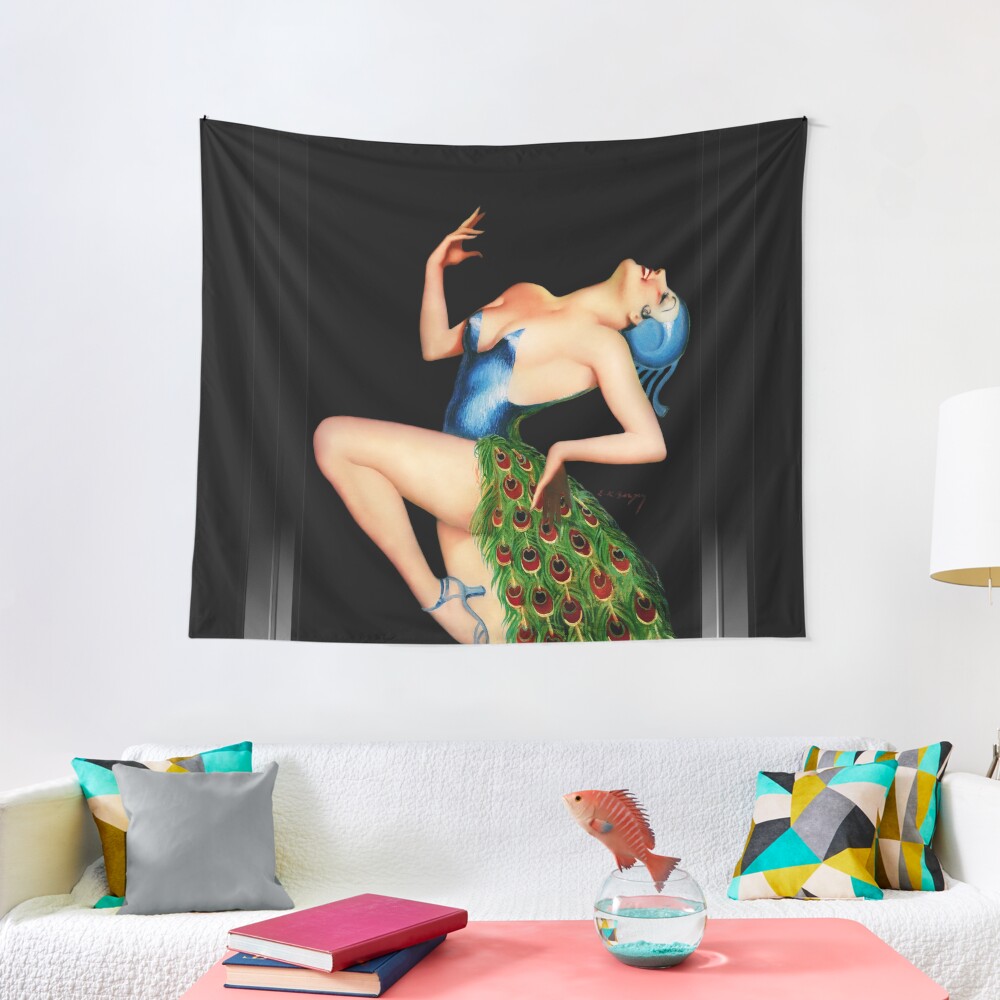
The Peacock Dancer is a retouched digital art old masters reproduction of a public domain image that you can purchase as wall art wall decor.
Nedanstående information härrör från Wikipedia.org
Earle K. Bergey (Augusti 26, 1901 - september 30, 1952) var en amerikansk konstnär och illustratör som målade omslag för tusentals massafiktionstidningar och pocketböcker. One of the most prolific pulp fiction artists of the 20th century, Bergey is recognized for creating the iconic cover of Gentlemen Prefer Blondes for Popular Library at the height of his career in 1948.
Marking the start of Bergey’s highly influential run as an American paperback illustrator, this bombshell painting made the mass paperback cover of Anita Loos’s blockbuster, Gentlemen Prefer Blondes (published as Popular Library #221).
Earle K. Bergey’s cover painting for Gentlemen Prefer Blondes, circa 1948.
Bergey was born in Philadelphia, Pennsylvania to A. Frank and Ella Kulp Bergey. He attended Pennsylvania Academy of the Fine Arts from 1921 till 1926, finishing formal Academy studies in the spring of 1926. He initially went to work in the art departments of Philadelphia newspapers including Public Ledger, and he drew the comic strip Deb Days in 1927. Early in his career, Bergey contributed many covers to the pulp magazines of publisher Fiction House.
By the mid-1930s, Bergey made a home and studio in Bucks County, Pennsylvania, and he married in 1935.
Throughout the 1930s, Bergey worked freelance for a number of publishing houses.
His eye-catching paintings were predominantly featured as covers on a wide array of pulp magazines, including romance (Thrilling Love, Popular Love, Love Romances) as well as detective, äventyr, aviation, and Westerns. Bergey illustrated mainstream publications, such as The Saturday Evening Post, during this time.
During the 1940s, Bergey continued to paint covers for romance, sporter, and detective pulp magazines, and he began working on a number of science fiction magazines, including Standard Publications’ Strange Stories, Startling Stories, and Captain Future, and later for Fantastic Story Magazine.
Bergey’s fine art training and salient gift for depicting anatomy made him a go-to artist across a diversity of genres that required scenes with dramatic movement, from photo-realistic sports portraits of famous athletes including Mickey Cochrane, Lou Gehrig, and Jim Thorpe to his signature Bergey Girls that appeared on risque pulps throughout the Depression and in science fiction scenarios from World War II.
The artist’s illustrations of scantily-clad women surviving in outer space served as an inspiration for Princess Leia’s slave-girl outfit in Return of the Jedi, even its color and cut, and Madonna’s conical brass brassiere. Bergey’s science fiction covers, sometimes described as “Bim, BEM, Bum,” usually featured a woman being menaced by a Bug-Eyed Monster, alien, or robot, with an heroic male astronaut coming to her assistance.
Bikini-tops worn by Bergey girls often resembled coppery metal, giving rise to the phrase “the girl in the brass bra,” used in reference to this sort of art. Visionaries in TV and film have been influenced by Bergey’s work; Gene Roddenberry, till exempel, provided his production designer for Star Trek with examples of Bergey’s futuristic pulp covers.
I 1948, Bergey gjorde övergången till den snabbt växande pocketindustrin tillsammans med skickliga pappersmassakonstnärer som Rudolph Belarski, vars arbete ofta förväxlas med Bergeys. Medan han fortsätter att måla massatäckningar till sin död.