

Permite Mécanicien Pin-up Girl
“Permite Mécanicien Pin-up Girl,” créé par un artiste américain Bill Medcalf dans 1955, est un exemple typique de l'art pin-up américain du milieu du XXe siècle.. Veau-médecine, né dans 1920 et est décédé à 2005, était connu pour sa contribution à l'âge d'or des illustrations de pin-up. Son travail, débordant de couleurs vibrantes et d'un sentiment d'optimisme, résume l’esprit culturel dynamique de la période d’après-guerre. Cette œuvre d'art, en particulier, est une représentation charmante et ludique d'un mécanicien dans une ambiance détendue, mais pose confiante, un sujet qui fusionne à la fois la beauté de la forme féminine et le côté granuleux, monde industriel de la mécanique.
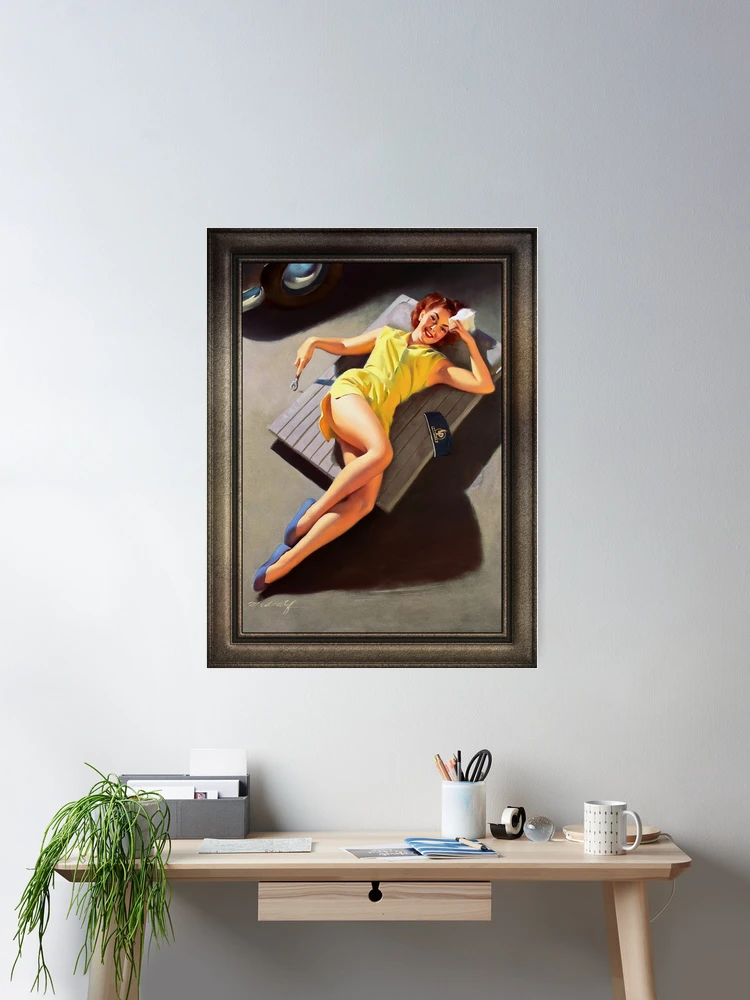
Table des matières
Sujet principal: La Pin-Up
Le point central de cette œuvre d’art est la jeune femme souriante vêtue d’une tenue de mécanicien jaune vif.. Sa posture est détendue alors qu'elle s'allonge sur un banc en bois, un bras posé au-dessus de sa tête, l'autre tenant nonchalamment une clé. Ses cheveux roux sont coiffés de boucles vintage, complétant ses traits frappants du visage : pommettes saillantes, un sourire amical, et une expression ludique qui transmet un sentiment de confort et de confiance dans son environnement. La tenue jaune vif contraste magnifiquement avec la tenue plus foncée., tons sourds de l'arrière-plan et ajoute au sentiment de légèreté qui imprègne la scène.
Elle est allongée avec une jambe croisée sur l'autre, suggérant un sentiment à la fois de désinvolture et de sensualité. La pose détendue, associé à son expression joyeuse, évoque un sentiment de facilité, comme si elle prenait une pause bien méritée dans son travail. This composition subtly suggests that women of the time could both be professionals in traditionally male-dominated fields and embody the nurturing, caring qualities associated with traditional feminine roles.
Objets et arrière-plan
The artwork is set against a backdrop of what appears to be a mechanic’s workshop or garage. A large vehicle wheel is visible in the top left corner, indicating the industrial setting. A small mechanic’s tool, likely a part of her trade, rests near the woman, while a piece of cloth or a bandana lies beside her, possibly used to wipe sweat from her brow, further adding to the theme of hard work and functionality.
The artist uses a rich, highly stylized color palette, with the woman’s yellow outfit standing in stark contrast to the more muted tones of the workshop. The use of warm, soft lighting on her figure creates a sense of depth, focusing attention on the subject while softening the harshness of the mechanical environment. The scene conveys both the industriousness of the setting and the beauty of the figure within it.
Terrain et matériaux
The bench on which the woman lies is simple and rustic, indicative of a workshop or garage environment. The composition gives the viewer the impression of an industrial space that is far from glamorous, yet the woman adds a sense of elegance and playfulness to the setting. The materials are concrete and wood, typical of a mechanic’s workshop, while the clothing and accessories have a smooth, polished look that draws the eye to the woman as the centerpiece of the painting.
The tools, the wrench in particular, are items that add to the authenticity of the scene, grounding it in the reality of mechanics and their work. These objects are all meticulously rendered in the painting, with attention paid to light and shadow, creating a three-dimensionality that enhances the realism of the scene.
Style et thème
Bill Medcalf’s artistic style in this piece is rooted in the pin-up tradition of the 1940s and 1950s, where glamour and sensuality were intertwined with themes of everyday life. The artwork leans into the cheerful and optimistic mood typical of this genre. The pin-up girl was often seen as a symbol of youthful beauty, confiance, and independence, and Medcalf’s interpretation of the mechanic archetype brings a refreshing perspective to this trope. The mechanics and tools, typically symbols of masculinity, are juxtaposed with the feminine form, suggesting that women could thrive in these traditionally male spaces.
This theme of gender equality, while subtle, is significant in the cultural context of the 1950s, when women were beginning to enter the workforce in greater numbers following World War II. The mechanic pin-up girl becomes both an icon of beauty and a symbol of female empowerment.
Humeur et atmosphère
L'ambiance de “Permite Mécanicien Pin-up Girl” is one of lightheartedness and charm. The woman exudes an air of self-assurance and comfort in her surroundings, while her playful smile invites the viewer to share in her moment of relaxation. The artist’s choice to position the woman in a laid-back, carefree pose reinforces the idea of femininity as not only beautiful but approachable and strong. The warm lighting and the smooth, rounded forms of the subject contrast with the rigid, mechanical elements of the background, creating a visual balance that speaks to the intersection of beauty and industry.
The soft shadowing around the woman’s body and the carefully rendered lighting create a glowing aura around her, highlighting her as the central figure in the painting. There is a juxtaposition between the hardness of the mechanical tools and the softness of the woman, which both amplifies her femininity and suggests a blend of strength and elegance.
Conclusion
“Permite Mécanicien Pin-up Girl” by Bill Medcalf stands as a testament to the art of pin-up illustrations that flourished in the mid-20th century. The painting is a celebration of both beauty and strength, combining the traditionally feminine image of a pin-up girl with the masculine world of mechanics. Grâce à sa pose confiante, tenue lumineuse, et expression ludique, Medcalf transmet un récit d’autonomisation et d’optimisme. Cette œuvre d'art, riche à la fois en attrait visuel et en signification culturelle, offre un aperçu intemporel de l'art vibrant et des idéaux de l'après-guerre.
Il s'agit d'une reproduction de maîtres anciens d'art numérique retouchée d'une image du domaine public.