

Petite Fille et Chat
Superrigardo de la artaĵo
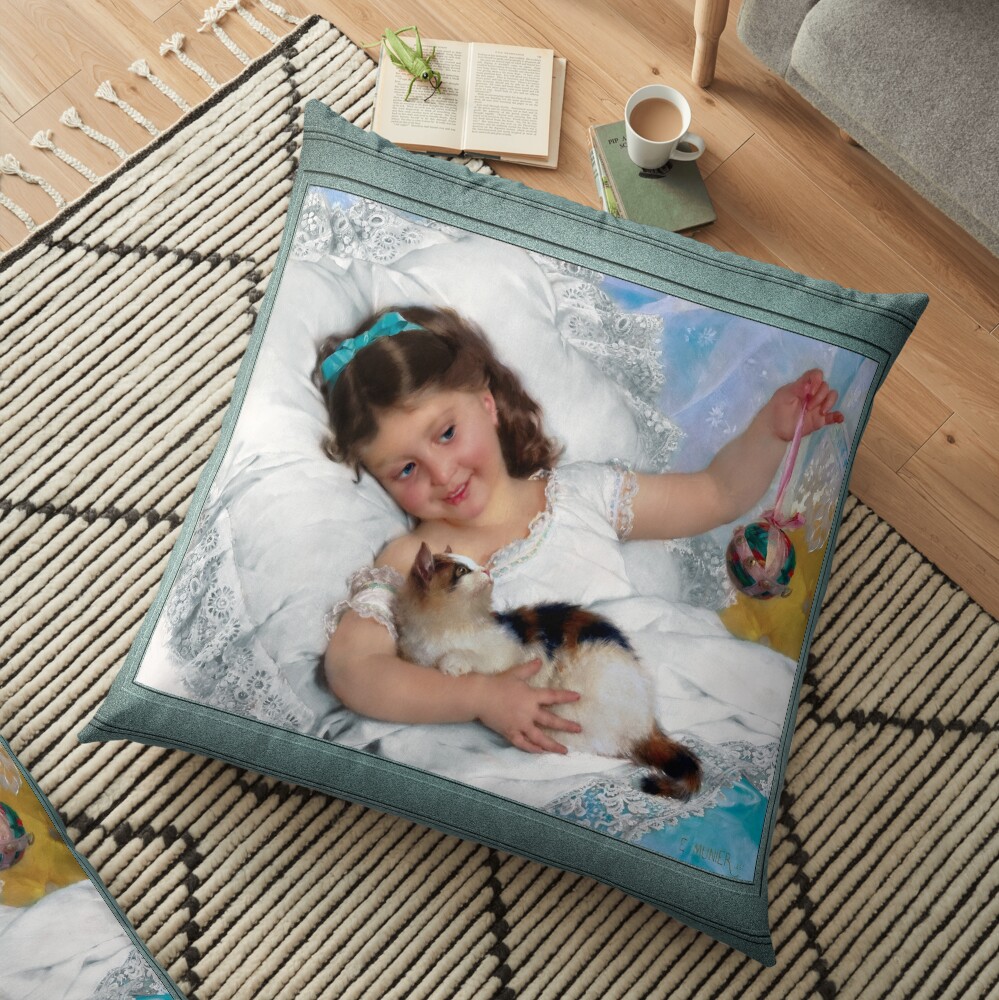
Petite Fille et Chat (Young Girl With Cat) c1882 is an exquisite example of 19th-century French academic painting, created by Emile Munier (1840 – 1895), a renowned French painter known for his detailed depictions of children and their emotional depth. Painted in 1882, this portrait captures a delicate moment of childhood innocence, perfectly encapsulated through the innocent gaze of a young girl who is lovingly interacting with a cat. The artist’s meticulous attention to detail, his ability to capture human expression, and his expert use of light and color make this piece a standout in the genre of academic realism.
Enhavtabelo
La Ĉefa Temo: The Young Girl
En la koro de “Petite Fille et Chat” is the young girl, whose porcelain-like skin and gentle expression convey both fragility and joy. She is depicted in a moment of quiet delight as she reclines on a cushion, her body slightly turned towards the viewer while her gaze is directed downward at the small cat resting beside her. The girl’s soft brown hair is styled in loose waves, with a bright blue ribbon nestled at the crown of her head, adding a touch of playfulness to her appearance. The pale blue ribbon contrasts beautifully with the softness of her white gown, further emphasizing the purity and simplicity of her childhood.
The fabric of her gown is rendered in soft, flowing folds that suggest a fine, luxurious material. Its delicate lace trims at the neckline and sleeves add an element of refinement, capturing the high level of craftsmanship typical of the period. The girl’s posture and demeanor evoke an image of serene contentment, perfectly in tune with the theme of childhood innocence that the artist sought to portray.
The Cat: A Companion in Innocence
The cat, nestled contentedly beside the girl, plays a pivotal role in the composition. It is rendered with extraordinary attention to detail, particularly in its fur, which exhibits the artist’s characteristic skill in portraying texture. The cat’s distinctive coat of fur—patches of white, Oranĝo, and brown—creates a sense of realism, while its playful yet peaceful demeanor adds to the tranquil atmosphere of the painting. The young girl’s hand rests gently on the cat’s back, a tender gesture that reinforces the bond between the child and her pet, a universal symbol of innocence and companionship.
The cat’s presence in the painting also serves as a subtle contrast to the girl’s softness and elegance. It represents a more spontaneous and untamed element, yet in this context, it becomes a gentle companion, further enhancing the serene mood of the artwork.
Fono kaj Agordo
The background of the painting is as meticulously composed as the figures in the foreground. The setting appears to be an indoor space, possibly a child’s nursery or a drawing room, where the soft textures of a luxurious fabric and a gentle play of light are at the forefront. Behind the young girl and cat, a soft, ethereal blue hue transitions to a creamy pastel yellow, kreante sonĝanton, preskaŭ alimonda atmosfero. The background is delicately painted, featuring light touches of drapery that hint at the artist’s attention to both the natural light filtering through the space and the textures of the fabrics.
Lace and other delicate elements such as floral patterns also appear in the background, adding complexity and depth to the scene without overwhelming the primary subject. The room, filled with these light, soft tones, emphasizes the purity of childhood, offering a quiet sanctuary where the girl and her cat are free to indulge in their peaceful moment.
The Use of Color and Light
Munier’s use of light and color is central to the emotional impact of “Petite Fille et Chat.” La mola, pastel tones—predominantly blues, whites, and subtle hints of pink—dominate the composition, creating a serene and almost dreamlike quality. The delicate color palette enhances the theme of innocence, furthering the narrative of childhood purity and happiness.
The interplay of light and shadow on the girl’s face and gown is masterfully handled. Munier uses light to bring out the luminous quality of her skin, contrasting it with the subtle shadowing beneath her chin and along her collarbone, which adds depth to her features. The glow of her cheeks and the soft illumination around her eyes suggest a youthful vitality, yet this is contrasted by the calm serenity of the scene.
Emotional Impact and Theme
“Petite Fille et Chat” captures a moment of innocence and tranquility. The theme of childhood—its purity, tenereco, and closeness to nature—is rendered with delicate precision. The interaction between the girl and her cat is both intimate and gentle, a visual expression of the love and affection that often characterizes the bond between children and their pets.
The emotional atmosphere of the painting is one of warmth and comfort, a sanctuary from the outside world. La mola, intimate moment between the girl and her cat seems to freeze time, inviting the viewer into a quiet, peaceful world where the only concerns are love and companionship. Munier’s portrayal of the girl’s sweet expression and the peaceful setting imbue the work with a sense of nostalgia, evoking a longing for simpler times and the beauty of childhood.
Arta Stilo: Academic Realism
Emile Munier was a master of academic realism, a style characterized by its focus on the careful study of light, human anatomy, and the natural world. His works often feature children in idyllic settings, exploring themes of innocence, purity, kaj emocia profundo. The precision with which Munier renders the details of the girl’s face, the textures of her gown, and the softness of the cat’s fur speaks to his exceptional technical skill and dedication to realism. His careful attention to detail in both the figures and the background elements reflects the high standards of academic painting in the 19th century.
Konkludo
“Petite Fille et Chat” is a timeless portrayal of childhood innocence and the beauty of quiet moments shared between a child and her pet. Through his exquisite use of light, koloro, kaj teksturo, Munier creates a scene that resonates with emotional warmth and tenderness. The piece stands as a perfect example of academic realism, blending technical skill with an intimate portrayal of the human experience.
Petite Fille et Chat is a remastered digital art old masters reproduction of a public domain image that is available as a tolo presaĵo rete.
Pri La Artisto
Informoj Malsupre Derivita De Vikipedio.org
Emile naskiĝis en Parizo, Francio al Pierre François Munier; artisto tapiŝisto ĉe la tapiŝa fabriko Nationale des Gobelins (En Parizo Francio) kaj Marie Louise Carpentier, Polisher en kaŝmira tuko.
Li ankaŭ havis du fratojn François kaj Florimond; Tio kune kun li, kiu trejnis kaj laboris kiel artisto por periodo ĉe la Nationale des Gobelins.
Ĉe la fabriko Emile estis trejnita kiel projektisto de Abel Lucas, kaj disvolvus proksiman rilaton kun Abel kaj lia familio, kiu kondukis al Emile edziniĝi al Lucas’ filino Heriette en 1861.
Bedaŭrinde en 1867, Ses semajnojn post kiam lia edzino naskis sian filon Emile Henri, Ŝi kontraktis severan reŭmatismon, kaj mortis antaŭtempe.
En 1871 Emile forlasis la tapiŝan fabrikon por daŭrigi pentradon plentempe, krom provizi pentrajn klasojn al plenkreskuloj tri noktojn semajne.
Tiam en 1872 Emile edziĝis al Sargine Augrand studento de Abel Lucas kaj amiko de Emile kaj Henriette; La paro havis unu filinon Marie-Louise, kiu naskiĝis en 1874.
En 1884 Li ricevis komisionon de guberniestro Leland Stanford de Kalifornio kaj lia edzino Jane Stanford por krei pentraĵon de ilia filo Leland Stanford, Jr., kiu forpasis en la aĝo de 15 jaroj; Ahd li titolis la pecon anĝelo konsolanta sian malĝojan patrinon; kiun la knabo kiel anĝelo, kiu revenis sur la teron por konsoli sian patrinon per la mano metita sur ŝian ŝultron.
Unu el la plej influaj instruistoj de Emiles estis la franca pentristo William-Adolphe Bouguereau (1825 – 1905), Kaj oni povas vidi la influon, kiun li havis sur Emile en multaj el la pecoj, kiujn li kreis kaj kun la paso de la tempo la du fariĝis proksimaj amikoj.
Unu el liaj plej famaj verkoj, Tio pruvis, ke ĉi tiu influo estas lia peco Trois Amis aŭ tri amikoj, ke li ekspoziciis ĉe la Pariza Salono en 1885; Tio bildigis aĉan knabineton ludantan sur sia lito kun sia katido kaj hundo.
Ĉi tiu laboro estis tiel bone ŝatata de la publiko, ke ĝi estis reproduktita en multaj formoj kaj ankaŭ estis uzata por reklamado de la brita sapo -kompanio Pears Soap; kiu estis establita en 1807, Produktante la mondojn unue travidebla sapo.
Ĉi tiu pentraĵo helpis establi lin kiel unu el la plej ĉefaj pentristoj de junaj infanoj kaj iliaj dorlotbestoj; Kaj li daŭre pentrus tiajn scenojn kune kun bestaj fiŝkaptaj scenoj, maraj pejzaĝoj, pejzaĝoj, ĝenro kamparaj scenoj, mitologia kaj religia temo tra la fruaj 1890 -aj jaroj ĝis lia neatendita morto en 1895 en la aĝo de 55.