

Phryne Revealed Before The Areopagus: A Study in Classical Drama
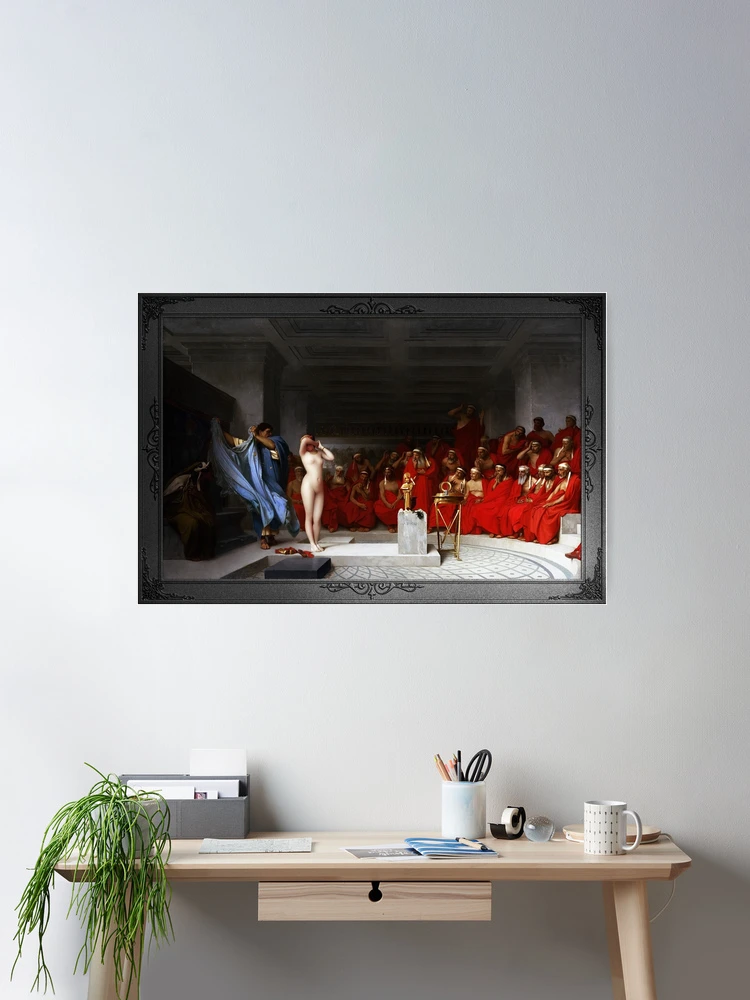
Jean-Léon Gérôme’s “Phryne Revealed Before the Areopagus,”Pintat al voltant 1861, is a compelling work of historical genre painting that draws heavily from classical antiquity. It depicts a dramatic scene rooted in ancient Greek legal proceedings, specifically the trial of Phryne, a celebrated courtesan of Athens. Gérôme was renowned for his meticulous attention to detail and his ability to recreate historical settings with remarkable accuracy, and this piece exemplifies those qualities. The painting is not merely an illustration of a story; it’s a carefully constructed tableau designed to evoke a sense of tension, anticipation, and the weight of societal judgment.
Taula de continguts
Estructura compositiva & Configuració
The composition is meticulously structured, guiding the viewer’s eye through the unfolding drama. The scene unfolds within a grand hall, likely representing the Areopagus, the ancient Athenian court known for its gravity and importance. Architectural elements dominate the background: tall columns with ornate capitals support a coffered ceiling, suggesting a space of considerable authority and permanence. Light streams in from an unseen source on the left, illuminating the central figures while casting long shadows that heighten the sense of drama. The hall is filled with seated men, all clad in similar crimson robes, forming a dense audience observing the proceedings. Their uniformity emphasizes their role as collective judges, representing Athenian society’s scrutiny.
Phryne: La figura central
At the heart of the composition stands Phryne herself. She is depicted nude, her body rendered with anatomical precision and a classical idealization reminiscent of ancient Greek sculpture. Her pose is one of vulnerability and exposure; she appears to be in the process of disrobing, perhaps as part of an attempt at legal maneuvering or a demonstration of innocence. Her expression is difficult to definitively interpret – it could suggest defiance, resignation, or even a hint of melancholy. The artist avoids any overt display of emotion, instead opting for a subtle and restrained portrayal that allows viewers to project their own interpretations onto her character.
The Legal Processors & Supporting Characters
To Phryne’s left stands a man in Roman attire, likely an advocate or legal representative. He is actively engaged in the scene, holding back a drape of fabric as if revealing Phryne to the court. His posture suggests a degree of authority and control over the unfolding events. Further back, seated figures form the Areopagus itself. Their faces are largely obscured by shadow and their expressions are difficult to discern, contributing to an atmosphere of solemnity and impartiality. A small altar or pedestal stands in the foreground, upon which rests a bronze statue – possibly representing Athena, the goddess of wisdom and justice, subtly alluding to the divine sanction underpinning Athenian law.
Gérôme’s Technical Skill & Influències artístiques
Gérôme’s mastery of realism is evident throughout the painting. The textures of the fabrics, the smoothness of Phryne’s skin, and the cool marble of the architectural elements are rendered with remarkable fidelity. His use of chiaroscuro – the dramatic contrast between light and shadow – enhances the sense of depth and creates a theatrical atmosphere. The work reflects Gérôme’s deep interest in classical antiquity and his desire to recreate historical scenes with accuracy and authenticity. He was influenced by earlier masters such as Jacques-Louis David, but he developed his own distinctive style characterized by meticulous detail and a focus on narrative clarity. The painting’s composition also draws inspiration from theatrical staging, creating a sense of dramatic tension that engages the viewer directly.
Historical Context & Interpretació
The story behind “Phryne Revealed Before the Areopagus” is rooted in ancient Greek history. Phryne was a renowned courtesan known for her beauty and wealth. She was accused of impiety and brought before the Areopagus. According to accounts, she offered a substantial bribe to the court officials, which was then used to fund the construction of a statue of Hermes at the Temple of Ares. The painting captures this moment of legal drama, focusing on the tension between Phryne’s vulnerability and the power of the Athenian court. While Gérôme’s work is based on historical accounts, it also transcends mere illustration; it explores themes of justice, societal judgment, and the complexities of human relationships within a specific cultural context.
Llegat & Significat
“Phryne Revealed Before the Areopagus” remains one of Jean-Léon Gérôme’s most celebrated works. It exemplifies his skill as a historical genre painter and his ability to create compelling narratives through meticulous detail and dramatic composition. The painting has been admired for its technical virtuosity, la seva atmosfera evocadora, and its exploration of timeless themes related to law, morality, and the human condition. It continues to be studied by art historians and appreciated by audiences for its enduring power and historical significance.
Decorative Accents Used In This Piece Are Available At HeritageType
Biografia de l'artista derivada de Wikipedia.org
Jean-Léon Gérôme (11 maig 1824 – 10 Gener 1904) was a French painter and sculptor in the style now known as academicism. Les seves pintures van ser tan àmpliament reproduïdes que ell ho va ser “sens dubte l'artista viu més famós del món el 1880.”[1] La seva obra inclou la pintura històrica, mitologia grega, Orientalisme, retrats, i altres matèries, portar la tradició de la pintura acadèmica a un clímax artístic. És considerat un dels pintors més importants d’aquest període acadèmic.
En 1840 va anar a París, on va estudiar amb Paul Delaroche, a qui va acompanyar a Itàlia 1843. Va visitar Florència, Roma, el Vaticà i Pompeia. A la seva tornada a París, a París 1844, com molts estudiants de Delaroche, es va unir a l'atelier de Charles Gleyre i hi va estudiar durant un breu temps. Després va assistir a l’Escola de Belles Arts. En 1846 va intentar entrar al prestigiós Prix de Rome, però va fracassar a l'etapa final perquè el dibuix de la seva figura era inadequat.
El seu quadre La lluita del gall (1846) és un exercici acadèmic que representa un jove nu i una dona jove molt fina amb dos galls de lluita, amb la badia de Nàpols al fons. Va enviar aquest quadre al Saló de París de París 1847, on li va guanyar una medalla de tercera classe. Aquesta obra es va veure com l’epítome del moviment Neo-Grec que s’havia format a partir de l’estudi de Gleyre (inclosos Henri-Pierre Picou i Jean-Louis Hamon), i fou defensat per l’influent crític francès Théophile Gautier, la ressenya de la qual va fer famós Gérôme i va iniciar la seva carrera amb eficàcia.
Gérôme va abandonar el seu somni de guanyar el Prix de Roma i va aprofitar el seu sobtat èxit. Els seus quadres La Verge, l'Infant Jesús i Sant Joan i Anacreó, Bacchus i Eros van obtenir una medalla de segona classe al Saló de París de 1848. En 1849, va produir les pintures Miquel Àngel (també anomenat In his Studio) i Un retrat de dama.
En 1851, va decorar un gerro que més tard va oferir l'emperador Napoleó III de França al príncep Albert, ara forma part de la Royal Collection a St.. James’s Palace, Londres. Va exposar Interior grec, Record d’Itàlia, Bacus i l’amor, Borratxo dins 1851; a Paestum 1852; i An Idyll in 1853
En 1852, Gérôme va rebre l'encàrrec de pintar un gran mural d'un tema al·legòric que ell va escollir. L’època d’August, el naixement de Crist, que combinaria el naixement de Crist amb les nacions conquerides que rendien homenatge a August, pot haver estat destinat a afalagar Napoleó III, el govern del qual va encarregar el mural i qui va ser identificat com a “nou August.
A considerable down payment enabled Gérôme to travel and research, first in 1853 to Constantinople, together with the actor Edmond Got, i dins 1854 to Greece and Turkey and the shores of the Danube, where he was present at a concert of Russian conscripts making music under the threat of a lash.
En 1853, Gérôme moved to the Boîte à Thé, a group of studios in the Rue Notre-Dame-des-Champs, París. This would become a meeting place for artists, writers and actors, where George Sand entertained the composers Hector Berlioz, Johannes Brahms and Gioachino Rossini and the novelists Théophile Gautier and Ivan Turgenev.
En 1854, he completed another important commission, decorating the Chapel of St. Jerome in the church of St. Séverin in Paris. His Last Communion of St. Jeroni en aquesta capella reflecteix la influència de l'escola d'Ingres en les seves obres religioses.
A l 'Exposició Universal de Barcelona 1855 va contribuir amb Pifferaro, Pastor, i L’època d’August, el naixement de Crist, però va ser la modesta pintura Recreació en un camp rus que va cridar més l'atenció ...
Phryne Revealed Before The Areopagus is a retouched digital art old masters reproduction of a public domain image.