

Phryne odhalený před Areopagus: A Study in Classical Drama
Jean-Léon Gérôme’s “Phryne Revealed Before the Areopagus,“ maloval kolem 1861, is a compelling work of historical genre painting that draws heavily from classical antiquity. It depicts a dramatic scene rooted in ancient Greek legal proceedings, specifically the trial of Phryne, a celebrated courtesan of Athens. Gérôme was renowned for his meticulous attention to detail and his ability to recreate historical settings with remarkable accuracy, and this piece exemplifies those qualities. The painting is not merely an illustration of a story; it’s a carefully constructed tableau designed to evoke a sense of tension, anticipation, and the weight of societal judgment.
Obsah
Složení struktury & Setting
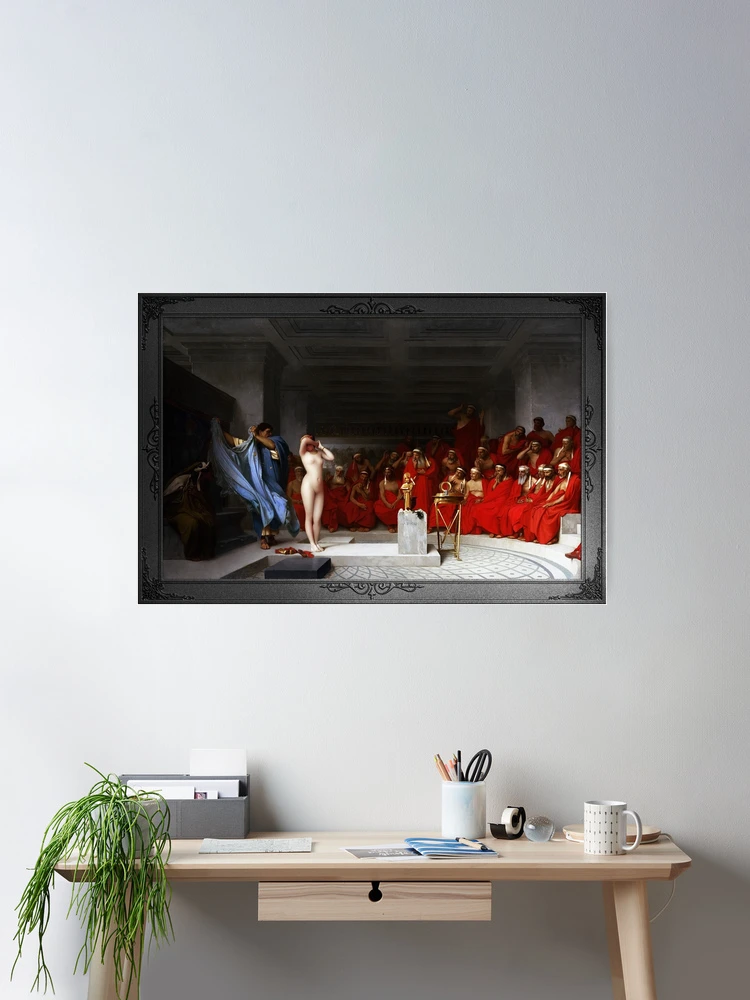
The composition is meticulously structured, guiding the viewer’s eye through the unfolding drama. The scene unfolds within a grand hall, likely representing the Areopagus, the ancient Athenian court known for its gravity and importance. Architectural elements dominate the background: tall columns with ornate capitals support a coffered ceiling, suggesting a space of considerable authority and permanence. Light streams in from an unseen source on the left, illuminating the central figures while casting long shadows that heighten the sense of drama. The hall is filled with seated men, all clad in similar crimson robes, forming a dense audience observing the proceedings. Their uniformity emphasizes their role as collective judges, representing Athenian society’s scrutiny.
Phryne: Ústřední postava
At the heart of the composition stands Phryne herself. She is depicted nude, her body rendered with anatomical precision and a classical idealization reminiscent of ancient Greek sculpture. Her pose is one of vulnerability and exposure; she appears to be in the process of disrobing, perhaps as part of an attempt at legal maneuvering or a demonstration of innocence. Her expression is difficult to definitively interpret – it could suggest defiance, resignation, or even a hint of melancholy. The artist avoids any overt display of emotion, instead opting for a subtle and restrained portrayal that allows viewers to project their own interpretations onto her character.
The Legal Processors & Supporting Characters
To Phryne’s left stands a man in Roman attire, likely an advocate or legal representative. He is actively engaged in the scene, holding back a drape of fabric as if revealing Phryne to the court. His posture suggests a degree of authority and control over the unfolding events. Further back, seated figures form the Areopagus itself. Their faces are largely obscured by shadow and their expressions are difficult to discern, contributing to an atmosphere of solemnity and impartiality. A small altar or pedestal stands in the foreground, upon which rests a bronze statue – possibly representing Athena, the goddess of wisdom and justice, subtly alluding to the divine sanction underpinning Athenian law.
Gérôme’s Technical Skill & Umělecké vlivy
Gérôme’s mastery of realism is evident throughout the painting. The textures of the fabrics, the smoothness of Phryne’s skin, and the cool marble of the architectural elements are rendered with remarkable fidelity. His use of chiaroscuro – the dramatic contrast between light and shadow – enhances the sense of depth and creates a theatrical atmosphere. The work reflects Gérôme’s deep interest in classical antiquity and his desire to recreate historical scenes with accuracy and authenticity. He was influenced by earlier masters such as Jacques-Louis David, but he developed his own distinctive style characterized by meticulous detail and a focus on narrative clarity. The painting’s composition also draws inspiration from theatrical staging, creating a sense of dramatic tension that engages the viewer directly.
Historical Context & Výklad
The story behind “Phryne Revealed Before the Areopagus” is rooted in ancient Greek history. Phryne was a renowned courtesan known for her beauty and wealth. She was accused of impiety and brought before the Areopagus. According to accounts, she offered a substantial bribe to the court officials, which was then used to fund the construction of a statue of Hermes at the Temple of Ares. The painting captures this moment of legal drama, focusing on the tension between Phryne’s vulnerability and the power of the Athenian court. While Gérôme’s work is based on historical accounts, it also transcends mere illustration; it explores themes of justice, societal judgment, and the complexities of human relationships within a specific cultural context.
Dědictví & Význam
“Phryne Revealed Before the Areopagus” remains one of Jean-Léon Gérôme’s most celebrated works. It exemplifies his skill as a historical genre painter and his ability to create compelling narratives through meticulous detail and dramatic composition. The painting has been admired for its technical virtuosity, its evocative atmosphere, and its exploration of timeless themes related to law, morality, and the human condition. It continues to be studied by art historians and appreciated by audiences for its enduring power and historical significance.
Dekorativní akcenty použité v tomto kusu jsou dostupné na HeritageType
Umělec bio Wikipedia.org
Jean-Léon Gérôme (11 Smět 1824 – 10 leden 1904) byl francouzský malíř a sochař ve stylu dnes známém jako akademismus. Jeho obrazy byly tak široce reprodukovány, že byl “do roku 1880 pravděpodobně nejslavnější žijící umělec na světě.”[1] Rozsah jeho tvorby zahrnoval historickou malbu, řecká mytologie, orientalismus, portréty, a další předměty, přivedení akademické malířské tradice k uměleckému vyvrcholení. Je považován za jednoho z nejvýznamnějších malířů tohoto akademického období.
v 1840 odjel do Paříže, kde studoval u Paula Delaroche, kterého doprovázel do Itálie v 1843. Navštívil Florencii, Řím, Vatikán a Pompeje. Při svém návratu do Paříže v r 1844, jako mnoho studentů z Delaroche, nastoupil do ateliéru Charlese Gleyra a krátce tam studoval. Poté navštěvoval Školu výtvarných umění. v 1846 pokusil se přihlásit do prestižní Prix de Rome, ale v konečné fázi neuspěl, protože jeho kresba postavy byla nedostatečná.
Jeho obraz The Cock Fight (1846) je akademické cvičení zobrazující nahého mladého muže a velmi tence zahalenou mladou ženu se dvěma bojujícími kohouty, s Neapolským zálivem v pozadí. Poslal tento obraz do pařížského salonu 1847, kde získal medaili třetí třídy. Tato práce byla považována za ztělesnění neo-řeckého hnutí, které se zformovalo z Gleyrova studia (včetně Henri-Pierre Picou a Jean-Louis Hamon), a prosazoval ji vlivný francouzský kritik Théophile Gautier, jehož recenze Gérôma proslavila a účinně odstartovala jeho kariéru.
Gérôme opustil svůj sen vyhrát Prix de Rome a využil svého náhlého úspěchu. Jeho obrazy Panna, Jezulátko a svatý Jan a Anakreon, Bacchus a Eros získali medaili druhé třídy na pařížském salonu v r 1848. v 1849, vytvořil obrazy Michelangelo (nazývaný také V jeho studiu) a Portrét dámy.
v 1851, ozdobil vázu, kterou později nabídl francouzský císař Napoleon III. princi Albertovi, nyní součástí Královské sbírky u sv. Jamesův palác, Londýn. Vystavoval řecký interiér, Suvenýr z Itálie, Bacchus a láska, Opilý 1851; v Paestu 1852; a An Idyll in 1853
v 1852, Gérôme dostal provizi namalovat velkou nástěnnou malbu alegorického předmětu podle svého výběru. Věk Augusta, narození Krista, který by spojil narození Krista s dobytými národy vzdávajícími poctu Augustovi, mohlo být určeno k polichocení Napoleonovi III, jehož vláda objednala nástěnnou malbu a který byl identifikován jako “nový Augustus.
Značná záloha umožnila Gérôme cestovat a zkoumat, první v 1853 do Konstantinopole, společně s hercem Edmondem Gotem, a v 1854 do Řecka a Turecka a na břehy Dunaje, kde byl přítomen na koncertě ruských branců tvořících hudbu pod hrozbou bičování.
v 1853, Gérôme se přesunul do Čajové skříňky, skupina studií na Rue Notre-Dame-des-Champs, Paříž. To by se stalo místem setkávání umělců, spisovatelé a herci, kde George Sand bavil skladatele Hectora Berlioze, Johannes Brahms a Gioachino Rossini a romanopisci Théophile Gautier a Ivan Turgenev.
v 1854, dokončil další důležitou zakázku, výzdoba kaple sv. Jeronýma v kostele sv. Severin v Paříži. Jeho poslední přijímání sv. Jeroným v této kapli odráží vliv školy Ingres na jeho náboženská díla.
Na Světovou výstavu 1855 přispěl Pifferaro, Pastýř, a Augustův věk, narození Krista, ale největší pozornost vzbudil skromný obraz Rekreace v ruském táboře…
Phryne Revealed Before The Areopagus je retušovaná digitální umělecká reprodukce starých mistrů veřejného obrazu..