

Phryne afsløret før Areopagus: A Study in Classical Drama
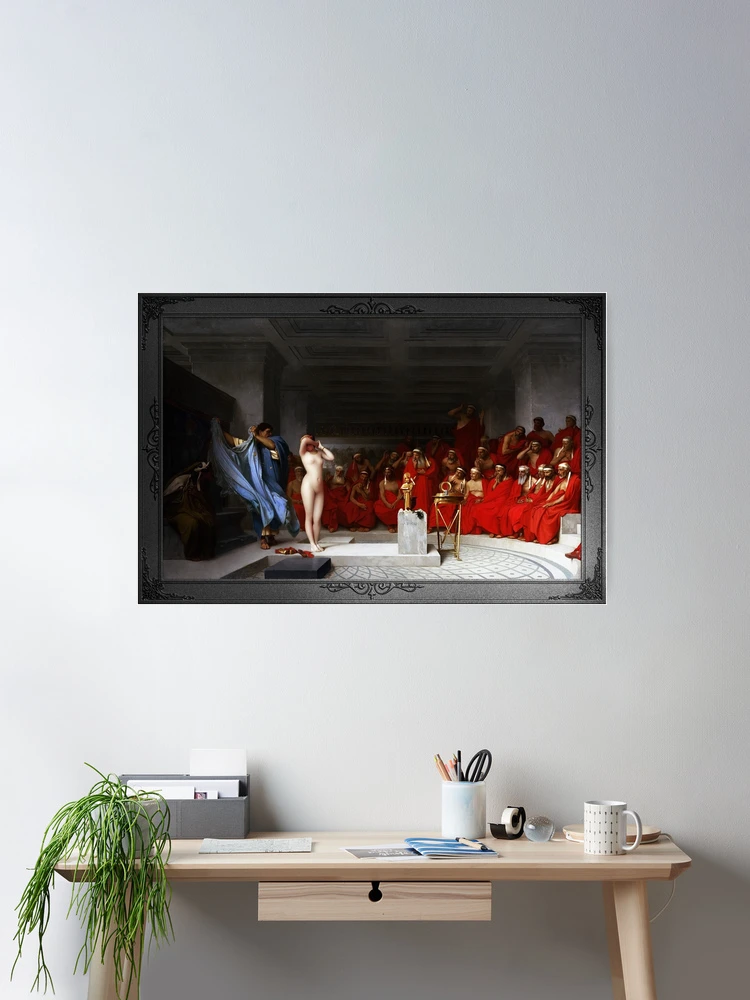
Jean-Léon Gérôme’s “Phryne Revealed Before the Areopagus,” painted around 1861, is a compelling work of historical genre painting that draws heavily from classical antiquity. It depicts a dramatic scene rooted in ancient Greek legal proceedings, specifically the trial of Phryne, a celebrated courtesan of Athens. Gérôme was renowned for his meticulous attention to detail and his ability to recreate historical settings with remarkable accuracy, and this piece exemplifies those qualities. The painting is not merely an illustration of a story; it’s a carefully constructed tableau designed to evoke a sense of tension, anticipation, and the weight of societal judgment.
Indholdsfortegnelse
Kompositionsstruktur & Setting
The composition is meticulously structured, guiding the viewer’s eye through the unfolding drama. The scene unfolds within a grand hall, likely representing the Areopagus, the ancient Athenian court known for its gravity and importance. Architectural elements dominate the background: tall columns with ornate capitals support a coffered ceiling, suggesting a space of considerable authority and permanence. Light streams in from an unseen source on the left, illuminating the central figures while casting long shadows that heighten the sense of drama. The hall is filled with seated men, all clad in similar crimson robes, forming a dense audience observing the proceedings. Their uniformity emphasizes their role as collective judges, representing Athenian society’s scrutiny.
Phryne: Den centrale figur
At the heart of the composition stands Phryne herself. She is depicted nude, her body rendered with anatomical precision and a classical idealization reminiscent of ancient Greek sculpture. Her pose is one of vulnerability and exposure; she appears to be in the process of disrobing, perhaps as part of an attempt at legal maneuvering or a demonstration of innocence. Her expression is difficult to definitively interpret – it could suggest defiance, resignation, or even a hint of melancholy. The artist avoids any overt display of emotion, instead opting for a subtle and restrained portrayal that allows viewers to project their own interpretations onto her character.
The Legal Processors & Supporting Characters
To Phryne’s left stands a man in Roman attire, likely an advocate or legal representative. He is actively engaged in the scene, holding back a drape of fabric as if revealing Phryne to the court. His posture suggests a degree of authority and control over the unfolding events. Further back, seated figures form the Areopagus itself. Their faces are largely obscured by shadow and their expressions are difficult to discern, contributing to an atmosphere of solemnity and impartiality. A small altar or pedestal stands in the foreground, upon which rests a bronze statue – possibly representing Athena, the goddess of wisdom and justice, subtly alluding to the divine sanction underpinning Athenian law.
Gérôme’s Technical Skill & Kunstneriske påvirkninger
Gérôme’s mastery of realism is evident throughout the painting. The textures of the fabrics, the smoothness of Phryne’s skin, and the cool marble of the architectural elements are rendered with remarkable fidelity. His use of chiaroscuro – the dramatic contrast between light and shadow – enhances the sense of depth and creates a theatrical atmosphere. The work reflects Gérôme’s deep interest in classical antiquity and his desire to recreate historical scenes with accuracy and authenticity. He was influenced by earlier masters such as Jacques-Louis David, but he developed his own distinctive style characterized by meticulous detail and a focus on narrative clarity. The painting’s composition also draws inspiration from theatrical staging, creating a sense of dramatic tension that engages the viewer directly.
Historical Context & Fortolkning
The story behind “Phryne Revealed Before the Areopagus” is rooted in ancient Greek history. Phryne was a renowned courtesan known for her beauty and wealth. She was accused of impiety and brought before the Areopagus. According to accounts, she offered a substantial bribe to the court officials, which was then used to fund the construction of a statue of Hermes at the Temple of Ares. The painting captures this moment of legal drama, focusing on the tension between Phryne’s vulnerability and the power of the Athenian court. While Gérôme’s work is based on historical accounts, it also transcends mere illustration; it explores themes of justice, societal judgment, and the complexities of human relationships within a specific cultural context.
Arv & Betydning
“Phryne Revealed Before the Areopagus” remains one of Jean-Léon Gérôme’s most celebrated works. It exemplifies his skill as a historical genre painter and his ability to create compelling narratives through meticulous detail and dramatic composition. The painting has been admired for its technical virtuosity, its evocative atmosphere, and its exploration of timeless themes related to law, moral, and the human condition. It continues to be studied by art historians and appreciated by audiences for its enduring power and historical significance.
Dekorative accenter, der bruges i dette stykke, fås i HeritageType
Kunstner bio afledt fra Wikipedia.org
Jean-Léon Gérôme (11 Kan 1824 - 10 januar 1904) var en fransk maler og billedhugger i den stil, der nu er kendt som akademisme. Hans malerier blev så bredt gengivet, at han var “uden tvivl verdens mest berømte levende kunstner i 1880.”[1] Omfanget af hans oeuvre omfattede historisk maleri, græsk mytologi, Orientalisme, portrætter, og andre emner, bringe den akademiske malerietradition til et kunstnerisk klimaks. Han betragtes som en af de vigtigste malere fra denne akademiske periode.
I 1840 han tog til Paris, hvor han studerede under Paul Delaroche, som han ledsagede til Italien i 1843. Han besøgte Firenze, Rom, Vatikanet og Pompeji. Da han vendte tilbage til Paris i 1844, ligesom mange studerende i Delaroche, han sluttede sig til atelieret hos Charles Gleyre og studerede der en kort tid. Derefter gik han på School of Fine Arts. I 1846 han forsøgte at komme ind i det prestigefyldte Prix de Rome, men mislykkedes i sidste fase, fordi hans figurtegning var utilstrækkelig.
Hans maleri Hanekampen (1846) er en akademisk øvelse, der skildrer en nøgen ung mand og en meget tyndt draperet ung kvinde med to kamphaner, med Napolibugten i baggrunden. Han sendte dette maleri til Paris Salon of 1847, hvor det gav ham en tredje klasses medalje. Dette værk blev set som indbegrebet af Neo-Grec-bevægelsen, der var dannet ud af Gleyres studie (herunder Henri-Pierre Picou og Jean-Louis Hamon), og blev forkæmpet af den indflydelsesrige franske kritiker Théophile Gautier, hvis anmeldelse gjorde Gérôme berømt og effektivt lancerede sin karriere.
Gérôme opgav sin drøm om at vinde Prix de Rome og udnyttede sin pludselige succes. Hans malerier Jomfruen, spædbarnet Jesus og Sankt Johannes og Anacreon, Bacchus og Eros tog en andenrangsmedalje på Paris Salon i 1848. I 1849, han producerede malerierne Michelangelo (også kaldet In his Studio) og Et portræt af en dame.
I 1851, han pyntede en vase senere tilbudt af kejser Napoleon III af Frankrig til prins Albert, nu en del af Royal Collection på St.. Jakobs Palads, London. Han udstillede græsk interiør, Souvenir fra Italien, Bacchus og kærlighed, Beruset i 1851; i Paestum 1852; og en idyl i 1853
I 1852, Gérôme modtog en kommission til at male et stort vægmaleri af et allegorisk emne, han valgte. Augustus alder, Kristi fødsel, som ville kombinere Kristi fødsel med erobrede nationer, der hylder Augustus, kan have været beregnet til at smigre Napoleon III, hvis regering bestilte vægmaleriet, og som blev identificeret som en “nye Augustus.
En betydelig forskudsbetaling gjorde Gérôme i stand til at rejse og forske, først i 1853 til Konstantinopel, sammen med skuespilleren Edmond Got, og i 1854 til Grækenland og Tyrkiet og Donaus kyster, hvor han var til stede ved en koncert af russiske værnepligtige, der lavede musik under trussel om en vippekurv.
I 1853, Gérôme flyttede til teboksen, en gruppe studier i Rue Notre-Dame-des-Champs, Paris. Dette ville blive et mødested for kunstnere, skribenter og skuespillere, hvor George Sand underholdt komponisterne Hector Berlioz, Johannes Brahms og Gioachino Rossini og romanforfatterne Théophile Gautier og Ivan Turgenev.
I 1854, han afsluttede endnu en vigtig kommission, udsmykning af kapellet St.. Jerome i kirken St.. Séverin i Paris. Hans sidste nadver af St.. Jerome i dette kapel afspejler Ingres -skolens indflydelse på hans religiøse værker.
Til den Universelle Udstilling af 1855 bidrog han med Pifferaro, Fårehyrde, og Augustus alder, Kristi fødsel, men det var det beskedne maleri Rekreation i en russisk lejr, der vakte mest opmærksomhed ...
Phryne Revealed Before The Areopagus er en retoucheret digital kunst gamle mestre gengivelse af et offentligt image.