

Phryne paljastui ennen areopagia: A Study in Classical Drama
Jean-Léon Gérôme’s “Phryne Revealed Before the Areopagus,”Maalattu ympäri 1861, is a compelling work of historical genre painting that draws heavily from classical antiquity. It depicts a dramatic scene rooted in ancient Greek legal proceedings, specifically the trial of Phryne, a celebrated courtesan of Athens. Gérôme was renowned for his meticulous attention to detail and his ability to recreate historical settings with remarkable accuracy, and this piece exemplifies those qualities. The painting is not merely an illustration of a story; it’s a carefully constructed tableau designed to evoke a sense of tension, anticipation, and the weight of societal judgment.
Sisällysluettelo
Koostumusrakenne & Asetus
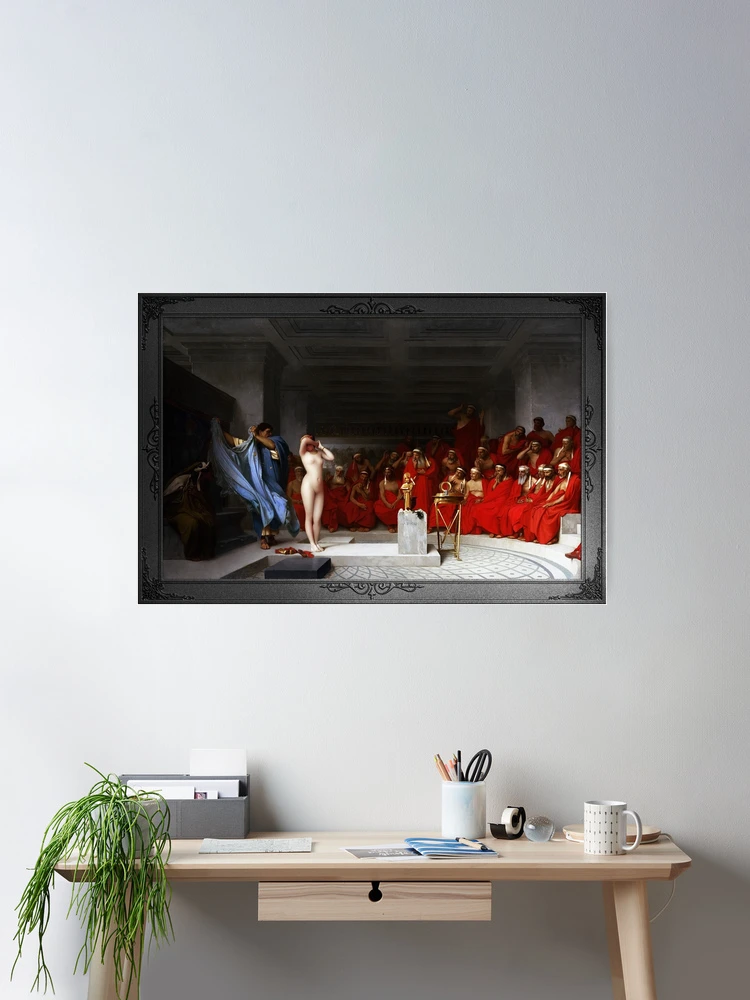
The composition is meticulously structured, guiding the viewer’s eye through the unfolding drama. The scene unfolds within a grand hall, likely representing the Areopagus, the ancient Athenian court known for its gravity and importance. Architectural elements dominate the background: tall columns with ornate capitals support a coffered ceiling, suggesting a space of considerable authority and permanence. Light streams in from an unseen source on the left, illuminating the central figures while casting long shadows that heighten the sense of drama. The hall is filled with seated men, all clad in similar crimson robes, forming a dense audience observing the proceedings. Their uniformity emphasizes their role as collective judges, representing Athenian society’s scrutiny.
Phryne: Keskushahmo
At the heart of the composition stands Phryne herself. She is depicted nude, her body rendered with anatomical precision and a classical idealization reminiscent of ancient Greek sculpture. Her pose is one of vulnerability and exposure; she appears to be in the process of disrobing, perhaps as part of an attempt at legal maneuvering or a demonstration of innocence. Her expression is difficult to definitively interpret – it could suggest defiance, resignation, or even a hint of melancholy. The artist avoids any overt display of emotion, instead opting for a subtle and restrained portrayal that allows viewers to project their own interpretations onto her character.
The Legal Processors & Supporting Characters
To Phryne’s left stands a man in Roman attire, likely an advocate or legal representative. He is actively engaged in the scene, holding back a drape of fabric as if revealing Phryne to the court. His posture suggests a degree of authority and control over the unfolding events. Further back, seated figures form the Areopagus itself. Their faces are largely obscured by shadow and their expressions are difficult to discern, contributing to an atmosphere of solemnity and impartiality. A small altar or pedestal stands in the foreground, upon which rests a bronze statue – possibly representing Athena, the goddess of wisdom and justice, subtly alluding to the divine sanction underpinning Athenian law.
Gérôme’s Technical Skill & Taiteellisia vaikutteita
Gérôme’s mastery of realism is evident throughout the painting. The textures of the fabrics, the smoothness of Phryne’s skin, and the cool marble of the architectural elements are rendered with remarkable fidelity. His use of chiaroscuro – the dramatic contrast between light and shadow – enhances the sense of depth and creates a theatrical atmosphere. The work reflects Gérôme’s deep interest in classical antiquity and his desire to recreate historical scenes with accuracy and authenticity. He was influenced by earlier masters such as Jacques-Louis David, but he developed his own distinctive style characterized by meticulous detail and a focus on narrative clarity. The painting’s composition also draws inspiration from theatrical staging, creating a sense of dramatic tension that engages the viewer directly.
Historical Context & Tulkinta
The story behind “Phryne Revealed Before the Areopagus” is rooted in ancient Greek history. Phryne was a renowned courtesan known for her beauty and wealth. She was accused of impiety and brought before the Areopagus. According to accounts, she offered a substantial bribe to the court officials, which was then used to fund the construction of a statue of Hermes at the Temple of Ares. The painting captures this moment of legal drama, focusing on the tension between Phryne’s vulnerability and the power of the Athenian court. While Gérôme’s work is based on historical accounts, it also transcends mere illustration; it explores themes of justice, societal judgment, and the complexities of human relationships within a specific cultural context.
Perintö & Merkitys
“Phryne Revealed Before the Areopagus” remains one of Jean-Léon Gérôme’s most celebrated works. It exemplifies his skill as a historical genre painter and his ability to create compelling narratives through meticulous detail and dramatic composition. The painting has been admired for its technical virtuosity, its evocative atmosphere, and its exploration of timeless themes related to law, morality, and the human condition. It continues to be studied by art historians and appreciated by audiences for its enduring power and historical significance.
Tässä kappaleessa käytetyt koristeelliset aksentit ovat saatavilla osoitteessa HeritageType
Taiteilija Bio on johdettu Wikipedia.org
Jean-Léon Gérôme (11 saattaa 1824 - 10 tammikuu 1904) oli ranskalainen taidemaalari ja kuvanveistäjä, joka tunnetaan nykyään akateemisuutena. Hänen maalauksensa toistettiin niin laajalti, että hän oli “epäilemättä maailman tunnetuin elävä taiteilija vuoteen 1880 mennessä.”[1] Hänen tuotantonsa käsitteli historiallista maalausta, kreikkalainen mytologia, Orientalismi, muotokuvia, ja muut aiheet, tuo akateeminen maalausperinne taiteelliseen huippukohtaan. Häntä pidetään yhtenä tämän akateemisen ajan tärkeimmistä maalareista.
Sisään 1840 hän meni Pariisiin, jossa hän opiskeli Paul Delarochen johdolla, jonka kanssa hän oli mukana Italiassa 1843. Hän vieraili Firenzessä, Rooma, Vatikaaniin ja Pompejiin. Palattuaan Pariisiin vuonna 1844, kuten monet Delarochen opiskelijat, hän liittyi Charles Gleyren ateljeeseen ja opiskeli siellä lyhyen aikaa. Sitten hän opiskeli Kuvataidekoulua. Sisään 1846 hän yritti päästä arvostetulle Prix de Roomalle, mutta epäonnistui viimeisessä vaiheessa, koska hänen piirustus oli riittämätön.
Hänen maalauksensa Kukkataistelu (1846) on akateeminen harjoitus, joka kuvaa alastonta nuorta miestä ja hyvin ohuesti verhottua nuorta naista, jossa on kaksi taistelukulmaa, taustalla Napolinlahti. Hän lähetti tämän maalauksen Pariisin salonkiin 1847, jossa se sai hänelle kolmannen luokan mitalin. Tätä teosta pidettiin Gleyren studiosta muodostuneen Neo-Grec-liikkeen ruumiillistumana (mukaan lukien Henri-Pierre Picou ja Jean-Louis Hamon), ja sitä puolusti vaikutusvaltainen ranskalainen kriitikko Théophile Gautier, jonka arvostelu teki Gérômen kuuluisaksi ja aloitti uransa tehokkaasti.
Gérôme luopui haaveestaan voittaa Prix de Rome ja hyödynsi äkillistä menestystään. Hänen maalauksensa Neitsyt, pikkulasten Jeesuksen ja pyhän Johanneksen ja Anakreonin, Bacchus ja Eros ottivat toisen luokan mitalin Pariisin salongissa vuonna 1848. Sisään 1849, hän tuotti Michelangelon maalauksia (kutsutaan myös studiossaan) ja Naisen muotokuva.
Sisään 1851, hän koristi maljakon, jonka Ranskan keisari Napoleon III tarjosi myöhemmin prinssi Albertille, nyt osa Royal Collectionia St.. Jamesin palatsi, Lontoo. Hän esitteli kreikkalaista sisustusta, Matkamuisto Italiasta, Bacchus ja rakkaus, Humalassa sisään 1851; Paestumissa 1852; ja Idyll sisään 1853
Sisään 1852, Gérôme sai tilauksen maalata suuri seinämaalaus valitsemastaan vertauskuvallisesta aiheesta. Augustuksen aikakausi, Kristuksen syntymä, joka yhdistäisi Kristuksen syntymän valloitettuihin kansoihin, jotka kunnioittavat Augusta, oli ehkä tarkoitettu imartelemaan Napoleon III: ta, jonka hallitus tilasi seinämaalauksen ja joka tunnistettiin a “uusi Augustus.
Huomattava käsiraha mahdollisti Gérômen matkustamisen ja tutkimuksen, ensin sisään 1853 Konstantinopoliin, yhdessä näyttelijä Edmond Gotin kanssa, ja sisään 1854 Kreikkaan ja Turkkiin sekä Tonavan rannoille, jossa hän oli läsnä konsertissa, jossa venäläiset varusmiehet musisoivat ripsien uhalla.
Sisään 1853, Gérôme muutti teerasiaan, ryhmä studioita Rue Notre-Dame-des-Champs -kadulla, Pariisi. Tästä tulisi taiteilijoiden kohtaamispaikka, kirjailijoita ja näyttelijöitä, jossa George Sand viihdytti säveltäjiä Hector Berliozia, Johannes Brahms ja Gioachino Rossini sekä kirjailijat Théophile Gautier ja Ivan Turgenev.
Sisään 1854, hän suoritti toisen tärkeän tehtävän, Pyhän kappelin koristelu. Jerome St.. Séverin Pariisissa. Hänen viimeinen ehtoollisensa St.. Jerome tässä kappelissa heijastaa Ingresin koulun vaikutusta hänen uskonnollisiin töihinsä.
Yleisnäyttelyyn 1855 hän osallistui Pifferaroon, Paimen, ja Augustuksen aikakausi, Kristuksen syntymä, mutta vaatimaton maalaus Virkistys venäläisellä leirillä herätti eniten huomiota ...
Phryne Revealed Before The Areopagus on retusoitu digitaalisen taiteen vanhojen mestareiden kopio julkisessa käytössä olevasta kuvasta.