

Nocht Phryne Roimh an Areopagus: Staidéar sa Drámaíocht Chlasaiceach
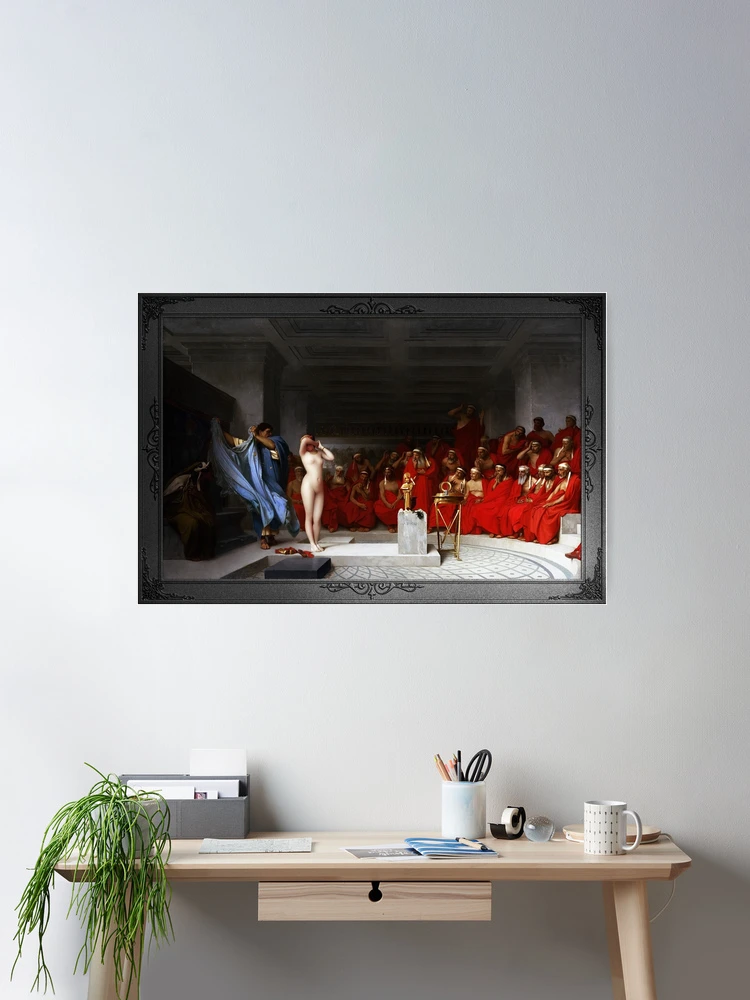
Jean-Leon Gerome's “Nocht Phryne Roimh an Areopagus,” péinteáilte timpeall 1861, saothar an-láidir de phéinteáil seánra stairiúil a tharraingíonn go mór ón tseaniarsmaí clasaiceach. Léiríonn sé radharc drámatúil atá fréamhaithe in imeachtaí dlí na Sean-Ghréige, go sonrach triail Phryne, cúirtéis cáiliúil na hAithne. Bhí cáil ar Gérôme as an aird ghéar a thug sé ar mhionsonraí agus as a chumas suíomhanna stairiúla a athchruthú le cruinneas iontach, agus tugann an píosa seo eiseamláir do na cáilíochtaí sin. Ní léiriú ar scéal amháin atá sa phictiúr; is tábla a tógadh go cúramach é atá deartha chun braistint teannais a mhúscailt, oirchill, agus meáchan breithiúnas sochaíoch.
Clár na nÁbhar
Struchtúr Comhdhéanta & Socrú
Tá an comhdhéanamh struchtúrtha go cúramach, súil an lucht féachana a threorú tríd an dráma atá ag teacht chun cinn. Leathnaíonn an radharc laistigh de halla mór, is dócha a ionadaíonn an Areopagus, an chúirt ársa Athenian a bhfuil aithne uirthi mar gheall ar a dhomhantarraingt agus a tábhacht. Gnéithe ailtireachta is mó atá sa chúlra: tacaíonn colúin arda le ceannlitreacha ornáideacha le huasteorainn choffered, ag moladh spás ina bhfuil údarás agus buanseas suntasach. Sreabhann solas isteach ó fhoinse nach bhfacthas riamh roimhe ar chlé, ag soilsiú na bhfigiúirí lárnacha agus ag caitheamh scáthanna fada a mhéadaíonn mothú na drámaíochta. Tá an halla líonta le fir ina suí, all clad in similar crimson robes, forming a dense audience observing the proceedings. Their uniformity emphasizes their role as collective judges, representing Athenian society’s scrutiny.
Phryne: An Fíor Lárnach
At the heart of the composition stands Phryne herself. She is depicted nude, her body rendered with anatomical precision and a classical idealization reminiscent of ancient Greek sculpture. Her pose is one of vulnerability and exposure; she appears to be in the process of disrobing, perhaps as part of an attempt at legal maneuvering or a demonstration of innocence. Her expression is difficult to definitively interpret – it could suggest defiance, resignation, or even a hint of melancholy. The artist avoids any overt display of emotion, instead opting for a subtle and restrained portrayal that allows viewers to project their own interpretations onto her character.
Na Próiseálaithe Dlí & Carachtair Tacaíochta
To Phryne’s left stands a man in Roman attire, likely an advocate or legal representative. He is actively engaged in the scene, holding back a drape of fabric as if revealing Phryne to the court. His posture suggests a degree of authority and control over the unfolding events. Further back, seated figures form the Areopagus itself. Their faces are largely obscured by shadow and their expressions are difficult to discern, contributing to an atmosphere of solemnity and impartiality. A small altar or pedestal stands in the foreground, upon which rests a bronze statue – possibly representing Athena, the goddess of wisdom and justice, subtly alluding to the divine sanction underpinning Athenian law.
Scil Theicniúil Gérôme & Tionchair Ealaíne
Gérôme’s mastery of realism is evident throughout the painting. The textures of the fabrics, the smoothness of Phryne’s skin, and the cool marble of the architectural elements are rendered with remarkable fidelity. His use of chiaroscuro – the dramatic contrast between light and shadow – enhances the sense of depth and creates a theatrical atmosphere. The work reflects Gérôme’s deep interest in classical antiquity and his desire to recreate historical scenes with accuracy and authenticity. He was influenced by earlier masters such as Jacques-Louis David, but he developed his own distinctive style characterized by meticulous detail and a focus on narrative clarity. Tarraingíonn comhdhéanamh an phictiúir inspioráid freisin ó stáitsiú amharclainne, rud a chruthaíonn teannas drámatúil a mheallann an breathnóir go díreach.
Comhthéacs Stairiúil & Léiriú
Tá an scéal taobh thiar de “Phryne Revealed Before the Areopagus” fréamhaithe i stair na Sean-Ghréige. Cúirtéis cháiliúil ab ea Phryne a raibh aithne uirthi as a áilleacht agus a saibhreas. Cuireadh ina leith go raibh impí uirthi agus tugadh os comhair an Areopagus í. De réir cuntais, thairg sí breab substaintiúil d'oifigigh na cúirte, a úsáideadh ansin chun tógáil dealbh de Hermes ag Teampall Ares a mhaoiniú. Gabhann an phéintéireacht an nóiméad seo de dhrámaíocht dhlíthiúil, ag díriú ar an teannas idir leochaileacht Phryne agus cumhacht chúirt na hAithne. Cé go bhfuil saothar Gérôme bunaithe ar chuntais stairiúla, ní sháraíonn sé ach léiriú freisin; it explores themes of justice, societal judgment, and the complexities of human relationships within a specific cultural context.
Oidhreacht & Suntas
“Phryne Revealed Before the Areopagus” remains one of Jean-Léon Gérôme’s most celebrated works. It exemplifies his skill as a historical genre painter and his ability to create compelling narratives through meticulous detail and dramatic composition. The painting has been admired for its technical virtuosity, its evocative atmosphere, and its exploration of timeless themes related to law, morality, and the human condition. It continues to be studied by art historians and appreciated by audiences for its enduring power and historical significance.
Decorative Accents Used In This Piece Are Available At HeritageType
Ealaíontóir Bith Díorthaithe Ó Wikipedia.org
Jean-Leon Gerome (11 Bealtaine 1824 - 10 Eanáir 1904) péintéir agus dealbhóir Francach a bhí ann sa stíl ar a dtugtar an t-acadamhlacht anois. Bhí a chuid saothar péintéireachta chomh forleathan is a bhí sé “d’fhéadfaí a mhaíomh gurb é an t-ealaíontóir beo is cáiliúla ar domhan faoi 1880.”[1] Áiríodh péintéireacht stairiúil i raon a chuid oeuvre, miotaseolaíocht na Gréige, Orientalism, portráidí, agus ábhair eile, ag tabhairt an traidisiúin phéinteála acadúil go barr ealaíonta. Meastar go bhfuil sé ar cheann de na péintéirí is tábhachtaí ón tréimhse acadúil seo.
I 1840 chuaigh sé go Páras, áit a ndearna sé staidéar faoi Paul Delaroche, a raibh sé in éineacht leis go dtí an Iodáil i 1843. Thug sé cuairt ar Fhlórans, An Róimh, na Vatacáine agus Pompeii. Ar fhilleadh dó go Páras i 1844, like many students of Delaroche, he joined the atelier of Charles Gleyre and studied there for a brief time. He then attended the École des Beaux-Arts. I 1846 he tried to enter the prestigious Prix de Rome, but failed in the final stage because his figure drawing was inadequate.
His painting The Cock Fight (1846) is an academic exercise depicting a nude young man and a very thinly draped young woman with two fighting cocks, with the Bay of Naples in the background. He sent this painting to the Paris Salon of 1847, where it gained him a third-class medal. This work was seen as the epitome of the Neo-Grec movement that had formed out of Gleyre’s studio (including Henri-Pierre Picou and Jean-Louis Hamon), and was championed by the influential French critic Théophile Gautier, whose review made Gérôme famous and effectively launched his career.
Gérôme abandoned his dream of winning the Prix de Rome and took advantage of his sudden success. His paintings The Virgin, the Infant Jesus and Saint John and Anacreon, Bacchus and Eros took a second-class medal at the Paris Salon in 1848. I 1849, he produced the paintings Michelangelo (also called In his Studio) and A Portrait of a Lady.
I 1851, he decorated a vase later offered by Emperor Napoleon III of France to Prince Albert, now part of the Royal Collection at St. James’s Palace, Londain. He exhibited Greek Interior, Souvenir d’Italie, Bacchus and Love, Drunk in 1851; Paestum in 1852; and An Idyll in 1853
I 1852, Fuair Gérôme coimisiún chun múrmhaisiú mór a phéinteáil d’ábhar ailgéarach dá rogha féin. Aois Augustus, Breith Chríost, rud a chomhcheangail breith Chríost le náisiúin chonctha ag tabhairt ómóis do Ágastas, b'fhéidir go raibh sé i gceist go ndéanfadh sé magadh ar Napoleon III, ar choimisiúnaigh a rialtas an múrmhaisiú agus cé a aithníodh mar a “Augustus nua.
Chuir íocaíocht shuntasach síos ar Gérôme taisteal agus taighde a dhéanamh, den chéad uair i 1853 go Constantinople, mar aon leis an aisteoir Edmond Got, agus i 1854 go dtí an Ghréig agus an Tuirc agus cladach na Danóibe, áit a raibh sé i láthair ag ceolchoirm coinscríobacha Rúiseacha ag déanamh ceoil faoi bhagairt ainnise.
I 1853, Bhog Gérôme go dtí an Boîte à Thé, grúpa stiúideonna sa Rue Notre-Dame-des-Champs, Páras. Bheadh sé seo ina ionad cruinnithe d’ealaíontóirí, writers and actors, where George Sand entertained the composers Hector Berlioz, Johannes Brahms and Gioachino Rossini and the novelists Théophile Gautier and Ivan Turgenev.
I 1854, he completed another important commission, decorating the Chapel of St. Jerome in the church of St. Séverin in Paris. His Last Communion of St. Jerome in this chapel reflects the influence of the school of Ingres on his religious works.
To the Universal Exhibition of 1855 he contributed Pifferaro, Shepherd, and The Age of Augustus, Breith Chríost, but it was the modest painting Recreation in a Russian Camp that garnered the most attention…
Phryne Revealed Before The Areopagus is a retouched digital art old masters reproduction of a public domain image.